
 •
Versione 1
Rating:
•
Versione 1
Rating:
THE REVIEW
Personal foreword, not required. Generally, I don't listen to new productions: there's already so much stuff out there that I still don't know, I mean publications from the '50s to the '90s; and I consider life not long enough to add the trends of the last 2 decades to my listening habits. In short, I know my limits; and knowing my limits, I've been left behind...
This time, I made an exception and purchased an LP released last month. Exception that, however, confirms my rule... in fact, it's recordings from '79, never published until now.
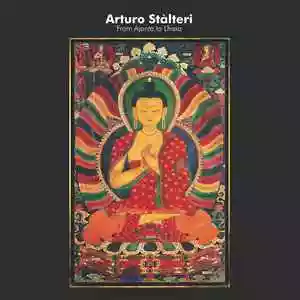
“From Ajanta to Lhasa” by Arturo Stalteri is a release from the label Soave, which specializes in ambient/electronic/avant-garde music.
Stalteri is a long-standing pianist, musicologist, and journalist, from his productions in the '70s with Pierrot Lunaire and solo, to his current activity as a radio host. When he recorded these tapes, precisely between May and November of 1979, he had just returned from a trip to India: at the time, it was fashionable to try to find oneself by going to India. The album indeed opens with the sound of an airplane.
“From Ajanta to Lhasa” appears, at first listen, as a tribute to Terry Riley. Especially the title track, lasting over 16 minutes and opening the LP, echoes the “repetitions” and cyclicality of “A Rainbow in a Curved Air”. And like Riley, Stalteri plays all the instruments: keyboards (Farfisa Organ, piano, Synt), guitars, sitar, percussion, balalaika, Indian clarinet, as well as tape preparation and various elaborations. Closing the first side is a successful rendition of a medieval piece, composed by Walther Von Der Vogelweide.
The second part is a mix of shorter, varied tracks. The mini-suite “The Sun” develops on themes of organ and Synt; once again with the quest for cyclicality as the basis of the 5 small (short) pearls that compose it. Following the six strings, which evoke a sense of dissonance, introduce “Studio n.6”. It's the only track where a voice is heard, speaking rather than singing: it's a very short intervention by Fabrizio Diofebi. With “Matmos”, a piece probably inspired by the energy substance of the erotic Barbarella, keyboards regain predominance. Closing the album is “Floating Moon” with Arturo Stalteri on piano.
In summary, the release of these “old” tapes proves to be a commendable operation for an interesting testimony of Italian avant-garde in the second half of the '70s. Not entirely original, true, but it remains a lovely document of the minimalist and ambient exploration, decidedly non-commercial, from our country.
Loading comments slowly
Summary by Bot
From Ajanta to Lhasa by Arturo Stalteri is a recently released LP of previously unpublished 1979 recordings. The album shows deep influence from Terry Riley’s minimalist style and features a rich mix of instruments. It serves as a valuable testimony of Italy’s experimental music scene in the late 70s. While not groundbreaking, it delights with its ambient textures and cyclic patterns.Tracklist
Arturo Stalteri
Italian pianist and composer active since the 1970s, associated with Pierrot Lunaire and a solo career spanning ambient, minimalist and avant‑garde music; also active as a music journalist and radio host.01 Reviews
