
 •
Rating:
•
Rating:
THE REVIEW
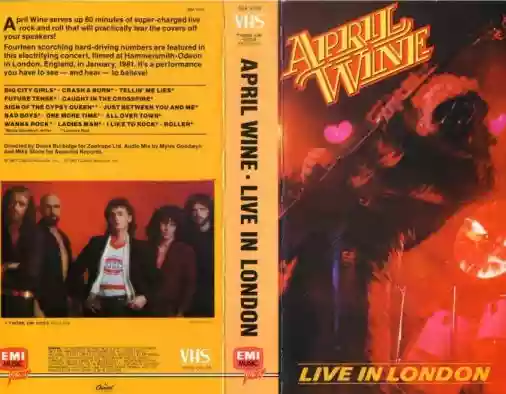
London 1981 Hammersmith Odeon: the roar of the beast in the arena. Rock'n'Roll when freed from all chains of commercialism, cheap self-celebration, and crude sonic violence becomes a rushing river of poetic energy, a three-chord melody—bass-guitar-drums, instrumental tour de forces: Rock isn't invented but recreated on the stage, on the fingers dancing over the wood, in the romantic vocal vibrations of Myles Goodwyn akin to Lou Gramm, among the old-style sticks of Jerry Mercer, in the rolling solos of Brian Greenway, never identifying with instrumental grandeur or a feast of megawatts.
A few small image effects, Myles declaims: "Thank you very much and welcome to the concert", no affectation, no pursuit of speed, but a controlled dosage of nervous, never refined solos that rain down in "Sign Of The Gypsy Queen", then overlapping celestial refrains that become sharp rolling structures in "One More Time" and Hard'n'Roll traveling on two voices in the chorus of "Tellin Me Lies", while rivulets of melody mix with faint vocal whispers in the sweetening ballad "Just Between You And Me". A bare stage, few lights, and five musicians having fun without special effects, suffice to create a visual document not exactly phantasmagoric but at least experienced like a fairy tale with a happy ending, the Rock tale, a magical contagion that propelled five Canadian lads from Halifax (Nova Scotia) on a tourist trip to London. The concert images intersect with the walk of the five April Wine among London double-decker buses and screaming kids, a party that continues at the concert, opened by the wild riff of "Big City Girls" borrowed from "Bad Boy Boogie" by AC/DC", with Goodwyn as the frontman at the microphone and as a guitarist improvising without showing off, wearing a simple white and red t-shirt. The message from April Wine is clear: music before the parade, sweat before the glitz, Rock before Disco Music.
Yet they started with the western candy "Fast Train", in the early '70s, when Goodwyn's sweet voice was conquering the Canadian scene, despite not having Ian Gillan's power or Robert Plant's charisma. Pioneers of simple Rock'n'Roll which then regenerated into straightforward Hard Rock starting with "First Glance", up to the commercial success of "The Nature Of The Beast" (from 1981), April Wine were always looking from the gallery at the theater of Zeppelin, Black Sabbath, Deep Purple, without ever striking. They find satisfaction at home with various singles: "Ooowatanite", "You Could Have Been A Lady" (cover by Hot Chocolate), "Bad Side Of The Moon" (cover by Elton John). Soft songs ("Like A Lover, Like A Song") alternate with more decisive chords like "The Whole World's Goin Crazy", scattered through various albums until 1981, when April Wine manages to condense their creativity onto a well-achieved platter. They find themselves in the land of Albion as the main attraction, but they don't feel rivals to Rush and Triumph, they were simply there before, even if now the guitars speak heavy and reveal almost the entire album in promotion "The Nature Of The Beast".
The sonic universe of April Wine passes through the accelerations of "Crash And Burn", without faithfully serving fast rock, or in the sleek and energetic melodic nuances of "Future Tense", without the immediacy of the songs reducing to a photocopy riff, to the effect guitar cherry lacking vocal harmonies to support it, as "Caught In The Crossfire" demonstrates, its uneven but gentle pace, varied in the moods of the six strings. A band that doesn't teach anything but embraces the lesson of the previous decade, renouncing Dance-Rock temptations or FM mishaps, not even paying much attention to the look, as it already happened with AC/DC who, Angus aside, certainly didn’t use flashy costumes.
This concert, despite its simplicity, remains a genuine testament to Hard Rock that winks at the '60s, a concentrate of spontaneous and well-played songs by a long-lasting band, famous on the North American scene though little known in Continental Europe.
Loading comments slowly
Summary by Bot
April Wine's 1981 London live performance captures unrefined, heartfelt Hard Rock with powerful vocals and skilled instrumentation. The concert highlights the band’s roots in simple Rock'n'Roll, steering clear of commercialism and flashy effects. The album serves as a genuine document of a hardworking band from Canada bringing authentic Rock energy to the stage. Their setlist reflects both commercial successes and early material, emphasizing a straightforward yet passionate musical style.Tracklist Lyrics
April Wine
April Wine is a Canadian hard rock band formed in Halifax, Nova Scotia, in 1969. Led for decades by singer-guitarist Myles Goodwyn, they became known for guitar-driven albums and hits such as Just Between You and Me, I Like to Rock, and Sign of the Gypsy Queen. Their 1981 release The Nature of the Beast brought international exposure.02 Reviews
