
 •
Rating:
•
Rating: THE REVIEW
Arezzo, 11th century. Guido of Arezzo, a monk and music theorist, in order to notate and teach music more easily, introduces a musical notation system with seven notes: Ut (Do), Re, Mi, Fa, Sol, La, Si. By applying this system, and also making use of semitones (flats and/or sharps), we arrive at a total of twelve notes.
17th century. Great composers such as Vivaldi and Bach, with these 12 notes, compose some of the most renowned works in the history of music—this is the Baroque era.
United States, 19th century. The religious music of African American communities—often slaves—becomes a way of expressing themselves and alleviating the daily hardship of work.
1966. Following various forms of popular and art music derived from Gospel, such as Blues, Jazz and later Rock, a guitarist named Jimi Hendrix realizes that even the noise produced by amplifying his instrument can be used to create music. Cacophony, feedback, and distortion in general become a pillar of rock music.
2024, Canada. A duo called Angine de Poitrine understands that, to publish successful music, the musical rules of the last 1000 years are not strictly necessary; seven notes? twelve? Why limit oneself to that?
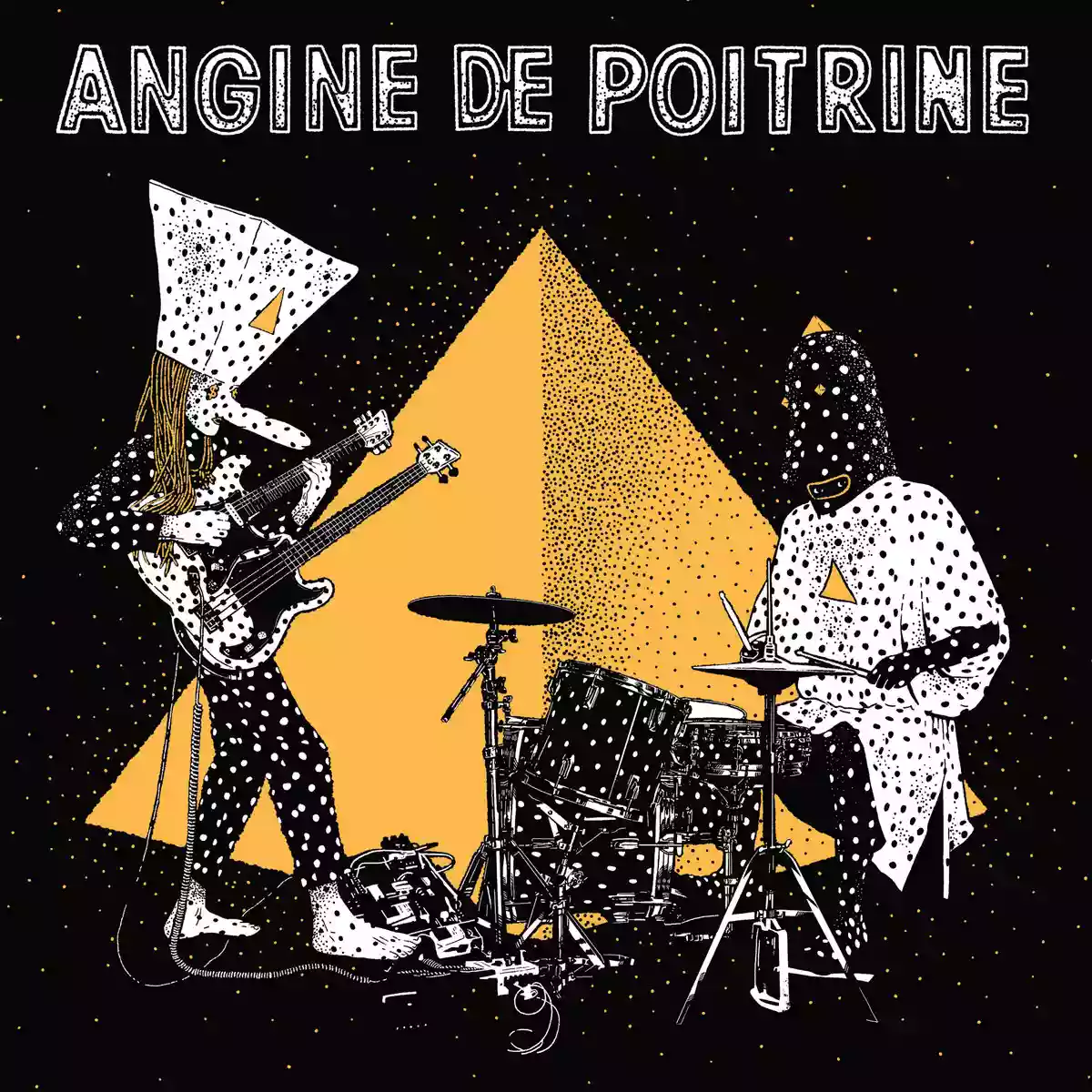
With this quick introduction to the history of music, we've given a general overview of the context, but specifically... what is so unique about this album and this group? Let me start by making one thing clear: microtonal music already existed before AdP released their first album, and although it had been kept to the underground, this is a genre of music that has gradually started making its way into rock and experimental territories. This Vol.II is an album entirely based on this microtonal structure, combined with elements of funk, math rock, and alternative; the only two members of the group (bassist/guitarist and drummer) perform completely on their own, mainly thanks to a loop station, a feature that creates a schematic structure of continuous real-time overdubs that never tires the listener. As in their previous record, the formula proves successful; there are several changes of meter, bass or guitar riffs that provide a base for numerous solos, simple yet impactful rhythms that lead the listening experience into something almost hypnotic. I won't dwell on listing the tracks of this record; all six pieces have a similar structure but at the same time present different nuances and sounds. Since everything is created “live” and with a loop station, it would be impossible to foresee different structures; with just two instrumentalists handling everything, multiple overdubs would be necessary to create something else. The final product, contrary to what one might think, is not overly heavy to listen to, as can happen with some post-rock or progressive albums from hyper-technical bands; this Vol.II, although it is probably not music that will appeal to everyone, can easily be enjoyed even in lighter contexts. However, the intent of these two musicians is not to create something standard (otherwise they wouldn’t have decided, on principle, to play microtones), but nor do they want to create something destined to remain in pure underground like much other (excellent) music. Their influences from canonical music can be found in artists such as Frank Zappa, British progressive rock from the '70s, and the punk/post-punk of bands like Television, which demonstrate the high level of musical knowledge carried by these two masked musicians. The merits of this album, then, aside from its masterful execution, lie in having brought attention to a product that is not only different from what we normally hear, but indeed something so unique that it goes against certain musical canons that have persisted for a millennium. To return to the initial caption: Jimi Hendrix certainly did not invent feedback in the absolute sense (as it is, in fact, a natural phenomenon), but he brought it to success within conventional music tracks; these Angine de Poitrine, in the same way, even if they did not invent microtones nor microtonal music, through these two albums are slowly bringing a “normalization” of certain quarter tones and “out of tune” notes within mainstream music. Even though among music enthusiasts positive reviews and listens are constantly increasing, I do not expect this album to climb radio charts, but I believe that, if these guys continue down this path, they will gain a lot of appreciation and respect from critics.
Best tracks: “Fabienk”, “Sarniezz”, “Angor”
Loading comments slowly
Summary by Bot
This review praises Angine de Poitrine's Vol.II, awarding it the highest rating. The reviewer highlights the album's innovation and memorable listening experience, calling it essential for fans of modern music. The assessment recommends the record for its remarkable artistic quality.
Angine de Poitrine
Angine de Poitrine is a Canadian duo (bass/guitar and drums) known for microtonal compositions performed with a loop station, blending elements of funk, math rock, and alternative. They perform masked and build tracks via real-time overdubs. Their release Vol.II continues the approach introduced on an earlier record.01 Reviews
