
 •
Rating:
•
Rating:
THE REVIEW
"Merdre!"
Yes, exactly "Merdre!": the first line of the first scene of the first act of "Ubu Roi", a neologism—fusion of mère (mother) and merde (shit)—thrown in the face of the Parisian bourgeoisie of the Belle Epoque and the battle cry with which Jarry always charged against all the theatrical and literary conventions of his time.
Who was Père Ubu? Simply the bourgeois according to Jarry. A being soaked with childish idiosyncrasies, cowardly towards the powerful and ruthless with the subordinates, gluttonous by nature and pataphysician by study, a wind-up puppet that embodied all the grotesque of the foolish mass and who—on stage—lived his comedy vomiting nonsense and not witty remarks.
In his bottomless greed, Père Ubu even swallowed the memory that posterity has had—and continues to have—of Alfred Jarry, and the cycle of his plays ("Ubu Roi", "Ubu Enchaîné", "Ubu Enchaîné") obscures all the rest of the shocking literary output of its author.
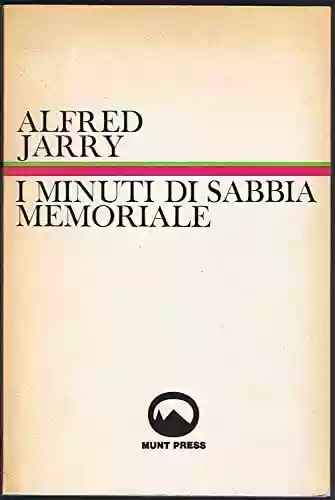
"Les Minutes de Sable Memorial" is technically a collection of poems, but like everything written by Jarry, it eludes and rejects any classification, any trivialization, any qualification that might label it definitively.
This is why trying to talk about it is so difficult.
I could tell you—that indeed—it is a collection of poems. But there are pieces of pure prose and even pseudo-prose that "hide" within them stanzas rhythmically guided by a precise lyrical deontology.
I could tell you that you feel the influence of Mallarmé for the linguistic invention, the syntactical precision, and the exasperated polysemy. But Jarry's vocabulary decisively steers towards the intense alchemical and the overall climax is full of a dense, otherworldly gothic where specks of a desecrating irony shimmer in the watermark on every page.
I could tell you that in "Haldernablou"—the masterpiece of the book—you can feel the hallucinatory morbidness of the speech of Lautréamont. But the piece goes even beyond the poetic prose of the Montevidean heretic: if the formal construction is that of a two-act pièce theater (with the corollary of precise directions), the virtually nonexistent plot and the predominance of the characters' "sensations" over physical action make it essentially a sui generis poem.
The book is not devoid of precise autobiographical references, even if constantly deformed and referred to something else. A technique that Jarry would later develop in "L'Amour Absolu" where the mystical-blasphemous-incestuous narration of Christ's life was the pretext to talk about his childhood in Brittany (or perhaps it was actually the opposite?).
"Les Minutes de Sable Memorial" are marked by a sensation of endless journey; a journey in which the reader is at the mercé of the "science of imaginary solutions"; a journey where not only everything and its opposite can happen, but often both things happen simultaneously. A journey, in the end, not so different from that depicted in "Gestas and Opinions of Doctor Faustroll, Pataphysician".
Rarely was an author more misunderstood and ignored in life while being plundered and idolized posthumously.
Rarely was a man more coherent in the conception of a life that defied, rejected, and mocked everything.
Dying on his deathbed—at only 34 years old—when asked if he wanted a curé (priest) to communicate, Jarry replied that he would rather have a cure-dents (toothpick). Those were his last words.
Loading comments slowly
Summary by Bot
This review examines Alfred Jarry's 'I Minuti di Sabbia Memoriale' as a complex, genre-defying work that blends poetry, prose, and theatrical elements. It highlights Jarry's linguistic invention, gothic atmosphere, and sharp irony. The reviewer praises the masterpiece 'Haldernablou' for its hallucinatory style and notes the autobiographical layers underlying the text. Overall, the review celebrates Jarry's coherence and bold rejection of conventions.
Alfred Jarry
Alfred Jarry (1873–1907) was a French writer and dramatist, best known for the play Ubu Roi and for founding the concept of 'pataphysics'.01 Reviews
