
 •
Versione 1
Rating:
•
Versione 1
Rating:
THE REVIEW
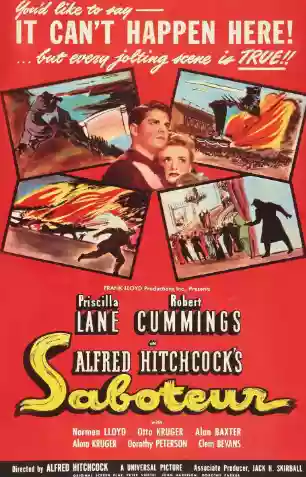
Not to be confused with Sabotage from 1936, shot in England, Saboteur (1942) is a film already fully immersed in American atmospheres and represents a significant chapter in Hitchcock’s filmography. Considered a "minor" title, it remains interesting nevertheless because it anticipates and touches upon themes that the director will masterfully develop in later works.
The theme of sabotage—particularly sensitive during wartime—is at the heart of the story. Barry Kane, a worker in an aircraft factory, is unjustly accused of causing a fire in which his best friend and colleague dies. In perfect Hitchcock fashion, Kane—young and innocent—takes flight and finds help from the inevitable blonde, Patricia, initially skeptical and then a convinced supporter.
The plot is enriched by ironic and iconic moments: an admiration for the boundless American landscape (deserts, mountains, vast open spaces), a nearly affectionate encounter with a group of circus performers reminiscent, in a gentle way, of the movie “Freaks”, and a scene inside a movie theater. But above all, it is the discovery that part of New York’s good society is complicit with the saboteurs that reveals one of the film’s most unsettling themes: the internal enemy, seemingly respectable, who threatens national security.
Hitchcock enthusiasts will recognize echoes of Notorious and especially North by Northwest. The latter already seems foreshadowed in the spectacular final sequence set on the Statue of Liberty (not exactly subtle symbolism), in which Barry faces the true saboteur: a scene that will be reprised, in Technicolor and with Cary Grant, in the Mount Rushmore finale.
If the film suffers from a somewhat didactic tone—understandable given the era and its propagandistic urgency—what works in its favor is the performance of the two leads, Robert Cummings and Priscilla Lane, perhaps little known in Italy but convincing. Cummings in particular manages to naturally embody the figure of the common man catapulted into events far bigger than himself.
From a technical standpoint, Hitchcock’s direction demonstrates his mastery in building suspense through authentic American locations, while the cinematography offers original solutions, starting with the evocative opening credits set in the factory, up to the various sequences shot "on location".
It is not an unmissable masterpiece, but remains a stimulating viewing for those who love Hitchcock, his subtle humor, and the pleasure of recognizing the seeds of what will blossom in his most celebrated films.
Loading comments slowly
Summary by Bot
The review highlights Alfred Hitchcock's Saboteur as a masterclass in suspense and storytelling. The film is praised for its impactful direction and contributions to the thriller genre. The author appreciates the tension and pivots that keep viewers engaged. This classic continues to influence modern thrillers. Fans of old Hollywood and suspense will find plenty to enjoy here.
Alfred Hitchcock
Alfred Hitchcock (1899–1980) was a British film director and producer, widely regarded as one of cinema’s most influential auteurs, famous for shaping modern suspense filmmaking and for his frequent on-screen cameos.20 Reviews
