
 •
Rating:
•
Rating:
THE REVIEW
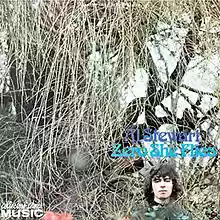
An artist's class is perceived through many details, and among them is undoubtedly the ability to reinvent oneself with style, maintaining high quality levels and a certain, indispensable consistency: in some musical fields, change and experimentation are viewed as an eyesore, the cliché elevated to a state of art; even in the singer-songwriter realm, just think of how some people reacted to Bob Dylan's so-called electric turn, or the shock provoked by Leonard Cohen with his "Death Of A Lady's Man." For his part, Al Stewart has always been an artist capable of reinventing himself: his first three albums show remarkable stylistic differences among them, showcasing an artist still searching for his ideal dimension, yet so talented and capable of expressing himself at high levels in all the patterns he experimented with. After the orchestral magnificence of "Bedsitter Images" and the introspective singer-songwriter folk-blues of "Love Chronicles," it's up to "Zero She Flies": it's 1970, practically the dawn of hard rock, but Al Stewart doesn't care, he follows his own path and goes back in time, producing an album of pure folk almost entirely acoustic.
If "Love Chronicles" was an album set exclusively in urban settings, "Zero She Flies," with the sole exception of "Electric Los Angeles Sunset," returns the listener to rustic atmospheres. Musically sparser and dryer than its predecessor, it does not inherit its introverted and pessimistic mood; it is certainly a reflective album but more dynamic than the second chapter, in which it proves to be more successful, and certainly more effective given the absence of missteps like "Love Chronicles" that I've already discussed. "Zero She Flies" has on its side the charm of simplicity, a natural refinement, and a distinctive feature: in its barely forty-minute duration, it gives ample space to instrumentals ("Burbling", "Room Of Roots") and brief semi-instrumentals ("A Small Fruit Song", "Black Hill", "Anna") that further accentuate the meditative atmosphere with which the album is infused, besides showcasing in the most immediate and evident way Al Stewart's great prowess as a folk musician.
"Zero She Flies" offers great exploits in all its "properly said" songs: the splendid melody with a vaguely Dylan-esuqe edge of "Gethsemane, Again", reflections, and images with a religious backdrop that would deserve a separate review, the stealthy and smoky stride of "My Enemies Have Sweet Voices", poetry by Pete Morgan transformed into a classic folk song, masterfully accompanied by bass and harmonica. The "electric turn" of "Love Chronicles" is not forgotten; it continues with the refined title track "Zero She Flies" which reworks the sounds of the previous album into a more visionary dimension, creating a fascinating poem filled with images and metaphors, and "Electric Los Angeles Sunset", which departs from the rest of the album by bringing the listener back to the chaotic metropolis like "In Brooklyn," but emphasizing violence, pollution, and the decadent nightlife: another perfect musical snapshot that constitutes a great surplus, adding that touch of incisive vitality that helps to make the album more varied and also more alive, while still fitting perfectly. "Zero She Flies" also contains Al Stewart's first historically themed song, the first of a long series, "Manuscript", a melancholic ballad accompanied by organ and orchestration, which recalls the events leading up to the outbreak of World War I like an old and faded black and white photo, from a distant and blurred perspective, a childhood memory.
Like the two previous albums, "Zero She Flies" can also be considered a work of transition and experimentation, adding another brick to the construction of a precise, personal, recognizable, and defined sound for Al Stewart, but, just like "Bedsitter Images," it remains a stunning record; texts of high poetic and literary value and simple, inspired melodies; the eclecticism, energy, and more contemporary sound that Stewart would develop in later years rests on these traditional and solid foundations, and that also makes "Zero She Flies" a mandatory and essential passage for all those who wish to approach the music of this great artist.
Loading comments slowly
Summary by Bot
Zero She Flies shows Al Stewart’s skillful reinvention within the folk genre, delivering a reflective yet dynamic acoustic album. It stands out for its poetic lyrics, historical themes, and instrumental variety. This record bridges his earlier works and later eclectic sound, capturing a refined, personal musical identity. A must-listen for fans and newcomers alike.Tracklist Lyrics
Al Stewart
Al Stewart (born 1945) is a Scottish singer-songwriter known for folk-rock and literate, history-infused storytelling. He broke through commercially in the mid-1970s, notably with the album and title track “Year of the Cat.”20 Reviews
Other reviews
By CLINT
Al Stewart remains, in my opinion, a tremendously underrated artist as all his songs throughout his production have always proven to be very enjoyable and relaxing.
Even after forty years, the album still feels fresh and played with that masterful blend of technical skill combined with some slight roughness or imperfection that I so love in records from that era.
