
 •
Rating:
•
Rating: THE REVIEW
The Ain Soph are a mythical group in the Italian and international esoteric post-industrial scene: over time, they have attained a true cult status. They were formed in Rome in the early '80s. The original lineup released a legendary trilogy - composed of I II, and III - inspired by magic and the works of Aleister Crowley. These albums were composed as actual “magical” rituals and should be understood as such: the formal aspect of the music cannot be separated from the esoteric and philosophical one. That said, even today, although perhaps a little naive, these recordings exude a spectral dark and satanic “feeling” that is perfect as a soundtrack for an occult horror film.
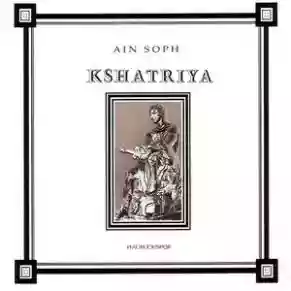
In 1988, the Ain Soph released what, in my opinion, is their masterpiece: "Kshatriya.” Kshatriya is a Sanskrit term that means “the warrior caste.” This is a very important work in the “ainsophian” career because, for the first time, strictly liturgical-ritual music is set aside to create something different: an ethical model that draws from the ancient teachings of the Tradition: the Kshatriya warrior viewed as a symbol of action in a contemporary world of ruins. Behind this concept are thinkers like Oswald Spengler, the author of “The Decline of the West,” Rene Guénon, and the Italian traditionalist philosopher Julius Evola with his “Revolt Against the Modern World.”
This was their first album pressed on vinyl, featuring, on the cover, a beautiful image of a sculpture of Ares by Lysippos. But beyond these references, which are still important for understanding the cultural context of Ain Soph, the music on the album is stunning. The primordial music in the trilogy made of obscure circular loops gives way to greater formal structuring.
The first track “Decimus Gradus” is characterized by a piano loop accompanied by the beautiful voice of Eliana, a singer from the Rome Opera Choir. The next track “Monsalvat” is shrouded in a sulfurous aura: the beginning recalls the initial ritual experiments, then an abrasive guitar and a church-like pipe organ make the general atmosphere sacred and pagan: the words are taken from Crowley's “Book Of Thoth.” With I.A.O., the tone becomes satanic and occult: a Gregorian chant that seems to come from the dark catacombs of a past era chants in trance a text in Latin (“In Deus Nascimur, in Jesu morimur, per Spiritu Sanctum reviviscium”) accompanied by the rumble of a drum. The title track embodies the spirit of the Kshatriya through the text recited by Corrado Mancini of Circus Joy, while the music is a sort of organized chaos where guitar distortions, piano, and bass create a telluric magma of rare power. This extraordinary album closes with the long - 14 minutes - “Stella Maris,” an elegiac and dark composition in which a celestial female soprano voice introduces us to ritual atmospheres where a ghostly voice recites a cryptic text in Latin.
With “Kshatriya,” Ain Soph put themselves on the same level as the early Current 93 and create a work that, even today, is seen as a true cornerstone of the esoteric ritual genre.
Loading comments slowly
Summary by Bot
Ain Soph's 1988 album Kshatriya marks a pivotal evolution in their esoteric post-industrial sound. Moving beyond earlier magical ritual music, it embraces traditional warrior ideals and philosophical depth. The album blends dark, sacred, and pagan elements, featuring haunting vocals, church organs, and rich instrumentation. Often compared to early Current 93, Kshatriya remains a landmark in occult music appreciated for its ritualistic power and cultural significance.Tracklist Videos
Ain Soph
Ain Soph are an Italian (Rome-based) esoteric post-industrial/ritual music collective, described in reviews as an entity that began in the early 1980s with home-recorded cassette experiments conceived as “magical” rituals (influenced by Aleister Crowley, Kabbalah/Enochian references, and liturgical atmospheres). Their 1988 album Kshatriya is repeatedly presented as their masterpiece, while Aurora (1992) is depicted as a major shift “from noise to music, from magic to ethics,” moving toward more song-based forms and explicit conceptual narratives.17 Reviews
Other reviews
By mementomori
"There is a before - and an after - 'Kshatriya' in the career of Ain Soph."
"Today we no longer need Kshatriya but hermits who, detached from the mud of today, preserve and pass on the fire of tradition."
