
 •
Versione 2
Rating:
•
Versione 2
Rating: THE REVIEW
“The term Ain Soph defines a group of individuals united by the same Will: the Will to no longer recognize themselves in an artificial collectivity that levels and homogenizes everything; the Will to immediately reclaim their own INDIVIDUALITY, their true PERSONALITY, and subsequently to enhance and grow it increasingly, until reintegrating it with that ultra-human - DIVINE - component that is intimately connected to it.”
From Brief Monographs on Esotericism, a booklet curated by some members of Ain Soph.
Ars Regia is a dark album in which the group draws on the teachings of alchemy. I am quite biased as this is my favorite album by Ain Soph. The Ars Regia was specifically discussed by Julius Evola in The Hermetic Tradition. According to Evola, Ars Regia is one of the Western initiatic paths to achieving a higher spiritual status, along with the so-called Grail Path. With Ars Regia, Ain Soph has composed a true symphony of terror, an unsettling and evocative album in its atmospheres. The music combines dark ambient with liturgical music. The effect created is sumptuous and arcane, reminiscent of the celebration of a black mass. The opening track V.I.T.R.I.O.L. (in alchemy, the term represents one of the phases of the magical integration cycle), is a gloomy sacred ceremony celebrated in a crypt adorned with esoteric vestments. “Credo”(G. Kremmerz)” is a long hypnotic loop of great evocative power in which the teachings of the esotericist and alchemist Giuliano Kremmerz are practiced. “Credo” should be listened to in the dark, in religious silence with headphones. With “Lapis Niger” the ritual continues with dark ambient plots. In “Honorii Ponteficis Evocatio”, a pipe organ takes center stage, releasing a sacred atmosphere. “Gradalis” (on side B) is a long meditative electronic invocation, macabre and hermetic. “Apanathismos” closes the circle in a gloomy manner. Aldo Chimenti defines it in the essential volume Sacred Noises as follows: “It is the final stage of the rite in which the elements recombine into a purer form, the work of the redness (Rubedo) that promises the achievement of the philosophical stone (gold).”
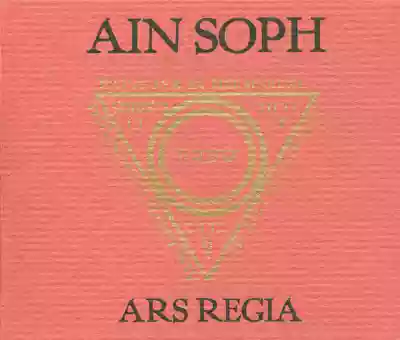
Ars Regia was released on cassette by Nekrophile Records in 1986. The album was later reissued on CD by the same Nekrophile in 1992 and by the French Athanor in 2003 (with 2 different colored covers. Specifically, 900 copies in green and 100 in red as depicted in this review).
Loading comments slowly
Summary by Bot
Ars Regia by Ain Soph is a dark, immersive album inspired by alchemical and esoteric teachings. Combining dark ambient and liturgical sounds, it creates a haunting atmosphere reminiscent of sacred rituals. The album is praised for its evocative power and spiritual depth. Originally released in 1986, it remains a significant work in the dark ambient genre.
Ain Soph
Ain Soph are an Italian (Rome-based) esoteric post-industrial/ritual music collective, described in reviews as an entity that began in the early 1980s with home-recorded cassette experiments conceived as “magical” rituals (influenced by Aleister Crowley, Kabbalah/Enochian references, and liturgical atmospheres). Their 1988 album Kshatriya is repeatedly presented as their masterpiece, while Aurora (1992) is depicted as a major shift “from noise to music, from magic to ethics,” moving toward more song-based forms and explicit conceptual narratives.17 Reviews
Other reviews
By mementomori
ARS REGIA is probably one of the most complete works ever produced by the Roman esoteric circle Ain Soph.
The non-music built here becomes describable, in profane terms, as an arcane psychedelia of the mind that knows how to envelop and intrigue the listener even at a superficial level of enjoyment.
