
 •
Versione 1
Rating:
•
Versione 1
Rating:
THE REVIEW
So, yes, the dream is dead, but they try again. Without innocence, it's true, but it's a self-referencing that oozes nostalgia. Without keyboards and new wave, because, come on, we're not those posers from TSOL (if only).
The only problem with this 1987 is that it has to face that 1981 written impulsively, directly in its best form. Hypnotic, mesmerizing black hole that everyone has to contend with. And with which everyone loses.
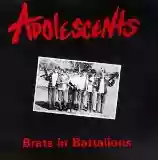
"Brats In Battalions", the title is beautiful. The triumvirate Agnew-Soto-Cadena (with Sandy Hansen and Alfie, Rikk's brother, joining), cynical and mocking as ever, spews curses at a trot, giving us yet another beach punk anthem. A sort of carefree and irreverent de profundis: the hardcore scene, mortally wounded by crossover and "Reign In Blood", is at its swan song. But they don't care at all. In fact, they move convulsively between punk rock and power pop, diligently copying the latest Descendents (listen to "I Love You", or Steve Soto's sobs in "Skate Babylon") and churn out a useless, manneristic, and superfluous record. In a word, wonderful.
The quintet's formula this time records a certain hardening at the expense of speed which, however, has never had a deep alliance with the Adolescents. Although heavier and more martial (read: the excellent "Welcome To Reality"), they still sell their skin dearly: the two-speed slamdance in "The Liar" is a torrid pogo machine, "Losing Battle" is a splendid "No Way" with controlled detonation, and "Peasant Song" is the polyphonic epitome of the perfect kids from Fullerton (with oozin-ahs ante litteram). And that's fine, come on. Sure, the real Adolescents are no longer there. These are more technical, but also self-referential and cloying. They play it safe, yes, but in a horizontal line. They can't see the goal.
And the comparison becomes sometimes merciless when you listen to "I Got a Right". The Stooges, filtered through Cadena's repressed hormonal aspirations, give life to a visceral, broken, alive punk. Nosebleeds, vomit, exoskeletons of sunburnt suburbs. Finally, you can breathe. The original pieces? By comparison, stifling cloaks of rhetoric.
But then you listen to Rikk Agnew. You hear his guitar fly. Winking at "Amoeba", at the good old times. And then, little by little, you realize that "Marching with the Reich" is a heartfelt restyling. That, with a pinch of Christian Death, "Kids of the Black Hole" vol. 2 has been made: the epic and theatrical "Things Start Moving".
Emphatic and superfluous, but full of nostalgia. Go on, you are forgiven.
Loading comments slowly
Summary by Bot
The Adolescents' 1987 album 'Brats In Battalions' offers a nostalgic yet uneven punk experience. While it lacks the raw immediacy of their 1981 work, it blends punk rock and power pop with self-referential energy. Highlights include standout tracks like 'I Got a Right' and Rikk Agnew's evocative guitar work. The album is a bittersweet, somewhat superfluous homage to their punk roots, reflecting both cynicism and heartfelt nostalgia.Tracklist Lyrics Videos
Adolescents
Adolescents are an American punk rock band from Fullerton, California, formed in 1980. Their 1981 self‑titled debut is a landmark of Southern California hardcore; key figures include vocalist Tony Reflex (Tony Cadena), bassist Steve Soto, and guitarist Rikk Agnew.03 Reviews
