
 •
Rating:
•
Rating:
THE REVIEW
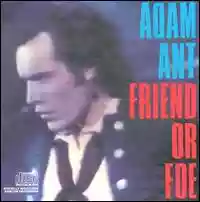
Maybe because he was tired of wearing such heavy makeup, maybe because he couldn't stand the idea of finding himself trapped in the fashion he had launched, maybe because the doorman of the building where he lived dressed like Captain Hook and his butler was General Caster, or maybe because inspirational veins eventually run dry, Adam Ant leaves behind everything built over the past two years and "changes his tune".
He dismantles the Ants (nothing more than an appendix, an army, a court of Adam the little king), certainly a now useless band whose disappearance from the scene takes nothing away from the image of a figure who hasn't been punk since '79 and has no intention of playing glam anymore. The collaboration/cowriting with guitarist and friend Marco Pirroni remains, who from this work on will be known simply as Marco. The scenario and the guitars are pulp ante-litteram, taken from a C-series American crime film, the breathless trumpets stolen from car chase scenes. The studded leather of '77 and the knight's cloaks of '81 have been replaced by Dick Tracy-style private investigator raincoats.
Adam's singing, as heard from the very first track and title track, maintains its general likable pleasantness; he still toys with the "uhau uhau" remnants of past musical episodes, but without overdoing it. The double drum, Antmusic's trademark, persists and fits perfectly among the trumpets that "are" the song. "Something Girl" is a delightful whistling march. With "Place In The Country" we return to this kind of ska tinged with rock n' roll. Drums and brass, Ant's falsettos in fine form. An irresistible track, but one that cannot help but give some space and time to this pulp guitar. And so far, we haven't stopped for a moment.
The pause arrives, but it's not a ballad, rather a strange funky-rock well-cadenced thanks to excellent bass and guitar work. The beginning is so rich in brass that you feel Rocky Balboa is about to step into the ring to sing a song at Madison Square Garden Arena. The rhythm, though not frantic, immediately makes your foot tap, thus no pauses. Ant vents his success stress in "Desperate But Not Serious". "Here Comes The Grump" is pure new wave entrusted to someone who knows nothing but to desecrate in music. I would have liked to hear it from one of these very derivative bands today in a "truly (!)" new wave version, or at least from a post-punk Adam Ant, not forced, for the sake of coherence with the rest of the album, to keep the guitars at such a low volume. The track is little more than a verse, repeated endlessly. "Under" the track, a subdued guitar travels, with notes emulating the background keyboard motifs of a hundred songs from the first half of the 80s, both English and Italian (there are pieces, for example, by Alice that have this two-three note background to the choruses). The erotomaniac Adam Ant claims in this album his right to life and joy by embellishing side A, delving into, and transforming it into an Aretha Franklin-style soul, the Doors' "eros-rock" "Hello I Love You". Not transcendent but tasty.
Side B begins like the first: "Goody Two Shoes" is a cross of ska and rock n' roll very similar but also more catchy than "Friend Or Foe" or "Place In The Country". On an out-of-tune violin, then, "Crackpot History & The Right To Lie" is born in which Ant sings the title-chorus and raps all the rest. A delightful filler, always being nothing more than a filler, and from which one can gather further relevant information about this young man stressed to the max. Adam also, more or less covertly, takes a dig at punk in this track: "all the rebels I've met told me they were destined to die, yet I still see them today, and they aren't dead yet". Splendid "Made Of Money" starts post-punk/rock n' roll guitaristic, thus it inevitably contains some "brass-plated" parts, not too invasive. Splendid is the "do do do" of an Elvis with still clearly visible safety pin holes in his nostrils, instead of any form of solo. "Marriages are made in heaven. So what the hell happened to mine?" Adam keeps asking. Strong this (then) new Adam Ant who wants to talk about himself, his issues and his stress, rather than waving pirate flags, who although still abundantly enjoying life, at least on paper, claims to be nostalgic for a life of a Mr. Nobody. The texts of this album are interesting also considering that nowadays (but for years) Our Man has retired into private life also due to some mysterious ailments, and considering the persistent rumors of severe psychological troubles.
The venting of this Adam on the edge of the abyss continues in "Cajun Twisters", a funky unfortunately almost unlistenable, in which Ant calls for privacy and considers himself a little red riding hood at the mercy of the media wolf. The rhythm picks back up with "Try This For Sighs", once again AdamElvis giving himself to soul. Though the verses aren't much, the chorus is quite catchy. Here too, unfortunately, an avoidable space for Marco's guitar, a tool placed way back in the lineup, with drums and trumpets at the forefront, and guitar behind even the bass. The album ends with "Man Called Marco", finally a "real" space granted to Marco Pirroni and his iron. Entirely instrumental, except for a voicemail where Marco greets us, it's a sort of "Midnight In Moscow" in a pulp key. Beautiful, worthy of Tarantino and the Coens, with an ending even worthy of a B-series western, thanks to the slow whistling finale.
It is pointless to dwell on how much bands like Madness and Specials have to do with punk and of which and how many genres/styles/artists the 1977 London scene was the primordial broth. Indeed, then, to say that this odd and charming character and ska had nothing to do with each other is inaccurate, given Adam's artistic origins. But Ant still succeeded in going beyond the mere reproduction of a style that is in his ropes, pulling an ska-rock n' roll, soul-rock, and funky-rock fusion out of the hat in common with Marco. Undoubtedly the most successful episodes are the wildest tracks. There the bad boy with the ideal son-in-law face is practically irresistible, as well as more credible than in other experiments. This does not take away from the fact that the average level of the tracks is more than appreciable, with only two real fillers. After this work, however, that Ant erotomaniac "identity" will develop, which will transform him into a pop gigolo in the bland and somewhat unsuccessful subsequent album "Strip", after which Adam will partially, and then completely, lose his way. But in 1982, he deserved applause for this fine album, and, first of all, for having managed to question himself, as all real artists must do.
Loading comments slowly
Summary by Bot
Adam Ant's 'Friend Or Foe' marks a significant shift from his punk and glam roots towards a fresh blend of ska, rock, and soul. Collaborating closely with Marco Pirroni, the album delivers energetic and stylish tracks with compelling brass and guitar work. Lyrically, Ant explores personal struggles and identity crises, making the album both introspective and musically engaging. Though not without minor fillers, the album stands out for its adventurous spirit and artistic growth. It remains an essential listen for fans of early 80s alternative rock.Tracklist Lyrics Videos
Adam Ant
Adam Ant (born Stuart Leslie Goddard) is an English singer and performer who rose to fame with Adam and the Ants in the late 1970s/early 1980s before launching a successful solo career marked by flamboyant style and hook-heavy new wave/glam-inflected pop.06 Reviews
