
 •
Rating:
•
Rating:
THE REVIEW
What artistic life after punk? What is possible for those who, directly in London Town, contributed to the plundering of art, raped the pentagrams, poured acid on certainties, hurled boiling oil on styles, and thoroughly mined the field to then witness the explosion?
Active on the artistic-musical scene since 1975 (even though his first and until then only record was dated 1979), in 1980 Adam Ant realized that, by destroying everything, London punk had practically destroyed itself too, like a kamikaze, a suicide bomber. Even for Ant, things were pretty much the same: McLaren had screwed his Ants to turn them into a pop group, his longtime manager and great friend Jordan (a saleswoman at Westwood's sex shop and punk icon planet-wide) had returned home to the south...
In 1980, Adam reconstructs his band (only in part) and above all convinces himself that the time has come to give free rein to his musical "obsessions": two drummers, Native American rhythms and choirs, pirate chants, screams of warriors charging themselves before the assault...
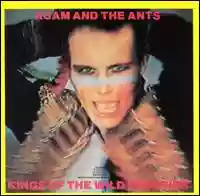
This record begins in full "new course" style with "Dog Eat Dog", a Native American dance upon which rises an epic guitar riff. Ant's singing sobs in imitation of Indian vocals. He incites the crowd of warriors and prepares them for battle. Between the verses, there is a harsh guitar interlude and low, epic "oohs." Then comes "Antmusic", a very amusing programmatic manifesto, or rather an advertising spot directed at himself... Bright voice, "hop hop" from people doing aerobics, a chorus of guitar strumming, and a flat guitar solo. "Want to have fun? Then unplug that juke box, do us this favor: that music has lost its flavor... So try another taste: Antmusic!"
"Feed Me To The Lions" starts with a great rhythm and an interrogative opening that goes "Too emotional am I?" It can't help but include, for "coherence," choirs that go "ahe uh ahe uh"... Inevitably, to make the song cover-band proof, there's a guitar solo not played by Pirroni but by Lawrence of Arabia. You move to New Mexico and transform into a refined stagecoach raider who pays homage to and quotes Clint Eastwood in a well-executed but idea-poor filler "Los Rancheros" (and those few are highly stereotypical). I prefer "Cowboy" by Jovanotti. "Ant Invasion" is a rock 'n' roll horror: a bass rhythm that "manipulates" the piece under a frightened guitar. The hunt for the giant ant is a delirious theme for a song and anything else. The splendid somewhat medieval special of a brave captain "frozen" with fear is noteworthy; also notable is Adam the dreamer's performance in the entire third verse: a man conquered by terror. A theatrical episode that succeeds, a worthy example of the "new Adamitic course."
The title track launches, after a native choir in the invader's language, a new programmatic manifesto song on a double drum that emulates tribal drums. The singing and bass notes are almost identical and travel (almost) parallel. Anglo-medieval melody on native-tribal rhythm. "Antpeople are the warriors, Antmusic is our banner!" shouts the leader maximo among the screams of his people, and then everyone dances with the wolves until the sun rises: then it will be time to die... Like it or not, the listener on duty, Ant's voice in this piece is that of a punkster like Joe Strummer. Moreover, this piece shows, more than others, how good the (post?-)punk is as a frame to such daring rock experiments.
"The Magnificent Five" resembles "Antmusic," mirroring its stylistic elements but failing to replicate its catchiness. "Don't Be Square (Be There)" seems almost disco; probably, given its form and taste, it dates back to his "previous musical life": filler with the chorus being the title of the last album ("Dirk Wears White Sox," besides being the chorus of this song and the previous album's title, is also the title of a song discarded at the time of the first album, found in its 2004 Deluxe edition: but how can you make an album where you discard the title track?). "Jolly Roger" is practically a "real" song by drunken pirates ready to crush a man's head with the tip of their wooden leg. A nice whistle... This is not at all a combination of punk and Ant's childhood tradition/imaginary: it is practically a total rip-off of a "style," if we can call it that.
"Making History" starts punk among guitars that scratch each other; it becomes a cheerful "summer" tune, and then, finally, loses itself with those usual - and, by the eleventh consecutive song, unbearable - "ohiohioh," which more than a Native American, Adam sounds like a South Tyrolean who has just downed a distillery of grappa. In the end, the piece never takes off, instead fading underground. "The Human Beings" is the convincing final experiment: it begins in line with the new wave production of that time and does nothing but quote the names of some American tribes, one after the other. Human beings would be nothing more than the members (the few left) of those few native tribes. The others? Worms, more or less solitary, that kill and are killed over a meaningless thing called power.
A very long album for the time, featuring a creative mind who had many things to clarify (with the world but perhaps also with himself). Despite the fillers, this record still shines for originality, this time not so much "compositional" but "structural," "planned," of "field choice": epic and/or medieval music, "piracy," drums and Indian chants, all together and all within a pop-rock structure that "stands firm."
An unrepeatable work for its "genuineness" and historical conjunctures, as well as the author's boldness (and indeed the subsequent "Prince Charming," despite attempting to follow the trend, will not measure up to this), which unfortunately and reluctantly triggered an almost absurd fashion trend known as the new romantic movement (a movement to which everything but should say Ant adhered), and which nevertheless condemned Western Europe to leave home with bandanas on their heads (notwithstanding those times didn't have the adequate technology for bulb transplants), to tattoo helm wheels, mermaids, pirate flags, and pink dolphins all over their bodies, to walk with a parrot on their shoulder and watch Portobello on TV because there was the parrot; to wear pirate eye patches, to buy Moschino clothes, to consider Moschino a stylist... But above all, and worst of all, it forced us to see on TV singers like Bertè or Fiordaliso dressing like the Flying Dutchman at various Festivalbar episodes. Just for this, I should take at least one star away from Adam Ant...
But perhaps, since twenty-seven years have passed, I forgive him.
Loading comments slowly
Summary by Bot
This detailed review explores Adam And The Ants' 1980 album Kings Of The Wild Frontier as a bold and original post-punk work. It highlights the album's tribal rhythms, epic themes, and theatrical performances while critiquing some weaker tracks and the unintended fashion trend it sparked. Overall praised for its creative daring and historical significance.Tracklist Lyrics Videos
Adam and The Ants
Adam and The Ants were a British band formed in London in 1977, fronted by Adam Ant (born Stuart Leslie Goddard). With guitarist/songwriting partner Marco Pirroni, they evolved from punk to a flamboyant new wave sound marked by tribal double-drum rhythms and theatrical imagery. They scored major UK hits, including the No.1 singles "Stand and Deliver" and "Prince Charming," and the UK No.1 album Kings of the Wild Frontier, before disbanding in 1982 as Adam Ant went solo.04 Reviews
