
 •
Rating:
•
Rating:
THE REVIEW
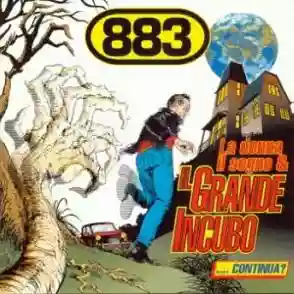
Lately, I've found myself rummaging through my dusty record shelf, listening again to albums I hadn't thought about in who knows how long. Maybe to bring back memories, emotions, and impressions from the past, I've focused on those albums whose melodies, songs, and tracks have most significantly marked my life. The music I prefer is composed 99.9% of foreign music, but there are also some Italian works that I consider truly valuable in my collection. And in this review, I am about to highlight an entirely made-in-Italy album, a record that represents my first little step into the world of music. This work is "La Donna, Il Sogno & Il Grande Incubo" by the late 883.
The album in question dates back to 1995, when I was a naive 6-year-old kid who was already starting to hear and feel some emotion from the songs popular at the time. In particular, it was Una Canzone d'Amore that pushed me, or rather pushed my family, to buy me the cassette of "La Donna, Il Sogno & Il Grande Incubo" from a stall in a small mountain village while I was on vacation. Sure, I was still too young to give a rational judgment on the work in question, but just look at the condition of that cassette now to see how much I wore it out by playing it over and over.
The 883 can be unanimously considered one of the first groups/bands to address young people with an extremely blunt, simple, almost banal language, perhaps sometimes even vulgar, yet direct, effective, and possessing an energy that lyrics and scores of esteemed colleagues in the Italian music biz of the '90s lacked. The social messages that the 883 intended to convey might have seemed crude, but thanks to that aforementioned language, they were able to reach the hearts of all Italian teenagers of the last decade of the 20th century. Now the 883, which after the initial lineup composed of Pezzali and Repetto became a one-man band (similar to Hucknall's Simply Red) before fizzling out at the beginning of the new decade, are no more. Only Max Pezzali remains, who, perhaps due to advancing age and artistic maturity (perhaps), can only sing insipid, sappy songs that cannot even be compared (not even negatively) to Sei Un Mito, Tieni Il Tempo, Nord Sud Ovest Est. In short, a great fall from grace.
What distinguishes the work is not the depth of the songs, which as mentioned are simple in terms of lyrics, but their musical richness, a sort of alternative to the usual Italian Pop and Pop-Rock, something different and much more catchy and digestible than the usual saccharine fare made in Italy. The album itself can be divided into two parts: a series of tracks that can be defined as "danceable," extremely simple and catchy, with lyrics of incredible lightness, and a set of romantic, melancholic, almost deep songs, but still maintaining a comprehensible and simple language.
Among the "dance" tracks we can consider Tieni Il Tempo, with a Latin flavor, very danceable, a spark for the '90s discos, La Radio a 1000 Watt, Musica, O Me O (Quei Deficienti Lì). An anomalous song from these but not assimilable to the "romantic" ones is Il Grande Incubo, a track that allows me to jump back 15 years when I hear it. The lyrics, accompanied by horror movie sound effects, allow the listener to enter a fantastic world, perhaps a bit playful, made of chases, runs, darkness, shady motels, and intriguing women.
One of the "romantic" and "melancholic" tracks of the album is Gli Anni, which I believe is the masterpiece of the 883, a song full of intensity and sadness. Also in this context are the aforementioned Una Canzone d'Amore and Senza Averti Qui. It is worth mentioning the extreme simplicity of the lyrics of Una Canzone d'Amore (If one day I could/ enter your dreams/ I would like to draw/ on the blackboard of/ your heart/ my dreams/ my dreams, you know. I think that rookies Scanu, Amoroso, Carta & Co. are not able to express themselves so effectively (but this is just a personal opinion).
Listening to this album again, you can understand what 883 and their music were, simple but direct, banal but not predictable, perhaps crude but effective and successful. A true gem of the Italian music scene of the '90s.
Loading comments slowly
Summary by Bot
This review revisits 883's 1995 album 'La Donna, Il Sogno & Il Grande Incubo,' highlighting its blend of catchy dance tunes and melancholic romantic songs. The album’s simple yet direct lyrics and energetic music made a lasting impact on Italian youth of the '90s. The reviewer reflects on personal nostalgia and notes the album's unique place in Italian pop history despite its lyrical simplicity. The band’s later decline is touched upon, contrasting the album’s success.Tracklist Lyrics Videos
883
883 were an Italian pop/pop-rock project initially formed as a duo by Max Pezzali and Mauro Repetto, breaking through in the early 1990s and becoming a major youth-culture phenomenon in Italy. Reviews repeatedly highlight their everyday, youth-focused storytelling and the later shift after Repetto’s departure, with reception ranging from affectionate nostalgia to harsh criticism of repetition and commercial decline.21 Reviews
Other reviews
By woodstock
The turning point... compositions that project directly into the pantheon of Italian classics of the '90s.
883, for a short time, were a true cultural phenomenon in Italy.
By Milord
Love, friendship, desires, nostalgia: in one "word", 883.
If one day I could enter your dreams, I would like to draw my dreams on the blackboard of your heart...
