
 •
Rating:
•
Rating:
THE REVIEW
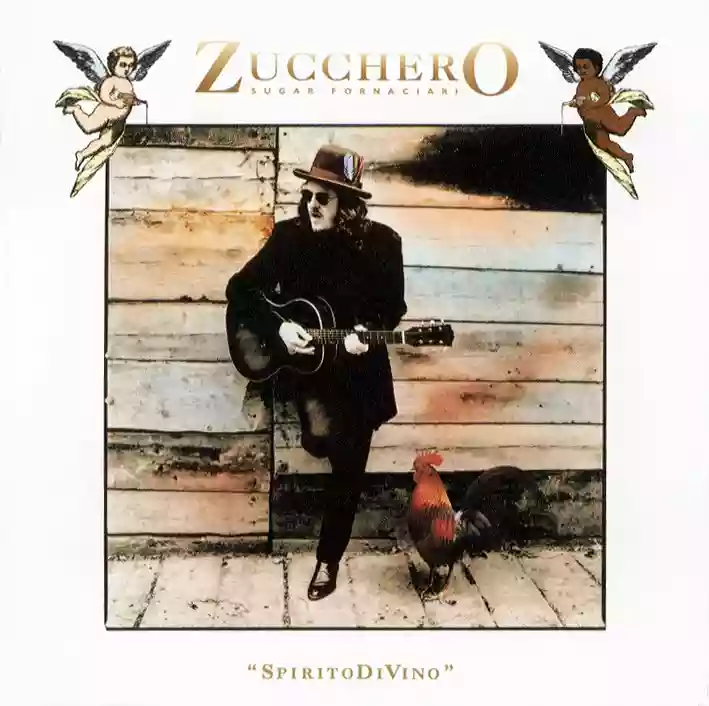
I felt the need to write this review because it seemed really strange to me that no one on this site had done it before me. All of Sugar's albums have been reviewed, but not this one.
Forgive me, but it is really strange. I know I'll face criticism, possibly severe, from people who don't agree at all with what I'm going to write, but a clarification is needed: Spirito DiVino is not the best album by Zucchero Sugar Fornaciari, but according to me, it is. Therefore, this is a completely subjective review.
It begins with Voo Doo Voo Doo, fun and irreverent. That's enough to say, because it's just an introduction. Polo Jones's bass line in the rhythm of the song is unmissable. With the next song Datemi Una Pompa, the rhythm doesn't decrease, and the lyrics remain full of suggestive tones referring to sex, but Sugar's anger starts to emerge. Maybe that's why the song doesn't end, but simply "becomes" the next track. So, after Zucchero's last tormented scream, the obsessive guitar riff of O.L.S.M.M. begins, and with it comes high-level music. The arrangements of this song are extraordinary. The great David Sancious had already driven the keyboards wild both in Voo Doo Voo Doo and in Datemi Una Pompa, but here he seems to truly find the right place, like all the other musicians. Especially the extraordinary bridge of this song, a perfectly effective climax that begins after the second chorus: from the voices cheering "Shake it!" to the harmonica solo that, growing in intensity, transforms into a sax solo that in turn explodes into Sugar's singing. A great track, certainly already experimented by Zucchero in previous works, but with nothing to envy from its predecessors Solo una sana... and Il Mare Impetuoso... This time the track has a closure, but certainly not the emotions. On the contrary. It is time for one of the highest moments of the album: Pane E Sale, that is, the second, very successful encounter between Our Star and Francesco De Gregori. Comparing it to the previous Diamante, I really couldn't choose between the two. It is certain that when Zucchero sets De Gregori's poems to music, truly elevated results are achieved. The atmosphere evoked by Pane E Sale is presented as something unique in the Italian musical landscape and is, in my opinion, one of the most important milestones ever reached by our singer-songwriters. The sound of this song is always saturated and swollen: from the basses drummed with a light touch to the unreal "spaces" evoked by the full chords of the synthesizers. I won’t say more, the only way to appreciate the beauty of this song is to listen to it.
I have always interpreted this first part of the album as a unique body because indeed the musical quality and the emotions that emerge are felt as an ascending climax of intensity that is more unique than rare. I don't know if this was an effect deliberately sought by Zucchero (I certainly like to believe it) but these are the sensations perceived by a listener enjoying these first four tracks in the album's order. And we are, anyway, only at the first four.
After Pane E Sale it's time for the mega-hit X Colpa Di Chi. Sure, it would have been nice if the level had risen even further after track no. 4, but it would have also been a very arduous task. In X Colpa Di Chi Zucchero indulges in his irony and his non-sense based on a harmonic base built by an agitated piano (excellent Sancious once again). An absolutely enjoyable song, even if overly used, which benefits once again from a good bridge. After closing this chapter, another extraordinary track begins. Certainly, the best texts of Zucchero have been crafted with the trusted Panella and Salerno or even left to be written by singer-songwriters of calibre like Gino Paoli and De Gregori. Sometimes, however, they are entirely by Zucchero: Il Volo is one of the most beautiful songs composed entirely by the singer. The atmospheres evoke almost unreal scenarios, although the natural elements are the true protagonists of this man's journey who "dreams of something good." It is known that the ghost of the ex-wife will forever return to torment Sugar's soul, but it's precisely the energy of this uncontrollable feeling that translates into such memorable songs.
The following Senza Rimorso does not abandon the melancholic and nostalgic tones, rather it seems to dive heavily into an almost opposite path to the previous track. While earlier there was an attempt to fly away (albeit unsuccessfully, as the line "Siamo caduti in volo" states), this time the atmospheres are much darker and deeper. Once again, the bridge is the most significant part of the song: disarmingly simple, both in the text and in the piano line of very few notes, but precisely for this reason of essential emotional effectiveness. Papà Perché is dedicated to the father. Zucchero talks about his loves, from his childhood to blues, and he does so through still nostalgic tones, but despite everything, the artist seems to sense positive moments. Then it's time for Così Celeste, another extraordinary ballad, with an almost Christmas flavor, which once again evokes the "sugarian" topos of the sun and the stars. As in Madre Dolcissima, singer Lisa Hunt delivers an extraordinary vocalization at the end of the track. Alleluja is (perhaps) the album's least successful track: the impression is that it lacks the drive and conviction of the previous tracks. Once again, it uses a profane text (written by Jovanotti) with explicit sexual references.
That said, I feel entitled to consider Spirito DiVino as one of the best Italian albums ever while at the same time being aware that this statement meets a thousand objections. But it doesn't matter, I know that many of them are also justified by the fact that Zucchero's image has partially declined. Albums like Bluesugar or Zu & Co feature some songs that certainly can't be called such. But we know, it's always easier to speak badly of things than to speak well of them.
Loading comments slowly
Summary by Bot
This subjective review praises Zucchero's album Spirito DiVino as his best work, highlighting its rich emotions, outstanding musicianship, and powerful collaborations, especially with Francesco De Gregori. The album's blend of blues, rock, and poetic lyrics creates a unique and unforgettable listening experience. While some tracks vary in strength, the overall intensity and artistic quality make it a landmark in Italian music.
Zucchero
Adelmo Fornaciari (born 1955, Roncocesi) is an Italian singer-songwriter known by his stage name Zucchero. He rose to prominence in the 1980s with blues‑influenced pop, major albums such as Blue's and Oro, incenso & birra, and numerous international collaborations.35 Reviews
