
 •
Rating:
•
Rating:
THE REVIEW
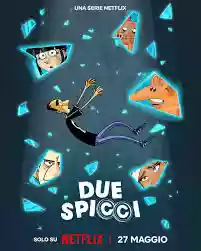
Zerocalcare had hinted at it: he was thinking of stopping drawing. It’s from this perspective that, perhaps, we should approach this eight-episode series, each episode lasting about half an hour.
"Due spicci" will be just another stop along a path of slightly repetitive efforts for those who have watched or read Zerocalcare perhaps with passion, but without ever really understanding him completely. But those who have deeply loved the Roman cartoonist, read everything he’s done, watched everything, devoured every interview – those who are truly die-hard fans – will see "Due Spicci" in a different light: this series is a closing circle.
ALLERTA SPOILER From here on, I’ll be making a lot of references to the plot. Deal with it.
What I mean is that all the culture, the rhetoric, and the poetics that underpin Zerocalcare’s body of work finally find an outlet, are brought to completion. It’s not just a matter of the quality of the series itself: we could discuss whether it has actually raised or lowered the bar or, in my opinion, probably raised it a little, though not drastically. What I mean is that in terms of how the series is constructed against the deep and symbolic meanings that each element has, well, we are really at the highest level.
When Smeralda, for example, justifies Paturnia by saying that she’s had a hard life, you can sense from the protagonist’s reply that he has – in some way – assimilated, understood, made his own the message that Secco bluntly explains to him in "Questo mondo non mi renderà cattivo".
The moment Zerocalcare talks to his mother is touching; the Armadillo (applause to Mastandrea) reveals a sensitive side, and the scene is truly tear-jerking: Zerocalcare has perhaps never drawn himself this vulnerable. And what can I say, the way he sums up his relationship with Lady Cocca in just a few minutes is pure class.
Do you get what I mean? I could give more examples, but it would be redundant. It’s as if Zerocalcare has created his final work. Maybe other works surpass it in some ways, and I’m certain that "Due Spicci" won’t be anyone’s most beloved Zerocalcare work, but it doesn’t matter, because the very core idea behind Zerocalcare’s art is all here.
"Due spicci" is pachydermic; it’s heavy. It’s heavier than his other works, or at least compared to most of them. It’s pachydermic because it’s dense, packed with meaning, not leaving anything behind. Only one theme isn’t touched upon: politics. But after all, we know that Zerocalcare has a personal relationship with political expression. So, yes, the series may feel less smooth-flowing than others, but what do we expect? It’s a more mature, more adult series; it talks about people who’re seriously into drugs, knives stuck in stomachs, and anti-violence centers. Let’s not forget that behind the sharp jokes and first-rate irony, Michele Rech hides – or rather, tells – stories that are often very weighty.
So what’s left, then? We just have to thank Zerocalcare, a figure who has given so much, and deep down we hope will keep giving, to Italian culture. His strong sense of humor constantly shapes the finest tastes of new generations, his never trite reflections are a godsend for today’s public debate, and his atmospheres, his emotions, his scenes are something that truly strike a deep chord. "Due spicci" could really be Zerocalcare’s magnum opus.
And anyway, when you put Plakkaggio in the soundtrack for me, I’m just happy. Rating: 96/100.
Loading comments slowly
Summary by Bot
The review praises Zerocalcare - Due spicci as a standout TV series, lauding its storytelling and emotional impact. The adaptation is highlighted for its blend of humor and heartfelt moments. The reviewer gives it the highest rating possible. The series is noted for appealing to both comic fans and TV audiences.
Zerocalcare
Zerocalcare (Michele Rech) is an Italian cartoonist and graphic novelist from Rome. Known for La profezia dell’armadillo and the animated series Strappare lungo i bordi and Questo mondo non mi renderà cattivo, he blends autobiography, Roman slang, pop‑culture references, and social themes.04 Reviews
