
 •
Rating:
•
Rating:
THE REVIEW
FIFTEEN SONGS.
ON THE PLATE.
by odradek
A few nights ago, I was listening to Lou Reed praise the technology applied to music, burying the past and the nostalgic.
Something along the lines of: “Old records are stuff for maniacs, today you can walk around with 5,000 songs in your pocket, who wants vinyl, who wants the crackle of vinyl?”
How can you disagree with that, I thought.
Sure, Lou, at 64, is young.
A rock icon is young by default.
And then, embracing these new endless possibilities seems to extend the condition even to mature gentlemen, constituting a sort of widespread youth in the enthusiasm of discovery, a colossal youth.
But as I got up from the sofa to approach the records and choose the one I wanted, I realized I was thinking: “But who wants 5,000 songs in their pocket? I am irredeemably old. For me, now, 15 are enough.”
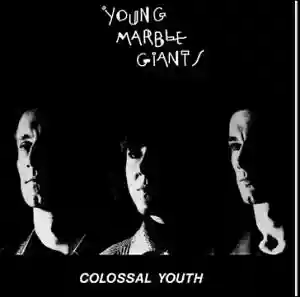
And, waiting for the needle to meet the grooves producing the unmistakable crackle, I watched the image on the large cardboard cover. An old record, a 25-year-old record.
Because at 25 years old, a record is old, right?
Indeed, ripped from the state of blissful rest in which they lie most of the time, among hundreds of their kind, the Young Marble Giants need a little time to acclimate (and I with them) once they reach the plate, in the bare rotating and crackling vinyl.
Because that poor electronic drum seems impossible, little more than a toy, with its sparse patterns.
And that bass... a sound with the year stamped on the strings, a 100% early '80s bass.
Then comes the thin, but sharp and unmistakable, line of the voice.
And I am once again in the tiny kingdom of the Young Marble Giants.
Colossal Youth, the only album from the Welsh trio, came out in 1980, the year of the Feelies’ “Crazy Rhythms”, Pere Ubu’s “Art Of Walking”, Tuxedomoon’s “Half Mute”, Talking Heads’ “Remain In Light”, and Joy Division’s “Closer.” And many others (because for the beginning of such a much-maligned decade, 1980 brought forth a lot of good things). And yet, despite such crowded competition, I always find a way to awaken them, for a few spins on the plate...
Inside are 15 songs, held together by the frugal use of sparse instrumentation (bass, guitar, organ, and the drum machine box) immersed in a suspended atmosphere where, each time, what strikes me most is the space that opens around those few elements.
As if their little songs purify the air around them, adding a special quality of surrounding silence, isolating the listener in a small box with natural reverb.
Where nothing else is needed.
Least of all the infamous “expressive urgency”.
There is no emphasis, in fact, in Alison Statton’s voice, only superficially diaphanous, but in reality softly surgical.
Capable of tracing melodic paths of apparent simplicity in which words sometimes flow even harrowing and ruthless.
And her two companions act in the same direction, with the same frugality, declining in different forms ingredients that often emerge only as evoked, in a “western” line of the bass, in the vaguely retro stride of an organ, in a mechanically pulsed rumba.
Songs constructed almost like haikus, with an average duration just over two and a half minutes. Singly different from almost everything heard in those years, and still unique today.
Minimal songs, I would say.
But better to clarify: I’m not referring to the musical trend often cited improperly, rather to Carver’s stories.
Who, regarding his writing, his subtractive process, used to say: “Others dig to the bone, I try to reach the marrow.”
Someone else, around the web, has used the term “stripped down” about their songs.
It sounds a bit brutal, too aggressive.
Far from the gentle nature of these microscopic giants.
I gladly leave it to you to choose the most suitable adjective, along with a handful of samples pulled from the CD, to draw some fleeting impression.
Yes, because though I may not be as young as old Lou, I thought it wasn’t a bad idea to also get the CD version, printed in 1994 by “Les Disques du Crepuscule.” Which naturally contains the proverbial bonus tracks.
Perhaps they will find a place in someone’s pocket among thousands of others, compressed in some diabolical format.
For me, tonight, the 15 original little stories are enough.
Not a second more, not a crackle less.
Served fresh and clear as ever.
On the plate.
Loading comments slowly
Summary by Bot
This review celebrates Young Marble Giants' sole 1980 album Colossal Youth, highlighting its minimalist instrumentation and Alison Statton's distinctive vocal style. The author contrasts the nostalgia of vinyl with modern digital convenience, appreciating the album's unique, sparse sound and atmospheric quality. The album's 15 short tracks create a quiet but powerful listening experience that remains compelling decades later.Tracklist Lyrics Videos
