
 •
Rating:
•
Rating:
THE REVIEW
Matthew Hopkins was a “fingerman”, a perjurer. Between 1645 and 1646, his main activity – for a generous fee from local public authorities or particularly wealthy individuals – consisted of wandering through the charming England, initiating witch trials against more or less anyone he disliked. In just 14 months of activity, aided by the sadistic John Sterne, he managed to humiliate, torture (often to death), and especially send to blaze at the stake as many as 230 unfortunate souls (more than any other snatcher in the 160 years of witch hunts that marked His Majesty's isle), earning the title of “Witchfinder General” (roughly translatable as “Neighborhood Bigwig” or “Supreme Bastard,” depending on one's point of view).
A few centuries later, in 1968, Hopkins would return to the spotlight when the good Michael Reeves would choose to dedicate one of his most famous films to him: “The Witchfinder General” (original title “Witchfinder General,” indeed: many might have seen some frames in the dreadful video for “Hopkins” by the Cathedral), where the role of the punisher is, as always, masterfully played by the much-missed Vincent Pryce. This very film would inspire, about a decade later – in the midst of the New Wave of British Heavy Metal – the name of this band, which at the time of the release of the album reviewed here, alongside the original core formed by Zeeb Parkes (vocals) and Phil Cope (guitar), included the newcomers Wolfy Trope on bass and Kid Nimble on drums.
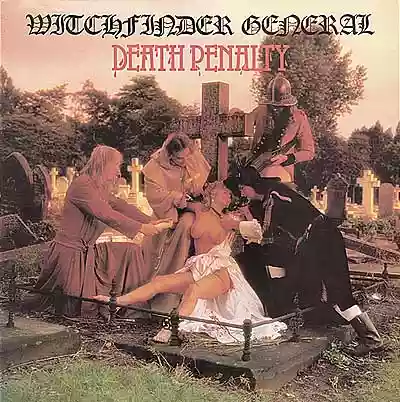
Released in 1982, “Death Penalty” (the band's first full-length, preceded only by a single - “Burning A Sinner / Satan’s Children”, released in '81 by Heavy Metal – and a 12’’ - “Soviet Invasion”), presents itself, it must be said, in the worst way. The cover, in fact, (where a buxom young lady is depicted half-naked about to be sacrificed by the band members among the tombstones of a cemetery) seems to be the creation of a mythical creature half Caravaggio, half Riccardo Schicchi who started playing with the contrast button on a remote control…
Fortunately, however, what strikes most about Witchfinder General, in the varied maelstrom of NWOBHM, is not so much the themes or that kind of “proto-satanic metal iconography” (which nonetheless characterized a good part of the bands of the movement, think of Angel Witch or Witchfynde) as a precise stylistic and compositional choice: to enhance the energy and “drive” of the New Wave by putting them at the service – sometimes, it must be said, in an overly audacious manner – of the sound and dark and gothic atmospheres of the early Black Sabbath. Just like in the Ozzy era albums, here too the winning formula is represented by the constant interplay of paranoia and boundless sweetness of the melodies, of captivating blues and looming distortions, subterranean tunings, and soothing arpeggios. Yet, if on one hand, the central break of the opener “Invisible Hate” is almost a half-plagiarism of “War Pigs”, and if the concluding “R.I.P.” is perhaps too much a mishmash of Black Sabbath canons (ending up mimicking their style in every aspect of the composition: from the riffing to the arrangements, from the drumming breaks to the accelerations, to the vocal lines), on the other, “Death Penalty” does not limit itself to being a deplorable mimicking, a banal settling into the groove already carved by the masters.
The NWOBHM intervenes to make the sound nastier, the incursions into psychedelia, which systematically peeked through while Iommi and colleagues were busy reinventing rock, give way to a greater aggressiveness born of the times and places in which this album came to light. The “jammish” episodes like “Rat Salad” are missing, the blues swells to now marry a more typically metal/hard rock flavor (as in the decidedly catchy “No Stayer”, in the heavy-oriented solo of “Burning A Sinner”, or in the accelerations of “Invisible Hate”), now with the progress of sounds that plunge into the abyss of doom (as in the title track). In short, not a true and proper reissue of Sabbathian canons, but an update, an attempt to refresh, through the union with the more typically heavy approach characteristic of the NW.
Parkes himself wisely decides not to engage in a futile pursuit of the pre-prostatitis Ozzy's sonic heights. The choice falls on a vocal style perhaps less hypnotic, less original, and versatile (and the linearity of the compositions certainly doesn't help), but undoubtedly heartfelt and effective. The result, it must be said, while far from being a dissatisfying product, ends up never making one shout a miracle. The feeling, then, is that what is missing is a “hit”, the song that stands out more than the others, the one that will make the band remembered even by those unfamiliar with their discography (just for comparison, an “Angel Witch” from Angel Witch on 'Angel Witch' is missing…!), with the only exception, perhaps, of the track that bears the band's name: undoubtedly among the best-achieved episodes of the whole package. All the compositions settle on unquestionably good levels, but certainly not exhilarating. The whole record lending itself a bit to inevitable criticisms of lack of originality does the rest.
So, we are not in front of a masterpiece, a crucial or innovative album. The temptation to reduce it superficially to a mere rehash of the proto-doom canons of the Birmingham quartet is strong and understandable. Yet, this album must be recognized for representing a bridge, a link, a connecting ring that, together with other little-known but very valid bands (above all the Quartz), would have ferried a genre and a style to the present day.
Loading comments slowly
Summary by Bot
Witchfinder General's debut album Death Penalty (1982) draws heavily on Black Sabbath's doom metal style fused with the energy of the New Wave of British Heavy Metal. While its cover art is criticized, the album stands out for its raw, gothic atmosphere and solid compositions. It lacks a breakthrough hit but serves as an important bridge in the evolution of heavy metal. The vocals are heartfelt, and the sound is an effective update to proto-doom canons.Tracklist Lyrics Videos
Witchfinder General
Witchfinder General are an English New Wave of British Heavy Metal band from Stourbridge, noted for combining NWOBHM energy with doom-laden, Black Sabbath-influenced atmospheres. Key albums reviewed here are Death Penalty (1982) and Friends Of Hell (1983).02 Reviews
