
 •
Rating:
•
Rating:
THE REVIEW
This British formation is known to music enthusiasts mainly thanks to their third album "Argus", which in distant 1972 forcefully imposed their moderate, melodic, and hyper-guitar rock into international charts, propelling the quartet towards a fleeting stint in the "premier league" of the big bands of the era, soon followed by a "relegation" to more modest, yet dignified and deserving, horizons.
Ten years and a full eight records lie between the aforementioned 1972 exploit and this work, of decent but not comparable success at the time. But for those who have an ear for Wishbone Ash's most typical sounds and tones, namely a mix of blues and folk with occasional progressive forays, all hardened by rock but without exaggeration, well, "Twin Barrels Burning" sounds decidedly foreign... You have to be an expert in the group's affairs to grasp the few common nuances (some harmonized twin guitar solo phrases, the high-pitched and somewhat raspy vocal tone of guitarist Andy Powell...).
The matter should be framed this way: after the considerable success wave of the early seventies, the group began discussing and then arguing over the reasons for their commercial downsizing, finally focusing on the figure of bassist/singer Martin Turner, truthfully nothing special both as a frontman and as a bassist. The solution seemed to have been found by replacing him with the famous John Wetton (Family, King Crimson, Uriah Heep, Roxy Music, UK in his prestigious curriculum back then) but for some reason, it didn’t work. Ironically, those songs that Wetton had vainly proposed to Wishbone Ash would later meet an incredible (and unjustified, in my opinion) commercial boom once realized by John with a brand-new formation: Asia.
With Wetton gone, finally here comes a bassist who doesn't sing solo but "pulls" fiercely on his instrument, that Trevor Bolder who had cut his teeth in Spiders from Mars, David Bowie's glam band. But the decisive move for the definitive focus of this work is the bold shift of singing duties in favor of guitarist Laurie Wisefield, who joined the formation since 1975 but had been underused as a frontman until then. Laurie has a voice not exceptional but in any case three times more gritty and determined than anyone else who had taken on this challenge in Wishbone Ash before him... thus able to confront, or rather primarily contribute to forging the new '80s style for this band: hard rock. Melodic and captivating, but hard.
Therefore, the rhythms stiffen, the tonal passages become rarer, the progressive and folk allowances are absent, no more lingering on the house specialty i.e. harmonized games of the twin lead guitar. Songs all of three, maximum four minutes, compact rhythm, more accentuated distortions, Wisefield giving his best to bawl out the verses and then immediately the opening of the refrain, stentorian, accessible, with open choruses. The album contains nine songs all made like this, immediate and catchy, effective even if not free of flaws (the '80s sound is unfortunate in itself, as the prevailing philosophy in productions: too much compression, too many reverbs).
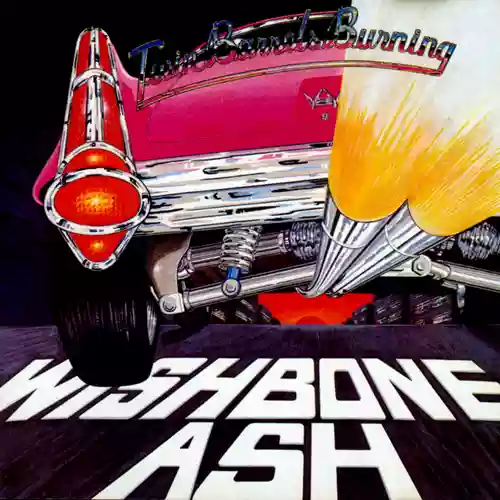
The album is extremely appealing, very successful when considering it does not seek depth and personality, but rather immediacy and simplicity. Even the cover betrays the attempt to shake off any reluctance to sophistication and snobbery in favor of the popular and (moderately) catchy in the heavy field.
These rock efforts, inaugurated in this work, would continue for another couple of albums, then the formation would throw in the towel (Wisefield would become the trusted guitarist for Tina Turner, then for Joe Cocker), to then reunite in the nineties, but at that point only as a nostalgia operation resurrecting components, music, tones, and the initial seventies approach.
Loading comments slowly
Summary by Bot
Wishbone Ash's 'Twin Barrels Burning' marks a significant shift from their 1970s melodic rock to a harder, more immediate 1980s hard rock style. Featuring gritty vocals by Laurie Wisefield and a powerful bass presence by Trevor Bolder, this album delivers compact, catchy songs that focus on raw energy over complexity. Though some production choices reflect typical 80s excesses, the album remains appealing for fans seeking straightforward rock. It captures a transitional phase in the band's long career.Tracklist Videos
Wishbone Ash
Wishbone Ash are an English rock band formed in 1969, widely associated with twin-lead guitar harmonies and melodic hard rock with blues, folk, and progressive elements. They broke through internationally with the 1972 album "Argus" and have continued to record and tour for decades, with guitarist Andy Powell as the long-standing central member.23 Reviews
