
 •
Rating:
•
Rating:
THE REVIEW
Once upon a time, there was New Hollywood. Once upon a time, there was a group of American directors who, borrowing the "revolutionary" realism of the French Nouvelle Vague (itself indebted to European neorealism), managed to produce a multitude of titles destined to enter history, to overturn conventions, styles, genres: Arthur Penn showcased the new female sexuality in "Gangster Story" (1967), Hopper celebrated the triumph and death of counterculture in "Easy Rider" (1969), Coppola magnified his authorship in the two episodes of "The Godfather" (1972, 1974) before filming the low-budget gem "The Conversation" (1974), Scorsese brought to the screen the disillusionment and collapse of a generation with "Taxi Driver" (1976). Numerous names influenced and marked the period from the late '60s to the late '70s: Allen, Altman, De Palma, Hellman, Nichols, Forman, Polanski, the early "period" of authors like Malick and Michael Cimino, besides the two who, in the opinion of this writer, effectively ended NH (even though they were exponents of it) namely George Lucas and Steven Spielberg. Many others, too many, deserve to be mentioned.
William Friedkin is another name of the Hollywood "new wave" who managed to etch into the history of cinema two of the most important titles of the '70s: "The French Connection" (1971) and "The Exorcist" (1973). After these two successes, Friedkin never again reached those levels, although there were films of absolute significance such as "Cruising" (1980) and "To Live and Die in L.A." (1985). His career then slowly descended into quite inexplicable oblivion for someone of his talent, from which the last "Killer Joe" is to be saved.
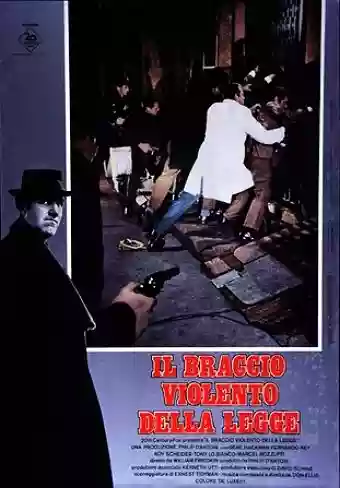
"The French Connection" was Friedkin's first public and critical success. A police film with a decidedly sparse plot: two policemen (Gene Hackman and Roy Scheider) are on the trail of a heroin shipment coming from Marseille, France. There are no other noteworthy subplots because Friedkin bases his entire film on the hyper-realistic pursuit of the mobsters involved in the operation.
The greatness of Friedkin's work lies in the innovative use of the camera to innovate within the genre as well: the good/evil, law/crime dichotomy, which has always been one of the narrative pivots of American cinema, is here annihilated by Friedkin, who places the various characters on the same level. There is no sense of justice in Jimmy's (Hackman) choices. There is no law that holds in that "asphalt jungle" of which John Huston had already narrated the brutality. We are in America disrupted by Vietnam, drugs (again "Easy Rider"), depersonalization. Ethical and moral solidities are dismissed, and everyone shows themselves for what they are: resentful, angry individuals lacking a real moral retro-culture. In Friedkin's vision, there is no difference between the hunter (the law) and the hunted (the criminals). They are each other and vice versa, and the very dark, explosive, and admonitory finale seems to be the ultimate climax of the pessimism that Friedkin harbors towards humankind.
Parallel to this elimination of "categories," the Chicago filmmaker has constructed the film with technical mastery to be taught to posterity. The camera follows the protagonists, tracks them with lateral and frontal tracking shots, and the impressive editing work by Greenberg (awarded with an Oscar) makes it one of the most extraordinary episodes of the period. Every single editing cut perfectly renders the timing of tailings, chases, and shootouts. The viewer is there, alongside the characters, immersed in Friedkin's realism. A direction that becomes invisible but is extremely complex and functional, so much so that its influence is easily traceable in other great names that have passed through Friedkin and this film: from Scorsese to Michael Mann to Tarantino.
In its icy coldness (praise be to Roizman in cinematography), "The French Connection" is a title that has made history and has contributed to (re)innovating the police genre. The clinical lucidity of Friedkin's probing eye delves into the recesses of man, lost in a labyrinthine, aseptic, and leaden New York. One of the most important, real, and heartfelt snapshots in the history of the police genre.
Loading comments slowly
Summary by Bot
William Friedkin’s The French Connection marked a milestone in New Hollywood cinema, innovating the police genre through stark realism and technical mastery. The film dismantles traditional good vs. evil narratives, reflecting the fractured moral landscape of 1970s America. Its groundbreaking camera work and editing have influenced many great filmmakers. Friedkin’s portrayal of a brutal and complex urban environment remains powerful and relevant.
William Friedkin
William Friedkin (1935–2023) was an American film director associated with the New Hollywood era, widely known for directing The French Connection (1971) and The Exorcist (1973).12 Reviews
Other reviews
By Stanlio
"I don’t believe it would win any Oscars today, despite the dynamic direction by William David Friedkin."
"Gene Hackman’s skill is undisputable; he even overshadows other equally excellent actors."
By JpLoyRow2
Friedkin is a top-notch director, and the alternation of highly-paced scenes with moments of dialogue is mixed in an exemplary way.
It was a triumphant success and won 5 Oscars (Best Picture, Director, Leading Actor, Adapted Screenplay, Editing) and created a path that many would follow with varying success.
