
 •
Rating:
•
Rating:
THE REVIEW
They tell me: "You'll have to wait a month to get it" - I say: "Ok."
A month later, the imported disc arrives at my home. I remove the annoying ultra-adhesive tab typical of imported CDs and open the case. I put the disc in the stereo and imagine scenes from the movie.
I'm talking about the soundtrack of 'To Live and Die in L.A.,' created by Wang Chung and released by Geffen Goldline Records in 1985.
Do you remember Wang Chung? 'Dance Hall Days,' the legendary hit anthem in pure '80s style.
'To Live and Die in L.A.,' do you remember it? Willem Dafoe, John Turturro, in a detective story that definitively set the standards for the genre.
You've probably seen it over and over again, but it's not the film that I want to talk about.
Wang Chung made this album as the third of their career, reaching the 41st place on the US Billboard Hot 100 in 1985.
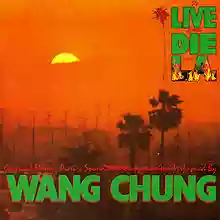
Starting from the artwork on the cover and back, it's almost impossible not to be intrigued. From the tracklist, we notice there are too few tracks for a soundtrack of a rather lengthy film. We like the title track; it gives us that lighthearted and carefree new wave taste that frames the introductory shots of Los Angeles.
The second track, 'Lullaby,' is a sappy pop hit that probably, if sung in Neapolitan, would cause us pain, but as it is, we accept it gladly.
'Wake Up, Stop Dreaming' is the epitome of the perfect song for every action film. Just as 'Angel of the City' by Robert Tepper in 'Cobra' with Stallone and 'On My Own Alone' by Stan Bush in 'Bloodsport' with Van Damme, here we have 'Wake Up, Stop Dreaming.' Pulsing, with a synth-bass riding the waves and an oriental melody, it can't help but move us when associated with Friedkin's film images. Perhaps listening to it separately from the film doesn't give the same feeling, but it certainly doesn't lose its power.
The vocals in 'Wait' duet with keyboards and bass in a fast car chase on the L.A. highways, while 'Black Blue White' naturally continues the chase with more pressing tones. The frenzy, the rhythm, the speed are the main matrices of the soundtrack, essentials for an engaging effect and a good parallel between image and sound, in constant dialogue.
The advice is to listen to this album in the car, with the risk of pressing the accelerator too hard due to identifying with the protagonists.
If you were to listen to it at home, I couldn't tell you the best time of day to put it in the stereo. Probably, looking at the cover again, I'd say at sunset.
Personally, I've never regretted the purchase. As a lover of album covers, just looking at it from the outside makes me believe it was a good deal.
Maybe someday I'll frame it, next to the movie and the poster.
Loading comments slowly
Summary by Bot
The review highlights Wang Chung’s 1985 soundtrack for the film To Live and Die in L.A., emphasizing its 80s new wave style and cinematic feel. Despite a relatively short tracklist, the album effectively captures the movie’s fast-paced action and atmosphere. The reviewer recommends listening especially during car rides or at sunset, appreciating both the music and the album’s aesthetic value.Tracklist Lyrics
Wang Chung
British new wave band formed in 1980, best known for 1980s hits such as 'Dance Hall Days' and 'Everybody Have Fun Tonight'.01 Reviews
