
 •
Rating:
•
Rating:
THE REVIEW
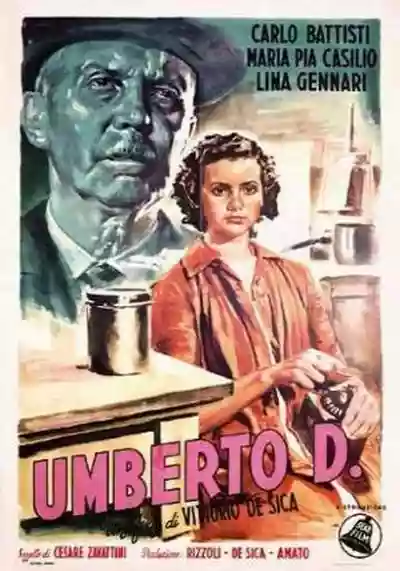
In 1952, Vittorio De Sica had to endure harsh criticism from the then Undersecretary of Entertainment, Giulio Andreotti, for the production of the film Umberto D. (written and scripted by Cesare Zavattini). De Sica's fault was that he gave a wrong representation of Italy abroad and had rendered "a poor service to his own country." Not denying the existence of evil, Divo Giulio essentially proposed to wash dirty laundry in private, miserably turning a blind eye to the human tragedies of the young Republic.
Fortunately, neither De Sica nor other Italian directors paid the slightest attention to this judgment, and Umberto D. can be calmly recognized as a masterpiece of neorealism and a treasure of world cinema, although the director had to deal with poor audience reaction, but not critical.
The clarity with which De Sica outlines the life of Umberdo Domenico Ferrari (played by professor and linguist Carlo Battisti, in his only cinematic performance), a former official of the Ministry of Public Works now retired and dealing with economic difficulties and debts with his landlady, shows us a part of Italy that wasn’t working, without rhetorical or sentimental flourishes. Umberto D. is a cultured, educated, and deeply intelligent person, but above all endowed with an indomitable dignity and a keen sense of humanity, evident in his friendship with the only two beings who show him genuine affection: his inseparable little dog Flaik and Maria (played by Maria Pia Casillo), the pregnant maid uncertain whether her true father is a Florentine or a Neapolitan soldier (another sad chapter of Italian society of the time briefly sketched, but which could form an autonomous and separate film). When this clarity is combined with an undeniable technical mastery and a particularly well-chosen aesthetic, Umberto D. ultimately becomes a bare and harsh film, where the director's eye serves only as a means of communication between the narrative and the spectator. An eye constantly present, especially in small daily actions, yet perpetually detached and impartial, although it offers a naturally alternative interpretation to the public perception of the time, with little regard for Andreotti the censor.
Vittorio De Sica offers a bitter but not apocalyptic scenario, thanks to the disorientation he reserves for the viewer at the end. A fundamental bitterness that, however, manages to make room for positive feelings and sensations, which comfort the audience that at the same time must remain insensitive to a tragedy—in terms of human lives—that did not occur. De Sica's message can be defined as a warning: today, the character of Umberto D., combined with benevolent fate, has averted the worst, but if things do not improve, tomorrow what no one would want could happen.
Umberto D. represents a cinema lesson that could, indeed can and must, still be relevant today: a warning for cinema that must not bow to the padded and sparkling reality promoted especially by local television. A film, in practice, that safeguards and stirs our social conscience.
Loading comments slowly
Summary by Bot
Vittorio De Sica's Umberto D. is a neorealist masterpiece portraying the harsh realities of postwar Italy with clarity and dignity. Despite contemporary censorship and poor audience reaction, the film remains a vital social commentary. The protagonist's struggle highlights human resilience amid economic hardship, supported by a subtle but powerful cinematic style. Umberto D. serves as a timeless warning and plea for social awareness in cinema.
Vittorio de Sica
Vittorio De Sica was an Italian film director and actor, a central figure of Italian neorealism. A frequent collaborator of Cesare Zavattini, he crafted humane, socially incisive films such as Sciuscià, Ladri di biciclette, Miracolo a Milano, L'oro di Napoli, and Umberto D. His work earned international acclaim and multiple Academy Awards.07 Reviews
