
 •
Rating:
•
Rating:
THE REVIEW
Time has almost completely faded the fresco in the cloister, leaving here and there only patches of red and blue. Below, ghosts of arches and gardens. Shapes of trees are recognizable and, still blue, a peacock. Above, small alcoves lined up have each been containing the shimmer of a star for centuries. In the attic of the merchant's house, dead now for more than six hundred years, the swifts make their nest again every spring, which also this evening chirp and whirl tirelessly. Here, while the square of sky that grants us a bit of coolness darkens, someone has calmly tuned their lute and played some compositions by Capirola.
The Brescia native Vincenzo Capirola was forty or a little more when he rented a room in Venice in 1517. A few years earlier, it is said, he was a guest at the court of Henry VIII, where he played some of his lute compositions. Not much more, but perhaps this matters little, is known about his life, except that he came from a family of wealthy merchants and that therefore perhaps he composed not for profession, but only for the pleasure of composing.
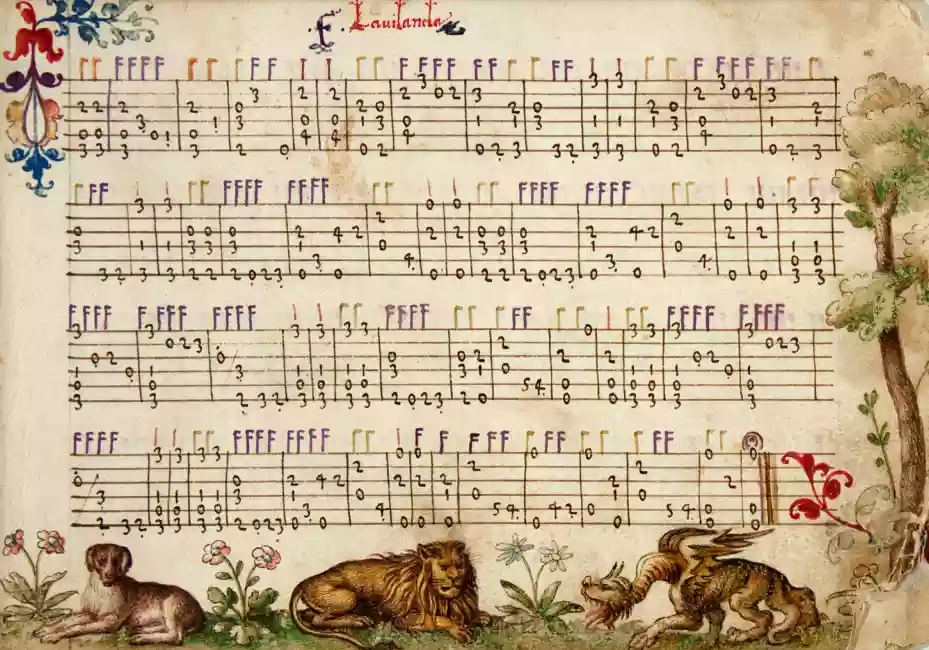
Above all, it is known that at the end of the nineteenth century a manuscript of lute compositions appeared in the antique market, finely decorated on every page with miniatures of plants and animals: it was, and is, the only copy of his compositions, which have survived by pure chance. The booklet moved from England to Florence, also passing through the hands of Leo Olschki, who had just a few years earlier founded his publishing house, and ended up at the Newberry Library of Chicago, where it has remained from 1904 to this day. But the reason these antiquarians were interested in it lies not at all in the transcribed music.
The writer of this booklet and Capirola's student, of whom we only know the name and the Venetian origin, wrote:
Considering I Vidal that many divine works have been lost through the ignorance of their owners, and desiring that this almost divine book […] be conserved perpetually, I wished to adorn it with such noble painting, so that if it arrived in the hands of someone who lacked such knowledge, it would be conserved for the beauty of the painting.
And so it has been, indeed. Only after sixty years, someone thought it wise to decipher that small booklet abandoned on a shelf of the ancient collections, perhaps more similar to a bestiary than to a score, and to transcribe it in modern notation.
And as for the music, what to say? Like the fresco in the cloister, this music remains a mystery, an allegory incapable of speaking to us. But from what little remains, from those few hints and that faded peacock, an incomprehensible candor emanates.
Loading comments slowly
Summary by Bot
The review reflects on Vincenzo Capirola's lute compositions preserved in a richly decorated 16th-century manuscript. It highlights the manuscript’s mysterious nature and its survival through centuries as both a musical and artistic artifact. Despite limited knowledge of Capirola’s life, the manuscript’s beauty and rarity continue to inspire curiosity and admiration. The music remains an enigmatic legacy, evoking an elusive historical charm.
Vincenzo Capirola
Italian Renaissance lutenist and composer from Brescia. Best known for the illuminated Capirola lutebook (early 16th century), the single surviving source of his lute compositions, held at the Newberry Library in Chicago.01 Reviews
