
 •
Rating:
•
Rating:
THE REVIEW
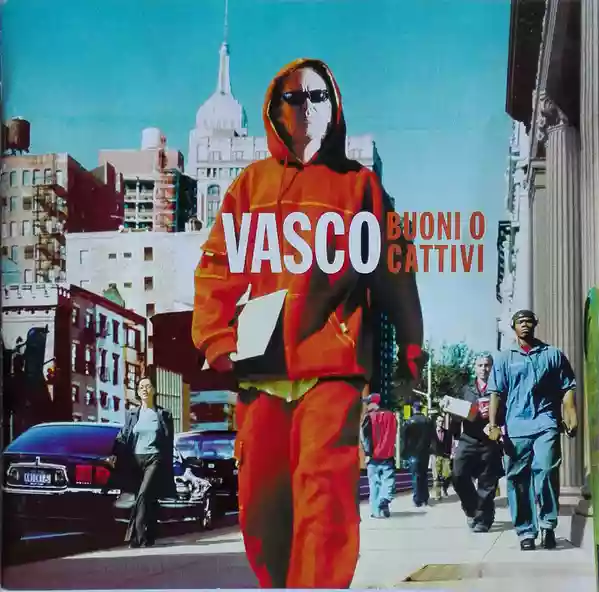
The numbers are on Vasco’s side, not mine. However, we have to look beyond the numbers. Which are these: 1,200,000 copies sold in Italy; 20,000 in Switzerland; 15 non-consecutive weeks at no.1 in the hit parade (to quote Lelio Luttazzi) and, believe it or not, the best-selling Italian album in the decade 2000-2009. You see, we should just pack it up, finish the review here and go to bed. “Buoni o cattivi”, released on April 2, 2004 (previewed a few weeks earlier at Don Ciotti’s Community), is Vasco’s longseller par excellence, even more so than “Bollicine” or “C’è chi dice no”, because it managed to sell so much—and more—at a time when record sales were already scarce, and no fewer than 5 singles were taken from it (all reaching number one, ça va sans dire).
Vasco was coming off the success of “Stupido Hotel” (2001), an already fairly mediocre album, which had actually raised his profile again after a not-so-brilliant period, at the threshold of his 50th birthday. A second youth: classic, ruthless, blessed. As usual, he records between Bologna and Los Angeles, as has been customary since “Gli spari sopra” (1993) and it’s no accident that from that album onward—the album itself anything but despicable—the quality of his output has (significantly) declined. He surrounds himself with his usual collaborators (from Tullio Ferro to Celso Valli, with Gaetano Curreri among them) and “fills”, even more than before, the album with sounds totally at odds with each other, mixing almost deafening electric guitars with string backgrounds, alternating rock songs with short-winded ballads. The sound is pure rock, as the title-track clearly shows, but in 47 minutes (finally, a good album length) there isn’t a single riff that sticks in your mind. Nothing. The only decent opening (track no. 8, “Cosa vuoi da me”) is a note-for-note copy of “Pretty Fly (for a White Guy)” by The Offspring. And no, it’s not a tribute, not a quotation, not an inspiration: it’s just copied.
The rest of the album is like going to McDonald’s. You order a Big Mac and you know exactly what you’re getting, you’re not expecting any surprises. That’s it. Everything you’ve already heard, everything already “learned”. The lyrics, moreover, are really dumb, with constant, trite rhymes like “non posso stare senza te” of course rhymed with “stai con me”—and so on, banality piled on banality, a concept repeated in at least two terribly identical songs. And then, for those who were there, you know—in those years we got brainwashed by a commercial that used the present “Come stai” (the one that “stands out from the commonplace”, whatever that means), not to mention the romantic songs, exhausting beyond all human endurance. “E...”, the lyrics were written by Maria Pia Tuccitto, Tuscan singer-songwriter, features some dreadful lines (“...E quando sento il tuo piacere che si muove lento/ho un brivido”; “...E se mordo una fragola/mordo anche te”—makes you long for “Sally”, at least there the strawberries were inedible). Let’s remain silent (better so) about “Anymore” and a string of songs that vanish into thin air after one play, including the incomprehensible “Señorita” (why is he thanking God his name isn’t Mario? And “put your hand here”, he really means there?) or the senseless mess of “Rock’n’roll show”.
The best piece comes at the end, when all hope seemed lost. “Un senso”, who doesn’t know it? No, it’s not a masterpiece and it doesn’t even make it to an eventual “vaschian” top 10, but it is good, it has its own reason for being, it has its own sound. Vasco wrote it inspired by Margaret Mazzantini’s novel “Non ti muovere” (she’s Sergio Castellitto’s wife), with music by Curreri, and the following year Castellitto would make a fine film of it starring Penélope Cruz and himself. It was announced about forty days before the album’s release and became an overwhelming success thanks to the aforementioned film, even though the record company, EMI, had gambled on the title-track as the first single. And so “Un senso” hit radio only in late December, quickly turning into a sort of “off-season” hit. Even Stadio benefitted (since Curreri revealed his authorship), so much so that their album “L’amore solubile” soared to no.3 in the hit parade.
That said, the album is bad—very bad. I’d almost dare say it’s his worst: it’s played decently but in an entirely (and dramatically) predictable way; the themes had been covered before—and better; the sense of impotence, of playing it safe, is evident from the very first track. He wanted to pamper his audience: he succeeded. But outside of the Vasco fan universe, there’s nothing.
Loading comments slowly
Summary by Bot
The review delivers a strongly negative take on Vasco Rossi's 'Buoni o cattivi'. The critic rates the album with the lowest possible score. No positive aspects are highlighted in the assessment. This underscores a sense of disappointment or frustration. Readers are warned that the album may not meet expectations.Tracklist Lyrics Videos
Vasco Rossi
Vasco Rossi is an Italian rock singer‑songwriter from Zocca (Modena), active since the late 1970s. Known as “Blasco,” he’s a central figure of Italian rock with enduring anthems and massive live shows.91 Reviews
Other reviews
By pv78
Musically, Vasco can’t give anything more because he has already given everything: melodies that straddle rock and pop, always the same.
Ethical philosophy from a Textbook and verbal pornography, this is what the album offers.
By zuckina
I want to find a sense to this life even if this life doesn’t make sense.
Tomorrow will come anyway... Feel that beautiful wind. There’s never enough time.
By DeAnonymous
He has an energy that the Rolling Stones could only dream of.
Blasco is a great Italian songwriter and you need to know him, otherwise, you all are ignorant.
By FedeHetfield
Vasco has managed to fall into a chicken coop… a place where chickens lay golden eggs, living off business rather than passion.
'Buoni o cattivi' is composed of shitty organic molecules; even the titles give cause for perplexity.
By DEMIAN
"I want to find a meaning to so many things...even if so many things don’t have a meaning...a....!"
"It’s Vasco in his purest form, singing sensations, not stories. Because you insert the story yourself, with your experiences."
