
 •
Rating:
•
Rating:
THE REVIEW
I am devoted to vinyl, to its crackling and noble sound, I sometimes lose myself watching the needle arrogantly traverse through that long hollow spiral. I love the stale and musty fragrance of the sleeves that have passed through who knows whose hands before mine; whenever I have the chance, I purchase dozens at fairs or antique markets. Recently, my attention fell on a famous multimedia buying and selling site, and having successfully completed yet another shrewd bargain, I received a package with about fifteen long plays, three of Van's "eighties" period, including "Common one" released in the summer of 1980. So, I rushed to the "fiko DeB" to try to glean some forward-looking information about it, but, disappointed and overwhelmed by a vacuum de profundis, I found not a trace of the record in question. Rich platter I dive into.
The irish-folkman, after a series of authoritative and essential works composed between his beginnings and the first half of the '70s, entered a professional crisis, during which he produced a couple of distorted records of excessively commercial caliber compared to his usual clichés. The clouded experience was brief, and in 1979 he inaugurated with "Into the music" a powerful parabola of mystical-introspective productions that led him through the eighties to a delicate search for styles of celtic and new-age origin, depriving his rise in the sales charts but earning him a place of honor in a more abstract and less conventional musical perspective, though pleasingly enjoyable.
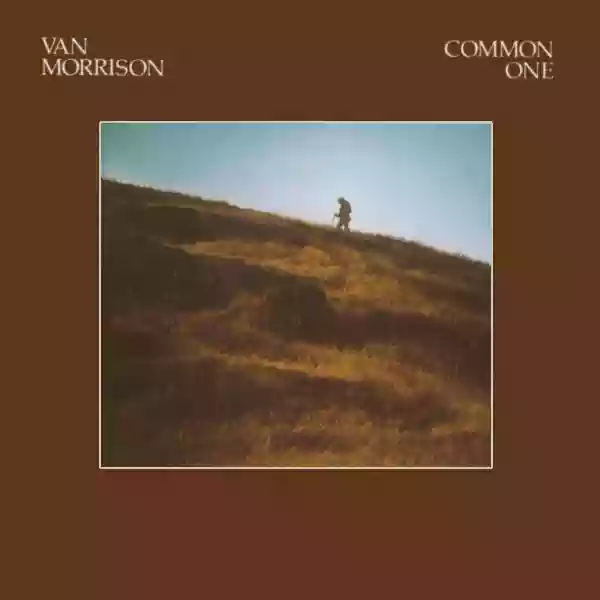
I immersed myself with extreme saturation in listening to "Common one", and was almost ecstatic by its peculiarity and let myself be captivated by some suggestive peculiarities. The first I noticed is the location of the track recordings, namely a high mountain studio located inside an ancient French monastery. This particular details Morrison's choice for an obstinate and intended isolation from any diversion, capturing this situation even on the cover depicting him as a hermit and detached, climbing a steep ascent along wild slopes, centuries away from urban contemporaneity. The sensation that arises from the opening track "Haunts of ancient peace" is that of a caress, a light breeze, the bass is soft, the guitars harmonious, the winds gentle, and the voice accompanies the listener with drowsiness on a journey along the archaic search for peace. The second "oddity" is the six tracks, a meager number compared to previous productions, two of which have an exhaustive duration of a quarter of an hour each (oddity number three): "Summertime in England" is the first of the two extended tracks, one of the fundamental pieces of his repertoire, filled with lush brightness and a generous rhythm, it momentarily separates from the calm spiral, enhancing the enchanting British rural setting with an encyclopedic text and evoking his cultural passions, so that the surrounding landscape tends to romantically color with the dreamlike essences of Joyce, Wordsworth, Eliot, Blake, Yeats, and Coleridge, unraveling the background in a jubilation of jovial silence. The itinerary continues with "Satisfied", "Wild honey" (opening the second side), and "Spirit", breaking away entirely from superficiality and soberly embracing a chain of arguments full of sweet desolation and moral redemption. The tracks are dressed with veils of organ and piano, still at the mercy of elegant trumpets, gentle horns, and delicate saxophones, solemnly led by Mark Isham and Pee Wee Ellis. The finale introduces "When hearts in open", enveloping the mind with a seductive hypnosis; it is the other powerfully extended track with the task of obstructing the paths of perdition and torment, granting a quarter of an hour of pure relief. The heart is open while the circle closes.
Van giant and transcendental, presenting a complex, deep, versatile record, stubbornly and intelligently extreme compared to the previous and subsequent ones, not inferior for this reason, but clearly imposing, cathartic, and rich with an ineluctable charm. Invaluable and granite work by a Morrison not yet melodically open and not yet dedicated to the aid of "synthetic" nuances of keyboards and electronics, which with accuracy and usability will accompany the following works throughout the just birthed decade.
Loading comments slowly
Summary by Bot
Van Morrison's 'Common One' stands out as a mystical and introspective album recorded in isolation in a French monastery. The album features only six tracks, including two extended pieces that evoke literary and pastoral themes. With lush instrumentation by notable musicians, it marks a deep, cathartic, and complex phase in Morrison’s career. The review praises its unique charm and artistic depth, distinguishing it from his more commercial works.
Van Morrison
Van Morrison (born George Ivan Morrison) is a Northern Irish singer-songwriter and musician known for blending rock, folk, blues, jazz and soul across a long career beginning in the 1960s.34 Reviews
