
 •
Rating:
•
Rating:
THE REVIEW
Reaching their fourth album of their dazzling career, the four from Pasadena had every reason to sit down and decide what to do. A screaming debut, a second album that was lackluster and less captivating, the third with some novelties that already hinted at the need not to be irretrievably bound to a standard that could become a tomb; at least for the ensemble, since His Majesty Eddie had already conquered a throne he would never descend from, even after his premature departure.
In the fourth album, synthesizers arrive, a sign that the need to experiment, contaminate, and especially transgress is truly pressing. But the writing of the songs does not deviate much from the tried-and-tested formula that the fans of the first hour now love unconditionally. "Fair warning" was an enigmatic chapter in the band's career and also a turning point more in concept than in the music per se. Van Halen was a brand name popular worldwide and received acclaim even from rockers who dabbled little in true metal. Furthermore, Van Halen was never an out-and-out metal group. Already in the first LP, they winked at the golden age of rock'n'roll with illustrious covers and alternated the most explosive and angry moments (On fire, Atomic punk) with sharp ballads full of polyphonic harmonies inspired by the Beach Boys (Feel your love tonight, Jamie's Crying). Even "Women and children first" was full of fun temptations and departures from the proper hard line, giving space to Eddie's guitar virtuosity and Dave's vocal prowess without worrying that purists might turn up their noses (Could this be magic).
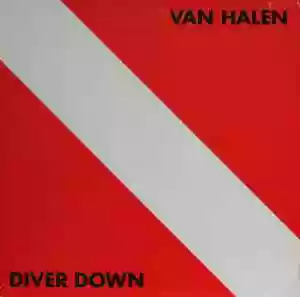
When the minimalist cover of "Diver down" hit the market and everyone took a look at the tracklist, the nose-turning was certainly significant. Half the album consisted of covers, not all that rock, to be honest. Other tributes to the golden age of R'N'R with Roy Orbison leading the way (the famous and incensed version of "Pretty woman" was a hit on radio stations worldwide) and then Ray Davies and Marvin Gaye among the authors pulled from the hat of History. Pure swing invasions with Papa Van Halen guesting on clarinet, a cappella divertissements at the end, and then a scattering of contaminations ranging from flamenco to electronics, carrying forward a discussion already started with the previous two albums more heterogeneously but also more coherently.
Certainly, those expecting a resurgence of harshness from the Californian quartet by glancing at a metal scene that was evolving brutally thanks to the thrash and speed wave mounting… well, they surely were disappointed or at least perplexed. Alex uses brushes in the swing piece (rightly so), and Dave chuckles cheerfully because he lives the spirit of rock'n'roll without the self-referential seriousness that many felt was obligatory. Van Halen were a band that had fun. They went on tour and held the stage with a circus rock show firmly anchored on Eddie's monstrous and innovative skills. "Diver down" was indeed a divertissement. It was the clear signal of artists saying: we can't keep pushing the envelope and mire ourselves in the usual wicked-sounding riffs because of Eddie's distortion... we'll show you we can play anything, that we have a vast musical culture, that being virtuosos doesn't just mean shooting paroxysmal solos.
There have been many relentless criticisms of "Diver down," both from fans and the pros. Few seemed to understand why such a work existed. Only in hindsight, much later, did certain positions change, and the album was rightly reevaluated for a myriad of specific characteristics and because it can't be labeled. Terrible condemnations were read even based on the cover (which says a lot); a sign that the disdain for the album went beyond the desire to dig a little deeper. For the record, the white diagonal on a red field is one of the maritime signals indicating the presence of a man overboard. And here - a brilliant idea - the band demonstrated that they wanted to detach from various clichés of the rock scene they were nonetheless attached to - the heavy metal one - renouncing the metalhead poses and using different, more conceptual language. Which perfectly fit the expressive intentions the album wanted to manifest.
"1984" established the pop consecration of Van Halen, it was the inevitable prelude to the divorce from Roth, and definitively legitimized keyboards as a leading instrument, carving one of the most well-known and recognizable riffs in rock history (Jump). The commercial success of the album totally and for a long time overshadowed "Diver down," even though it was somehow indebted to it because it was a testing ground for many solutions - not just sonic - later adopted.
Much to the detractors' chagrin, I adore "Diver down," I find it a very enjoyable, singable, highly varied standalone object, and above all, courageous for having represented the coherence and artistic independence of four guys who at that time didn't want to live off their laurels.
Loading comments slowly
Summary by Bot
Van Halen's fourth album, Diver Down, marked a daring departure from pure hard rock by incorporating covers and diverse musical styles. While initially criticized, it demonstrated the band's versatility and artistic independence. The album mixes classic rock tributes with experimental elements, capturing Van Halen's playful spirit and Eddie Van Halen's virtuosity. Despite mixed fan reactions, the review celebrates Diver Down as an enjoyable and courageous piece in their discography.Tracklist Lyrics Videos
Van Halen
Van Halen was an American hard rock band formed in Pasadena, California, best known for the guitar work of Eddie Van Halen and major eras fronted by David Lee Roth and later Sammy Hagar.20 Reviews
Other reviews
By the green manalishi
Half of the album consists of poorly chosen covers, more suited to a soft music album than to a hard rock band like Van Halen.
Diver Down is as bare as its horrible cover, an album put together without ideas.
