
 •
Rating:
•
Rating:
THE REVIEW
A wonderful world.
They say.
Maybe it is, or more likely maybe not.
A wonderful appearance, at least.
So it was for Uriah Heep in nineteen seventy-four; a wonderful appearance, that of the English band, reached after a long and arduous climb made of drummers discarded like Dietorelle candies, failures at home, and journalistic torpedoes (now legendary is the article by Melissa Mills, who in '70 - among other things - went as far as to say that "Uriah Heep is ten times more boring than Jethro Tull").
For two years the band reigned in its best formation, with the talented Kerslake on drums and the late, great Gary Thain on bass.
In 1972, as the few cat-lovers who will comment on this review well know, the twins “Demons And Wizards” and “The Magician’s Birthday” were released, monstrous masterpieces that consecrated the band and wrapped them in an aura that turned them into models - perhaps never too celebrated - for a slew of genres, bands and artists in the following decades.
After another album (“Sweet Freedom”) and a live with worldwide success, proud of their unique amalgam, the five of them returned with an LP that is evidently the offspring of everything they had musically learned.
Mick Box is always the usual gnome who, as soon as he sees the wha-wha pedal among his hair, hops on it and makes his sound, although never super technical (even if he does indeed make his dirty figures), absolutely unmistakable. Lee Kerslake has great personality and effective technique that, linked to the impressive bass of Gary Thain (who said "Why"?), blends into a rhythm with a dragging gait (a shining example is the nice “I Wanna Be Free” from the album “Look At Yourself”). David Byron sings like a god, produces and drinks. The legendary Ken Hensley does everything else: he plays keyboards, the piano, the second guitar, sings, cooks, tidies up, passes the Swiffer, collects Sma points and knits golf sweaters for the others because the climate in Munich can be quite harsh.
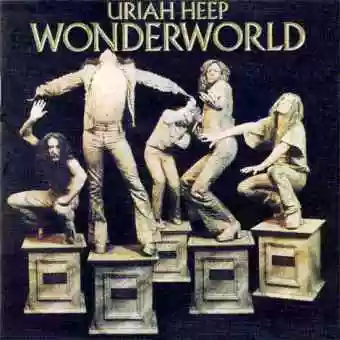
“Wonderworld” is composed of nine rather diverse tracks all in all, compared to those in the previous albums. The debut goes to the lovely title track, a song heeppian to the core: organ carpet and decisive, clean drums, backing vocals (of the choirs) and counterblows (of Byron).
“Suicidal Man” follows along the same lines, but it is Box now leading the group, and he does it using the guitar strings as if they were dental floss during the verses and then showing off with the pedal as only he knows how to. The beautiful “The Shadow And The Wind” is the usual, compelling ballad and Byron honors it with an excellent performance before involving Hensley first and then friends and family in two minutes of irresistible choruses.
“So Tired” is another driven and determined track that doesn’t leave a bitter taste, even though it’s not “Easy Livin’”, just as the delicate and pleasant “The Easy Road”, while very beautiful, is not, after all, the unreachable “Rain”. These songs in the end highlight what this LP is, that is, an excellent work with valuable tracks, where perhaps, though, part of the genius that distinguished the immortal albums of the band’s golden biennium is missing.
However, the race resumes with “Something Or Nothing”, an effective summary of the quintet’s style, with the guitar blending with the organ and then joyfully skipping in happy chords while the bass drives the herd to graze in the fields. Very nice are the six round minutes of “I Won’t Mind”: the joyful drums initially join the distorted guitar of Box and then whatever it is appropriate to join: Byron's beautiful voice (small note: to cut the head off, let’s say Byron always sings, so we avoid sterile partisan arguments and everyone is happier), Hensley's keyboards, Thain's crazy bass and company briscola; and gladly we move forward.
“We Got We” glides away with pleasure and strongly recalls the theme of the aforementioned “Why” - which, for those who don’t know, is a sort of glorious mystery of Uriah Heep, as it doesn’t appear in any official album but boasts of itself - in at least seventy-three different versions - as a bonus track almost everywhere: in CD reissues, in various compilations, in the “Do Re Ciak Gulp!” column by Mollica and “Guerrino consiglia” on Tv Parma, in addition to being distributed as an attachment to “Topolino” and publications such as the “Giornale Geotecnico”, the Ikea catalog and “La sentinella” of Lamon.
The album closes with the long and dreamy “Dreams”, where the solidity of an irreproachable rhythm is contrasted with the dreaminess of the keyboards in moments of calm interrupted by the usual wha-wha, which sometimes is a pain, if someone is asleep.
Or, rather, was sleeping.
Here, I knew it, I woke up.
The dream is interrupted.
Perhaps the idyll changes people, perhaps it’s just hard to maintain.
Perhaps it’s fate that quarrels and tragedies cast a veil of sadness over a world that seemed wonderful.
That easier road that Uriah Heep sang about was destroying good Thain, so much crap and an electric shock had no pity on him. That same deceptive road, some years later, will lead David Byron and his cursed surname into the alcoholic abyss that will kill him.
Dreams, however, do not die: dreams actually dissolve the shadow in the heart and the wind in the mind. Dreams are circles of hands, dreams are a brotherly embrace.
Soon, respectful and still enthusiastic, Uriah Heep returned to Fantasy and left behind the now corrupted world.
Since then, they have never returned.
Mick still hops on that pedal today, and those who sleep cannot but wake up.
Loading comments slowly
Summary by Bot
Uriah Heep's 1974 album Wonderworld reflects the band's unique blend of classic and progressive rock, showcasing their musical evolution after a successful golden period. The review highlights the solid performances of key members like Mick Box and David Byron, while noting that the album, though excellent, slightly lacks some of the genius of earlier works. Personal reflections on the band's struggles and losses add emotional depth. Ultimately, Wonderworld remains a cherished, diverse album in Uriah Heep's catalog.Tracklist Lyrics Videos
Uriah Heep
English rock band formed in 1969, led by guitarist Mick Box; notable for 1970s hard/progressive albums, Hammond-driven arrangements and close vocal harmonies. Continued recording and touring across decades with multiple lineup changes.32 Reviews
