
 •
Rating:
•
Rating:
THE REVIEW
Serendipity. A word that cyclically appears in my life. Unexpectedly finding something while looking for something else, in a few words, a positive coincidence.
A glance at the desk calendar contradicts what I see beyond the glass; February 2010 is almost over.
I search through the disordered pile of CDs for something reflective, preferably instrumental, to accompany me and the book I'm about to start reading.
Then my gaze collides with the slightly more organized pile of vinyls. From the stack emerges a double album with a somewhat anonymous cover compared to the others, like those bound volumes of certain encyclopedias I've never opened.
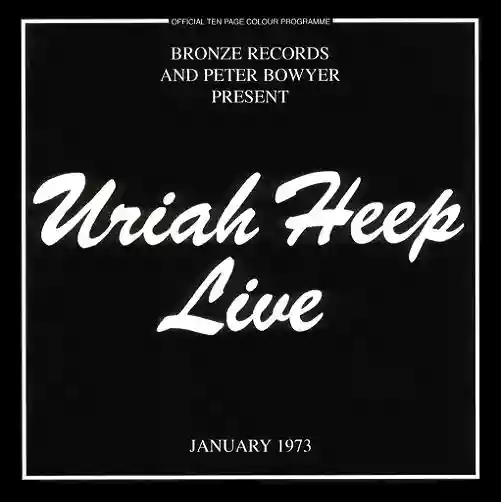
The simple inscription says it all: "Uriah Heep Live January 1973". It can't help but catch your eye given the completely black color chosen by the band for this first live album. Black for mourning, I think.
Nothing to do with the more famous and celebrated black album by AC/DC, but another glance at the calendar reminds me that 25 years ago, a unique and influential character left this world: David Byron.
I wasn't wrong, but I certainly couldn't have imagined that in exactly three days (February 28, to be precise), it will be the 25th anniversary of that tragic event.
25, a round number. The few lines I jot down spontaneously are my personal tribute to him, to the songs written with the Heep, and obviously to his unique way of singing and interpreting a written text (by the way, I highly recommend reading the translations of the lyrics he wrote with Ken Hensley to understand their visionary/melancholic depth). I won't dwell unnecessarily on praises about the album; there’s little to say. The recording of the 1973 UK tour, mostly from Birmingham, was at the time considered the only "rival" to the masterpiece of live rock albums, known as "Made In Japan". The only one that could come close to what the fellow Purples had done a few months earlier.
Here, there is only one part of the two-hour concert the group held in those years, with a particular preference for tracks from "Look At Yourself".
It seems almost superfluous to mention its content, as there is an abundance of insights that could emerge, and I don't have all that time. The long versions of "Gypsy" (where finally Lee "the bear" Kerslake unleashes his often restrained impulses in studio recordings) and especially of "July morning" earn the album a place of honor in any discography. A tremendous setlist and too tempting an opportunity for Ken Hensley to improvise far and wide with his organs and synthesizers, something that punctually happens. A "Tears In My Eyes" with Mick Box on fire, the devastating "Look At Yourself" blasted at insane speeds, the poetry of "Circle Of Hands" ending with Gary Thain's "incredible" bass that reaches its peak in these grooves.
The rest is pure vintage hard prog with a final medley of famous 50-'60s rock'n'roll covers featuring a theatrical Byron as the real star. A medley that even today gives a real lesson to the myriad of bands that will come after them. That is, above all, before the money, before the fame, before the show, when you take the stage, the first rule of rock'n'roll is to have fun and not take yourself too seriously.
I am absolutely sure that even for those who only know Uriah Heep for their anthem "Easy Livin'" and the immortal riff of "Gypsy", listening to this album will be a revelation. You'll understand with your own ears why every music critic in the field loves this black album.
Make it yours, knowing that you have in your hands one of the definitive rock masterpieces of the seventies.
The only recommendation I make is that it is strictly prohibited to listen to it if you don't know the original studio versions of the songs. You will rob yourself of part of the pleasure, finding yourself face to face with something new. The improvisations of all the members, the impeccable live reproduction of the polyphonic choruses (a true trademark of the band), Byron's unmistakable voice among thousands, the torrential and much rougher versions of their classics. All the essentials to give a new outfit to what you already know.
A bit like in a darkroom while you hold the snapshot that gradually takes shape, thinking about the moment you took it, fearing you got the lighting wrong or moved your arm too much. Then all of a sudden, the subject of that shot appears. And you think: yes, just as I imagined it.
For today, the book can wait on the windowsill, checking that the calendar doesn't lie. While David Byron at the end of the album lets out a "Thank you very much, good night, God bless you!", I find myself with one more certainty, no small thing these days, I already feel a bit of spring on me.
And to think I was looking for something else.
The opinion of Commendatore Bossolazzi:
More than an album, a manifesto. "July morning" above all. 5 medlars.
Loading comments slowly
Summary by Bot
This review highlights the enduring excellence of Uriah Heep’s live album recorded in January 1973. It serves as a heartfelt tribute to David Byron and praises the band's energetic live renditions, especially their improvisational skills. Emphasizing the album’s place among the greatest live rock records, it recommends familiarity with the studio originals to fully appreciate this dynamic performance. Overall, it presents the album as an essential listen for classic rock fans.
Uriah Heep
English rock band formed in 1969, led by guitarist Mick Box; notable for 1970s hard/progressive albums, Hammond-driven arrangements and close vocal harmonies. Continued recording and touring across decades with multiple lineup changes.32 Reviews
