
 •
Rating:
•
Rating:
THE REVIEW
Since their formation in 1969, the English band has always faced an uphill road. Their emergence in the wake of other realities such as Led Zeppelin and Deep Purple inevitably made them less known, despite deserving the same recognition as the aforementioned bands. Added to this was the tedium of critics who, from the very beginning, destroyed them, relegating them to the margins of the European and world rock scene. The masterpieces of the early years were not enough to convince the detractors. For this reason, the albums that came after 1972, after "The Magician's Birthday," had the even more complex task of saving face for a band that courageously continued its journey, also producing good quality works like "Wonderworld" and especially "Firefly."
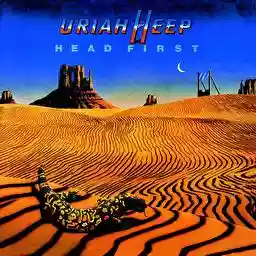
The initial difficulties the band carried with them for a long time culminated in 1980 with the departure of the keyboardist and mastermind of the group Ken Hensley, followed by the departures of other band members: singer John Lawton and drummer Lee Kerslake bid farewell to the only remaining leader, that Mick Box who still stands today as the historical flag bearer of Uriah Heep. Thus, after the release of the barely sufficient "Abominog" in 1982, the five band members returned to the studio to give birth to the fifteenth chapter of their long musical life: a year after "Abominog," "Head First" was released, with the very challenging task of not making fans miss the early days of Uriah Heep and at the same time redeem the recent lackluster releases.
The album in question, however, confirms the hesitations of recent times: "Conquest" and "Abominog" did not excite, seen as good rock albums from a band that had churned out absolute masterpieces. On this path also lies "Head First," opened by the electric charge of the splendid "The Other Side of Midnight", followed by the effective pop/rock of "Stay on Top". Two songs that, along with the subsequent "Lonely Nights" (a Bryan Adams cover), provide a more than positive start to the platter. Right from the start, we find a cohesive band that still demonstrates their musical verve: Peter Goalby behind the microphone performs his role well (albeit inferior to singers like Byron or Lawton), Mick Box emphasizes his prowess with the six strings just as Kerslake's return behind the drums is felt (his departure only impacted the "Conquest" album, where he was replaced by Chris Slade).
After a positive, charged start that raises hope, Uriah Heep return to ensnare themselves with sufficient compositions of unoriginal rock, exactly what one would not expect from a band like them. "Sweet Talk", "Love is Blind", and "Red Lights" pass by without particular excitement. That air of superficiality already felt in some previous works resurfaces, which fortunately is partly swept away by "Rollin the Rock" and "Straight Through the Heart". This does not negate that the British band has suffered greatly from internal conflicts and constant lineup disruptions, and the result is an album that is certainly adequate, but adds nothing to the career of one of the most beautiful rock realities in history.
Their fate was written even before they were born, their story seemed to have already been told. Against the criticism, difficulties, and the weight of other bands, they pursued an absolutely enviable career. "Head First" is part of this story, although it is not one of the key events.
1. "The Other Side Of Midnight" (3:55)
2. "Stay On Top" (3:35)
3. "Lonely Nights" (4:07)
4. "Sweet Talk" (3:51)
5. "Love Is Blind" (3:38)
6. "Roll Overture" (2:18)
7. "Red Lights" (2:57)
8. "Rollin The Rock" (5:31)
9. "Straight Through The Heart" (3:39)
10. "Weekend Warriors" (3:50)
Loading comments slowly
Summary by Bot
Uriah Heep's 'Head First' continues the band's struggle to regain the critical acclaim of their early years. Despite a promising start with strong tracks like 'The Other Side of Midnight' and 'Stay on Top,' the album falls into predictable rock territory. Lineup disruptions and internal conflicts are evident, resulting in a solid but uninspired record that adds little to their legacy. The band’s resilience stands out even if this album doesn’t become a defining moment.Tracklist Lyrics
Uriah Heep
English rock band formed in 1969, led by guitarist Mick Box; notable for 1970s hard/progressive albums, Hammond-driven arrangements and close vocal harmonies. Continued recording and touring across decades with multiple lineup changes.32 Reviews
