
 •
Rating:
•
Rating:
THE REVIEW
For unknown reasons, the Uriah Heep, a band that once wrote some of the most beautiful pages of British hard rock, never managed to break into the hearts of enthusiasts as much as other sacred monsters, namely the usual Led Zeppelin, Deep Purple, and Black Sabbath. Authors of gems like "Demons and Wizards" and "The Magician's Birthday", they managed, during their most interesting phase, to combine the impetuosity of hard rock with the progressive layers of Ken Hensley's keyboards, all accompanied by the charismatic voice of David Byron.
Always led by the indestructible Mick Box, a guitarist with a great taste for melody, the group has traversed, over more than four decades, an innumerable number of lineup changes, sometimes managed excellently, other times much less so. In the mid-Seventies, having lost Byron, who by then was more devoted to the bottle than the microphone and having put an end to their most popular incarnation, Ken Hensley and company brought on board John Lawton, giving life to a brief but fruitful partnership. Less flamboyant than his predecessor but evidently more reliable, Lawton would prove to be the right choice that allowed the group to continue for a few more years without major lineup upheavals.
The new era would see the London quintet move increasingly away from those hard/progressive coordinates, which had decreed their fortune, to enter territories close to AOR. Therefore, the long tracks that characterized their early albums disappear, moving toward a more melodic and impactful offering, very similar to what their fellow countrymen Rainbow would soon become protagonists of in their "American" version. The musical direction of the group, credit in hand, remains in the hands of the excellent Hensley, who finds in Lawton's vocal cords the perfect instrument to provide a worthy follow-up to the masterpieces of bygone times.
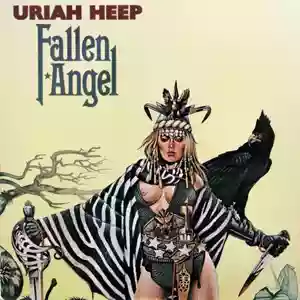
"Firefly" launches the new adventure in '77, quickly followed by "Innocent Victim". The change in direction is evident and seems to displease some, but on the other hand, refreshing their repertoire with fresher, modern tracks must have seemed vital at the time. Convinced of the stylistic shift made, Uriah Heep emerges the following year with this "Fallen Angel", which would unfortunately also turn out to be the last of this version of the group.
The lineup that had already worked on the two previous albums is fully confirmed, and the coordinates on which the album moves do not show any particular changes from the recent past. "Woman of the Night" kicks things off with an engaging track, supported by Lawton's excellent performance, while "Falling in Love" and "One More Night" fully represent the new Uriah Heep, proponents of a melodic rock of good quality. "Come Back to Me" is surely the peak of the album: Lawton's heartfelt interpretation proves to be an added advantage of an exciting and engaging track, a ballad of significant sophistication and class. The second part of the record seems to show some signs of slowing down: while "Whad'ya Say" has a good rhythm and showcases musicians in great shape, tracks like "Save It" or "Love or Nothing" do not add much to what was already proposed by the early pieces, almost giving the impression that Box and company had wisely placed the best compositions on the A-side of the vinyl. "I'm Alive" is the classic sting in the tail, a sturdy piece still featured in the band's setlists today. The eponymous track closes the album and another phase in the long history of the Heep, which seems to suffer, like much of side B, from a certain lack of ideas.
In conclusion, "Fallen Angel" is surely a good album, although, objectively, uneven, with some noteworthy tracks still performed on tour today, and others that seem to be pure fillers, uninspired and boring. Having lost a talent like Byron and with punk on the horizon, the Uriah Heep found themselves in the difficult situation of having to carry on the group within a music scene now in turmoil. The change of skin, with the shift from hard progressive to AOR, worked and would define a decade of the Londoners' production: the nostalgic criticized but stubbornly proposing a sound that had already passed its time would have been vain. After "Fallen Angel", another lineup was set up, which would last for a very short time and yield only "Conquest", in 1980, cited by many as the lowest point in the long discography of the English. The fiasco even caused a hard nut like Ken Hensley, until then the backbone of the group, to throw in the towel. The difficult task of getting Uriah Heep up and running from scratch would fall to Mick Box, by then the only survivor of the original lineup, but that's another story.
"Fallen Angel":
- Woman of the Night
- Falling in Love
- One More Night
- Put Your Lovin' on Me
- Come Back to Me
- Whad'ya Say
- Save It
- Love or Nothing
- I'm Alive
- Fallen Angel
- John Lawton, vocals
- Mick Box, guitars
- Trevor Bolder, bass
- Lee Kerslake, drums
- Ken Hensley, keyboards and guitars
Loading comments slowly
Summary by Bot
Fallen Angel marks Uriah Heep’s transition from hard progressive rock towards a more melodic AOR sound under John Lawton’s vocals. While the album features strong tracks like "Come Back to Me" and "I'm Alive," it also shows signs of unevenness and slower pacing in its latter half. The album reflects the band’s struggle to adapt in a changing musical landscape post-David Byron. Overall, it’s a solid album with notable songs but lacks the creative spark of earlier classics.Tracklist Lyrics Videos
Uriah Heep
English rock band formed in 1969, led by guitarist Mick Box; notable for 1970s hard/progressive albums, Hammond-driven arrangements and close vocal harmonies. Continued recording and touring across decades with multiple lineup changes.32 Reviews
