
 •
Rating:
•
Rating:
THE REVIEW
Having to keep a band like Uriah Heep going is probably not the easiest thing in the world: an endless number of line-up changes, world tours as if they were falling from the sky, a vast repertoire to memorize, and over forty years of rock 'n' roll history to constantly confront. Quite the hassle. Mick Box knows a thing or two about these troubles, the indestructible guitarist of the British combo since its inception, someone who, frankly, seems to have taken playing as a mission. Indeed, a saint's patience must have been required to manage the myriad chaos of the early 1980s Uriah Heep.
The era with John Lawton on vocals, which saw the British abandoning the hard progressive sound that made them famous, had ended long ago, a new line-up had been formed but the result was a near disaster. "Conquest," released in 1980, turned out to be such a flop that even a heavyweight like Ken Hensley, a classy keyboardist and excellent composer, threw in the towel and decided it was time to move on to other things. For a moment, there was even talk of bringing back David Byron, the historic voice, as the audience is always happy to see some old faces, but the idea died before it even started. End of the game? Not exactly. The good Mick then rolled up his sleeves and, in fact, restarted the band from scratch.
With the rhythm section lost along the way, the great Lee Kerslake returns to the drums, bringing with him bassist Bob Daisley, both fresh from significant experiences as session musicians for the best solo Ozzy Osbourne. The umpteenth change on the microphone sees the arrival of Peter Goalby, who would prove to be an excellent interpreter of Uriah's new direction, and on keyboards, John Sinclair, whose collaboration with Box and company would later be a good reason for him to be recruited into King Ozzy's court a few years later. An all-star line-up, therefore, for a new course that aimed to bring back a name, Uriah Heep, which seemed to have lost much of its former glory.
Musically, this new incarnation of the Britons picks up where they left off in recent years, thus cutting ties with the progressive and fantasy atmospheres of the past to rediscover themselves as authors of a robust and classy AOR.
"Too Scared To Run" is an excellent opener, fast and engaging, with a chorus seemingly written specifically to be shouted out loud during concerts. If "Chasing Shadows" confirms the good impressions of the initial track, "On The Rebound" and "Hot Night In A Cold Town" see Uriah Heep tackling covers, the first by Russ Ballard and the second by John Cougar.
As the tracks proceed, it is impossible not to notice how, even in the choice of personnel, musicians were selected who could easily embrace the choices of the group's new direction: Sinclair is not Ken Hensley and doesn't want to be; the style is entirely different but perfect for these Heep-AOR version, just as Peter Goalby, already known in the hard rock scene for a brief stint with Trapeze, is undoubtedly suitable for these melodic but impactful tracks. Other pieces that perfectly represent the new incarnation of the British are "That's The Way That It Is," still part of today's setlist, and the heartfelt "Prisoner." With "Think It Over," we could almost talk about a self-cover, as it is a track from the previous era of the band, related to the "Conquest" album period, and both authors, singer John Sloman and bassist Trevor Bolder, had both parted ways with Mick Box and company.
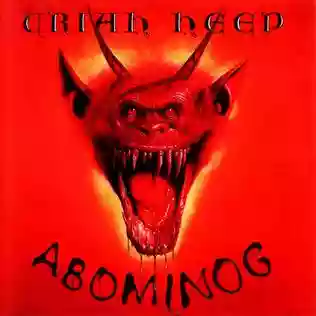
If we're being picky, it might be pointed out that the number of covers is perhaps excessive and that, even for the sake of artistic integrity, it might have been better to focus on original material rather than playing it safe by revamping tracks already tested by others, but the result each time is more than worthy and the pieces are well-reworked, making it frankly impossible to distinguish which are Mick Box's brainchildren and which are not. The overall sensation of the album is that of a commercial operation meticulously managed, from the truly chameleonic ability to leave behind the dying sounds of hard progressive and to be reborn as an AOR group, to the chosen cover image, an unsightly red-orange atrocity, but one that clearly aimed to intrigue fans of a British heavy metal scene on the rise.
In the same period, to promote the album, an EP, "Abominog Junior", was also released, which included, besides "On The Rebound," the tracks "Tin Soldier" and "Son Of A Bitch," now omnipresent bonuses of various reissues of the record.
All things considered, "Abominog" was certainly a well-done album that fully achieved its intent, namely to recreate a certain interest around a prominent group of the season but which had long seemed destined for an inevitable decline. Much like when John Lawton was on the microphone, the choice of singer certainly made a difference, managing to stabilize a group that definitely needed to maintain its lineup intact for at least two consecutive albums. "Abominog" would initiate an interesting chapter in Uriah Heep's history, perhaps less seminal than when David Byron and Ken Hensley were protagonists, but certainly deserving of attention. Not a masterpiece, but nonetheless an album to rediscover.
- Peter Goalby, vocals
- Mick Box, guitars and vocals
- John Sinclair, keyboards and vocals
- Bob Daisley, bass and vocals
- Lee Kerslake, drums
"Abominog":
- Too Scared To Run
- Chasing Shadows
- On The Rebound
- Hot Night In A Cold Town
- Running All Night (With The Lion)
- That's The Way That It Is
- Prisoner
- Hot Persuasion
- Sell Your Soul
- Think It Over
Loading comments slowly
Summary by Bot
Abominog marked a fresh start for Uriah Heep amidst numerous lineup changes and past setbacks. The album abandons their progressive roots for a solid AOR sound led by new vocalist Peter Goalby. Although featuring several covers, the well-executed songs reestablish the band’s presence in the 1980s rock scene. Not a masterpiece, but a commendable revival worth revisiting.Tracklist Lyrics Videos
Uriah Heep
English rock band formed in 1969, led by guitarist Mick Box; notable for 1970s hard/progressive albums, Hammond-driven arrangements and close vocal harmonies. Continued recording and touring across decades with multiple lineup changes.32 Reviews
Other reviews
By Roby86
"Too Scared To Run" is a furious and sharp guitar riff, almost metal, marking the song intensely.
The new 1982 arrangement of "Think It Over" transforms it into a gem and another highlight of the album.
