
 •
Rating:
•
Rating:
THE REVIEW
Me: “Do you remember the UFO?”
Someone: “Of course, but I don't believe in them!”
Me: “Don't talk nonsense, I'm talking about the English rock band!”
Someone: “Oh right! The ones who had Michael Schenker as their guitarist!”
Me: “Another nonsense, or rather, that’s true but that’s not all there is to the UFOs!”
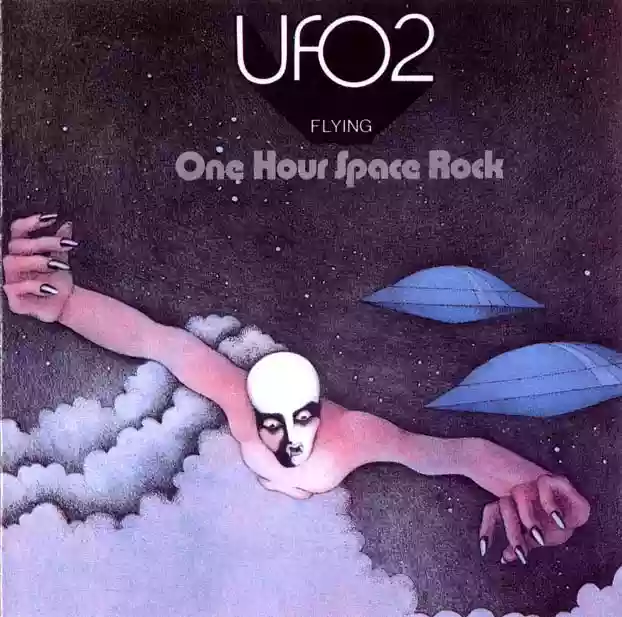
Exactly, because there was both a pre-Schenker and a post-Schenker period. Today I want to talk about the period before the arrival of the six-string phenomenon, and specifically about “Ufo 2: Flying”. It was released in 1971, and features a cover depicting an alien-man chased by two flying saucers, consistent with all the band’s unique covers. The album has veins ranging from prog to hard rock, at times it's also psychedelic and I imagine many will think: “here's the usual psychedelic album of those years, if I have to listen to something psychedelic, I'll put on a Pink Floyd CD”, but it’s not exactly like that.
The sound of this album is very peculiar, it's called space-rock and the first time I thought: “what the hell is this space-rock?”, because to be honest, until discovering UFO I didn't even know there was a genre called that. To understand exactly what I’m getting into I have to wait until track number two “Star Storm”, a piece of almost 19 minutes that has the merit of changing a lot as the minutes pass, thus managing not to be boring. In fact, there comes a point (about halfway through the song) where you fall into a sort of trance, thanks to these sounds that I would define precisely as “space,” or even better “UFO-like.”
The other standout track of the album is the title-track, the fifth and last track, also with a not-so-radio-friendly duration since we're talking about almost half an hour. “Flying” nonetheless is not a song like the previous one that leads to a tourniquet and heated spoon (to return to the “trance” discourse), but it is slightly more pressing in rhythm thanks to the many dialogues that occur between Phil Mogg on vocals and Mick Bolton on lead guitar. Phil is in better shape than ever, fantastic and seductive voice, while Mick on guitar is phenomenal, not exactly a master of technique but still managing to amaze with his creativity in accompanying the entire piece for over 26 minutes with riffs, arpeggios, and solos. To better convey the idea, I'll say it's a very Sabbath-like piece.
The other three missing tracks are: "Silver Bird", "Prince Kajuku", and "The Coming of Prince Kajuku", with obviously shorter durations compared to the other two and also with different rhythms, much more consistent with the hard-rock of the era. From what can be inferred, it’s not an album you can play in the car to go shopping ten kilometers away, but instead, it is certainly quite demanding given the duration and the compactness of the two main tracks, but I don't think you'll regret using 60 minutes of your life for this after listening.
Try to believe...
Loading comments slowly
Summary by Bot
This review highlights the underappreciated pre-Schenker phase of English rock band UFO, focusing on their 1971 album 'UFO 2: Flying.' It explores the album's unique space-rock sound, blending prog and hard rock with psychedelic elements. The reviewer praises lengthy standout tracks 'Star Storm' and 'Flying' for their creativity and immersive experience. Despite its demanding nature and length, the album is recommended as a rewarding listen for fans of classic rock and experimental genres.
UFO
UFO are a British hard rock band formed in London in 1968 by Phil Mogg, Pete Way, Andy Parker and Mick Bolton. Their 1970s run with guitarist Michael Schenker—spanning Phenomenon, Force It and Lights Out—helped bridge space/blues roots to melodic hard rock and influenced the coming heavy metal generation. Signature cuts include “Doctor Doctor” and “Rock Bottom,” and the live Strangers in the Night (1979) is widely acclaimed.10 Reviews
