
 •
Rating:
•
Rating:
THE REVIEW
UFOs are remembered more for having guitarist Michael Schenker from the Scorpions in their lineup than for what they did in the early period of their life, around 1970. The British public took several years, if ever, to notice this extraordinary heavy-rock band.
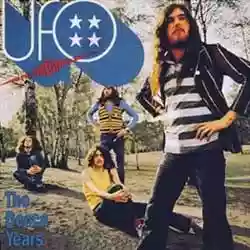
The material included in this collection encompasses everything the band produced with Beacon/Decca following the contract with record producer Noel Moore, and it was almost completely ignored in their native country. Despite this detached attitude at home, UFOs literally invaded the music market in Japan and Germany, scoring a series of unexpected successes.
The band originated in the late 60s when vocalist Phill Mogg, bassist Pete Way, and guitarist Mick Bolton played in London under the name Hocus Pocus; after recruiting drummer Andy Parker, they changed their name to UFO.
The first fruits were gathered with the single "Melinda," a blend of psychedelic heavy rock with the bass in the forefront, and "Unidentified Flying Object," respectively A-B Sides of the single; it was immediately clear that UFOs were serious.
Despite no one in England noticing the release of the first LP "UFO," the album was a success in Japan, also favored by the cover of the classic "C'mon Everybody" by Eddie Cochran, released as a single exclusively for the Japanese audience.
The heavier formula was slowly abandoned with the second effort "UFO II Flying," towards more progressive horizons tending to dirtier space-rock less hallucinatory than contemporaries Hawkwind.
The best episodes are "Prince Kajuku" and "The Coming Of Prince Kajuku," characterized by a strong progressive vein while always keeping an eye on a heavy timbre, worthy of the early periods.
Still inexplicably snubbed in Great Britain, our extraterrestrials recorded a live album, which under three different names ("Live," "Land In Tokyo," and "UFO Landed In Japan") preceded even the more accredited works of Deep Purple and Cheap Trick.
Shortly after, Bolton left the band to join the Pink Fairies; initially replaced by Larry Wallis first, and Bernie Marsden later, it was Schenker's turn, whose arrival also coincided with the label change to Chrysalis Records.
From then on, and the reason is unclear, UFOs finally achieved well-deserved success in England, but by then everything had already been written and played.
This collection is the testament of what this extraordinary band has left us to enjoy in small doses, from the first, in my opinion, more significant period. Don't prejudge, order right away; for those who have never listened, it might prove interesting, especially if you only know post-Schenker UFO.
MASSIVE.
Loading comments slowly
Summary by Bot
This review highlights UFO's early career during their Decca years, emphasizing their unique heavy-rock and progressive sound that was largely overlooked in the UK but embraced in Japan and Germany. It covers the band's formation, key tracks, lineup changes, and their underrated status prior to Schenker's arrival. The collection is praised as an essential listen for fans and newcomers alike.Tracklist Lyrics Videos
03 Timothy (03:30)
06 Shake About (03:48)
07 Galactic Love (03:00)
08 The Coming Of Prince Kajuku (03:46)
09 (Come Away) Melinda (05:07)
10 Unidentified Flying Object (02:18)
11 Loving Club, 7" - Version (03:59)
13 Sweet Little Thing (03:52)
14 Treacle People (03:25)
15 Evil (03:29)
17 Who Do You Love (07:50)
18 Prince Kajuku / The Coming Of Prince Kajuku, Live (08:30)
UFO
UFO are a British hard rock band formed in London in 1968 by Phil Mogg, Pete Way, Andy Parker and Mick Bolton. Their 1970s run with guitarist Michael Schenker—spanning Phenomenon, Force It and Lights Out—helped bridge space/blues roots to melodic hard rock and influenced the coming heavy metal generation. Signature cuts include “Doctor Doctor” and “Rock Bottom,” and the live Strangers in the Night (1979) is widely acclaimed.10 Reviews
