
 •
Rating:
•
Rating: THE REVIEW
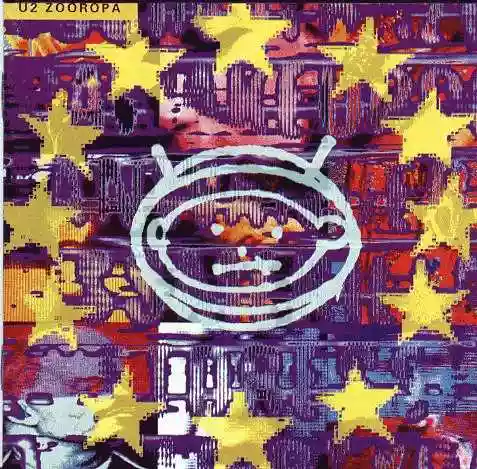
You insert the CD into the player, press Play, and listen: the beginning, with the piano (sampled? played? it doesn't matter) barely perceptible but growing, sounds like a long instrumental intro. The notes are vaguely unsettling and almost sinister, almost (to repeat the game of synesthetic associations) like the tolling of a bell in the desert, or the crescendo of "All Tomorrow's Parties"... however, the cinematic crossfade scene-change is tangible, and here come the stylized/sampled background noises mixed with voices making their appearance on the scene. After a sort of "counter-climax," a relaxing pause, where one senses a "scene change in the fade" from the mists of these sampled melodies with post-industrial noises, music emerges, the same music as always, from the band with Bonovox and The Edge: the guitar, liquid and spatial, the bass counterpoint, and finally the beginning of the percussion: "Zooropa". The references mentioned above are thus explainable: the attitude towards writing in a cinematic modus is due to the long collaboration with Wenders (and not only), the echoes of the Velvet Underground reveal more than elective affinities, the real encounter (Lou Reed and Co. were supporters at the 1993 Naples dates of the... "Zooropa Tour") which apparently left its mark. In this track, which sounds like "Until The End Of The World" in an apocalyptic presage version, it seems the meaning of the entire work is concentrated. An unexpected work, an album bizarrely released while the group is engaged in the tour initially named "Zoo Tv". So unexpected (and little announced) that it arrives in stores without (in fact) the Dublin band including even a track in the setlist (for now), and yet it makes a "course change" of the tour's name. Thematically, the title of the opening track is explicit: Europe, a continent (willingly or unwillingly) open to infinite contaminations, traffic of peoples and cultures, scarred by two world wars and now a fragile area of peace surrounded by a world-universe shattered by irresolvable conflicts of every kind, by unspeakable horrors and the forerunners of a desired/feared globalization, and while maintaining a certain (unstable) "order", it at least feels the seismic shocks, and loses sight of its own center. As P. Negri has astutely pointed out "there is a key verse in the title track, which reveals the sense of the entire work": this verse, in the reprise placed almost at the end of the song, says "and I have no compass", meaning "I have lost the compass", the guiding line of viewing the complexity of the contemporary world. It is understandable how this song gives a sense of a "manifesto of an era", that of the post-contemporaneity towards which we are heading, and it captures in its musical poetry the subtle unease. Monumental and (at the same time) splendid, to make a comparison with another work set "at the antipodes" of this album, namely "The Joshua Tree", if in that album the opening song, the epochal "Where The Streets Have No Name", was worked on and refined so much that it absorbed half of the album's entire production time, here "Zooropa" represents the perfect counterpoint, while being something that "goes beyond" the boundaries of a simple pop-rock song (contaminated), and of a "simple" album.
The rest of the album is partly a reaffirmation of The Edge's musical talent and Bonovox's lyrical and vocal talent, partly a (deliberately) surprising opening to fields of experimentation never before "dared". The first category includes "The Wanderer", a Bonovox-Jonny Cash duet, "Babyface", a rock song dressed as a pop song (or vice versa), where (again) echoes of the Velvet Underground are heard, and "Stay (Faraway So Close)", a romantic old-style ballad perfect for entering the landscape of images and music of Wim Wenders' "Faraway, So Close".
The second category includes the most atypical episodes of (perhaps) the group's entire future career ("Zooropa" is the first of 5 albums the band is committed to recording after renewing their contract with Island): "Numb", the leading single, where the monotone voice is that of The Edge, with Bonovox's backing vocals, placed in the background, and an electro-(indefinable) soundscape where, between the lines, one "feels" a subtle melodic line; "Daddy's Gonna Pay For Your Crashed Cars", bears the industrial imprint of Flood, producer of the album, who from Nodes (one of the ultra-experimental groups he was part of in the first person) to Nine Inch Nails has established himself as one of the "super producers" (here alongside Brian Eno); and especially "Lemon", theoretically something that might not excite everyone, practically (perhaps) upon closer inspection, a traditional (and inspired) U2 song reprocessed more than simply "dressed up" in techno-pop form that mimics certain disco music of the '80s. If I may venture an image, I would say that here the circle closes: that of a work, "Zooropa", which between classicism staged in the disorienting light of post-contemporaneity (think of De Chirico's Metaphysical Painting, or Derek Jarman's films) and more apparent than real modernity, offers a portrait of the world as realistic as possible: elusive, "zoomed", grainy in individual pixels, dreamlike and finally poetic, as every (possible) historical era is, and will be (according to the writer, of course) always; and closes another cycle: that of U2, who besides always having been authors of great songs, here combine their (indisputable) lyrical talent with the awareness of "projecting themselves" into a dimension unknown to them. That of a (not yet known) "Brave New World".
Loading comments slowly
Summary by Bot
This review praises U2's Zooropa as a bold, cinematic album that blends traditional rock with experimental and electronic elements. The opening title track sets a mood of unease and complexity, reflecting Europe's fractured identity and a changing global landscape. The album juxtaposes classic songwriting with daring sonic experimentation, showcasing The Edge's and Bono's talents. Zooropa represents both a continuation and a new direction for U2, marking a pivotal moment in their career.Tracklist Lyrics Videos
U2
U2 are an Irish rock band formed in Dublin in 1976 by Bono, The Edge, Adam Clayton and Larry Mullen Jr. Rising from post‑punk roots to global fame, they fused atmospheric guitar textures with anthemic songwriting and ambitious tours such as Zoo TV and U2 360°.129 Reviews
Other reviews
By Jy
NUMB is indeed the sonic manifesto of the band’s new direction.
‘Stay’ is the song where electronics take a back seat for once, in favor of a superb performance by the entire band.
By Bleak
"With all the controversies it has brought along, it remains for me one of the best albums by the Irish band."
"Not a masterpiece, I repeat. In the case of U2, in my opinion, such a word is absolutely to be avoided."
By Rax
"'Zooropa' is a series of songs of an idea dressed in elegant electronics."
"Pass marks for the production and the decency of the songs. U2 never engaged in the bravado that fills REM albums."
