
 •
Rating:
•
Rating:
THE REVIEW
The nineties begin with three masterpieces: R.E.M.'s Out of Time, Nirvana's Nevermind, and Achtung Baby, U2's turning point.
Not only does 1991, but the last decade of the century as a whole, is well represented in Achtung Baby, which marks an epochal change in music for U2. Like a powerful wave, maturity overwhelms the Dublin band, creating an incredible work with an impeccable sequence of twelve tracks that, listened to dozens of times, never tire, but rather, endlessly fascinate with their sequence of sounds that ooze sensations and emotions.
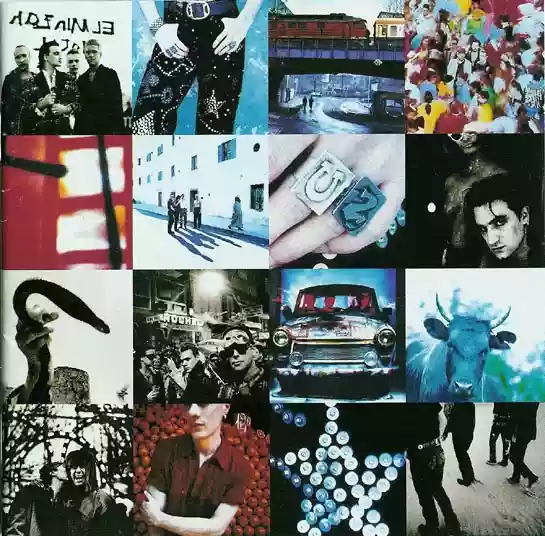
The album is a kaleidoscope projecting astonishing images, the same ones that would be broadcasted by music videos around the world and that, along with thousands of lights, explode and reach directly into the hearts and minds of the hundreds of thousands of people who witnessed one of the most significant and grandiose live rock shows in history. The ZooTv Tour and the subsequent Zooropa Tour convey to those watching and listening new, and perhaps unrepeatable, emotions. The explosive power of the music's meanings and the messages tied to it, not only from the song lyrics but from the images broadcasted on video as well as from the puzzle of a cover that is already an entire program. The twelve tracks are images, meanings, twelve stars all shining with their own light. Zoo Station opens the show with an electronic riff that gives you goosebumps and makes you feel ready for sensations "even better than the real thing." One fears no rivals and is one of the most captivating love songs ever. It's one of the tracks where the powerful succession characterizing the sequence of songs stops and embraces you, then leaves you spinning again with an overwhelming push of sounds racing at top speed (The Fly), and then stopping again with the heartbreaking and reflective Acrobat and Ultraviolet. The album closes with an acritical announcement, Love is Blindness, with a melancholic chant, almost like saying farewell to the freshly concluded masterpiece, which leaves the group's fans moved and astounded. An unexpected gust of "cold" air that leaves an indelible mark on U2 fans, but also on those who had never listened to the band before.
None of them will find in U2 such a strong inspiration to create symbolisms and mythicism again. This album arrives with the usual support of the genius of Brian Eno and Daniel Lanois, who produce Bono and his companions at the height of their artistic career. Influences and contributions that wisely exploit the talents of the Irish group and that allow this album to be placed at the top ranks of those produced in the last decade of the twentieth century. A symbol. The album finds no repetition, and subsequent covers would be nothing more than a vain and miserable commercial attempt to ride the unrepeatable success due to a higher inspiration.
Loading comments slowly
Summary by Bot
Achtung Baby represents a major turning point for U2 and a milestone in 1990s music. The album showcases a seamless blend of emotional depth and sonic innovation, with twelve unforgettable tracks. Produced by Brian Eno and Daniel Lanois, it captures the band's maturity and influence. The accompanying Zoo Tv Tour reinforced its impact, delivering one of rock's grandest live experiences. The album remains a lasting symbol of artistic inspiration and evolution.Tracklist Lyrics Videos
U2
U2 are an Irish rock band formed in Dublin in 1976 by Bono, The Edge, Adam Clayton and Larry Mullen Jr. Rising from post‑punk roots to global fame, they fused atmospheric guitar textures with anthemic songwriting and ambitious tours such as Zoo TV and U2 360°.129 Reviews
Other reviews
By giov
Perhaps it remains the last U2 album to have a soul: not too caught up in market rules, the grandeur of tours, and the lack of ideas that is noticeable lately in some of their latest works.
Recorded between Berlin and Dublin, precisely to capture the emotions that a people were experiencing after the fall of a cursed wall.
By pinkoSpallino
A much more important album, with electronic sounds that join the classic rock sounds in songs like 'Mysterious Ways'.
U2 remains the most important rock band in the world, and they prove it in 'One', the most beautiful ballad of all time.
By Alevox
Like an electric shock. The U2 of "The Joshua Tree" are abruptly awakened by the infernal sound of a fly in the head.
U2 change their skin. They shake off the heavy role of rock prophets to project themselves into a colder and more disillusioned dimension.
By deckard2019
Bono Vox, the leader of the Dublin band, states at a concert held in their homeland, 'We won’t see each other for a while, we need to go and dream it all up again.'
The album requires several listens before it is fully assimilated and subsequently declared as an absolute masterpiece.
By vicio
Achtung Baby is understood as a crucial milestone in U2’s career.
After Achtung Baby, U2 have never been the same.
