
 •
Rating:
•
Rating:
THE REVIEW
More than a thousand years ago, when Southern Europe was feeling the aftershocks of the now-defunct Roman Empire and Christianity had already taken a firm hold on the people of that time, the "civilized" world began to know the whirlwind and ferocity of barbarian warriors who tumbled in endless hordes from the cold, mysterious (because not yet well known), and distant territories of the North.
They were ruthless warriors with no hindrance other than their resourcefulness to guide them: they arrived suddenly, often by sea, on those picturesque and fast ships of theirs, landed in some cove, and began to loot and pillage everything there was to plunder around. Monasteries, villages, castles, towns. They left behind nothing but ruins and fires. They wore attire unknown for the time. They covered themselves in furs and wielded swords and axes with exquisite silver inlays, rode for days and days without ever tiring, and when they went into battle or more often to raid, they went with painted faces and uttered howls and yells that made one's skin crawl just hearing them. Rarely could the armies of those days withstand them. Everyone was scared to death of those men who fought bare-chested and smeared with the blood of their enemies, which often, after being slaughtered, were displayed on the spikes of their standards as trophies. They moved without a precise plan, guided by a proud and daring leader who must have known more than the devil since he had to be an excellent admiral for the ships, a great general on the battlefields, a good leader in the settlements they built, an impartial judge, and an infallible priest. All characteristics that alone should make these tough-skinned men extraordinary characters. People who, besides warring when there was war to be made, often set sail and hoisted anchor to go just about everywhere: along the Scandinavian countries above all, but also in Europe to find the necessary "living space," reaching, it is said, even South Africa and possibly, decades before Columbus, also a land they called "Vinland" which should more or less correspond to the northwestern coast of America.
A group of these bold and courageous Viking men, one day, guided by a local chieftain, Rurik, who gathered 501 of them around him, took, instead of the West, the direction of the East, and ventured through the wild steppes and plains of Central Europe, eventually colonizing vast lands swept by wind and snow, crossing the Ural Mountains, then descending to the coasts of the Black Sea and settling in the territories of the Byzantine Empire, which, very cleverly, taking advantage of the fact that these "Variaghi" (as their lineage was indeed called), besides being fearsome warriors, were also skilled merchants or in any case dedicated to profit above all else, hired them first as mercenaries and subsequently absorbed them into its fold. King Rurik, however, not content with the treatment given to his men, whom he considered nothing more than sellouts, retraced the path he had once taken, settled in a hospitable bend near a lake he remembered passing during his previous journey, and began organizing the life of his village, which soon became so populous, also due to the local genes reduced to vassalage, that it became a kingdom, later becoming the territory of today's Great Russia.
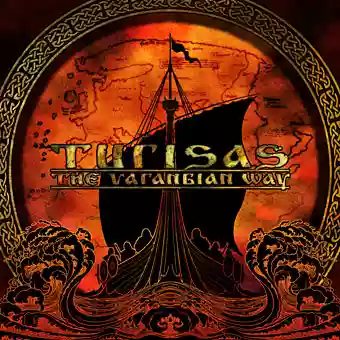
All these facts are history, which Turisas, a Finnish band dedicated to a blend of symphonic and pompous Power and aggressive Extreme Metal that contains the seeds of the most canonical Death/Black until it spills over into badass and well-executed Thrash hints, which has little to envy other colleagues in the same field, narrates in their concept album "The Varangian Way."
Thus, in this album, one can listen to excellent examples of well-played, well-executed, structurally robust, and powerful Viking metal accompanied by redundant and epic symphonic and baroque parts, which have brought much fortune to bands like Therion, just to give an example.
As for the tracks, we find ourselves comparing instrumental structures with few frills, exemplified by the absence of both prologues and monologues. Badass songs that will delight many, with catchy choruses that infuse adrenaline in every pore and which greatly indulge, for the more sensitive listeners, in the imaginative and epic flourishes.
Nowadays, in fact, listening to songs like "To Holmgard and Beyond," a true ranking hit (check it out to believe it), or "A Portage to Unkown," is indeed a refined pleasure, reaching the point where, after wearing them out, one feels the urge to take the rusty chainmail and the chiseled sword bought on the internet to go fight. Against whom, these days, it's inconceivable to imagine, much to the chagrin of the police who will chase you down and won't know what sedition it is.
It's true, there's nothing really new in this album, other than the talent of this band which, with just two albums, this and the previous "Battle Metal," is carving out a following that many envy, starting with similar colleagues who are taking years to make their mark.
Perhaps the key to understanding the great success that Turisas is having lies precisely in their ultimately simple approach to music, which goes against the pompousness and lack, possibly deliberate, of immediacy typical of score-based archetypes. In fact, the more the songs aim to be complex, the more they turn out to be catchy, leading to, in this case, a sound orgy as in a track like "In The Court of Jarisleif," where an electric and hysterical violin paints a gypsy and magical atmosphere, in a medieval setting that embeds itself effortlessly in your mind, without even needing to close your eyes to imagine it.
Perhaps this is a limitation. Perhaps all the mystery, the "black thread" leading certain genres of music, is shown here in broad daylight and may seem less fascinating than it is, yet I can assure you that, at times, it's still nice to be captivated by these things without having to resort to repeated listens of an album to recreate a personal synopsis. And if someone like me, who has Therion and Opeth holy cards prominently displayed on the nightstand at home, says so, I believe you can trust me.
So, just for once, let yourself be enchanted. Let yourself be guided on the journey that started from Finland, covered thousands of kilometers, crossed the Black Sea, and reached the court of Constantinople, at the gates of the civilized world, with that sense of conflict and war that, for example, Turisas want to express in a song like "Cursed Be Iron," or with the description of the hazards on the journey in "The Dnieper Rapids." Pure and simple desire to discover, to go, to fight, and to build history. And, beyond all the merits and demerits of this band, we should thank them for their undeniable intelligence.
Loading comments slowly
Summary by Bot
Turisas' album The Varangian Way is a powerful and well-crafted Viking metal concept album that blends symphonic, power, and extreme metal elements. The songs feature catchy and adrenaline-pumping choruses, rich storytelling based on historical Varangian warriors, and epic instrumental arrangements. Despite not being groundbreaking in style, the album is praised for its talent, accessibility, and imaginative atmosphere. It's recommended for fans of metal seeking a hearty dose of Viking-inspired musical adventure.
Turisas
Turisas is a Finnish metal band known for blending Viking, folk, symphonic and power metal. Notable albums include Battle Metal (2004) and The Varangian Way (2007).02 Reviews
