
 •
Rating:
•
Rating:
THE REVIEW
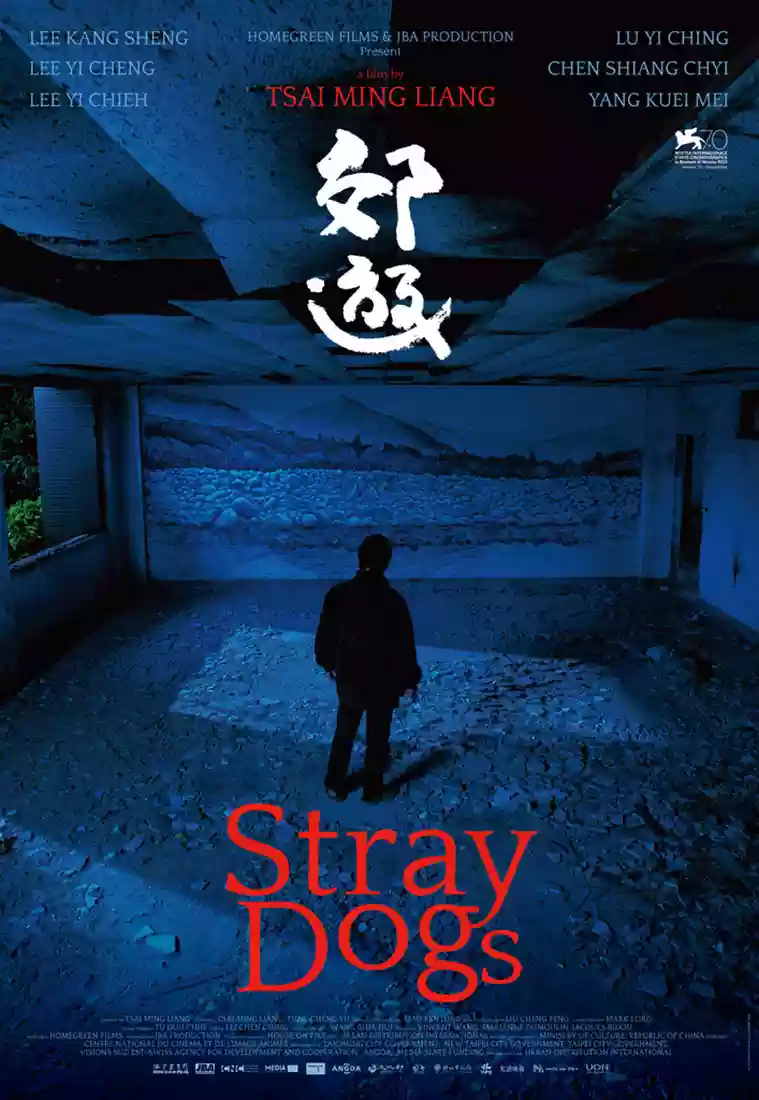
As we reach the end of the film, we can do nothing but sink into the most astonished and somber silence, just as Tsai Ming-Liang himself suggests, without any compromise with the terrifying finale, bordering on metacinema. Because translating such a sensory and at the same time metaphysical experience into words inevitably means diminishing it: one could talk about the power, the rawness, and the incredible poetry that exudes from every image; about the photography that becomes pure art and delight, counterbalancing the sculptural mastery in capturing the most heartbreaking misery in every shot; about the time that flows so slowly it no longer exists; about the myriad of questions that emerge rapidly and the voids of thought that immediately follow; about the icy absence of hope and pity for man, who here, unequivocally identified with the canine species, marks territory with urine, feeds on spoiled leftovers, and shuns any physical, sexual, emotional contact. Yes, we could talk about this and many other precious details essential for understanding such laborious and tormented work, but much of what has been said so far does not represent any particular novelty in Tsai's cinema - a cinema with a crystalline/crystallized and always self-referential style, where the whole is more than the sum of its parts both at the microscopic level (what constitutes the film) and the macro (the filmography itself).
What truly remains to be said can be summarized in a few lines: Stray Dogs (Silver Lion at the Venice Biennale 2013) is nothing but the latest, solemn expression of a director who is now desperate and aware of having reached the end of his dead-end street: his discourse becomes peremptory and disheartening, his proverbial class in filming (sculpting, molding, immortalizing) his films here reaches an indisputable state of grace. Precisely from these premises, we might say that this is ultimately a work dedicated only to those who are well-acquainted with the artist and have no need to know what they are getting into: here concludes, after twenty years of career and ten feature films, the journey of the fetish-character Hsiao-Kang/Lee Kang-Sheng, who has become the father of a family in disarray, without a future, on the verge of disintegration; and simultaneously, the director decides to close forever with the world of cinema and his faithful viewers, abandoning them to themselves, not without first having hurled down a heavy baton to pick up, a legacy of thought that no one will want to bear. And so, at the finale, an oppressive, hallucinatory, unsustainable, revealing drapery of silence will descend (slowly, inexorably): the specters that populated the screen have left the scenes; we remain alone, and our absolute void to stare at, contemplate, fear. A mute anticatharsis, an epitaph destined to imprint itself forever in memory.
Loading comments slowly
Summary by Bot
Stray Dogs by Tsai Ming-Liang is a profound, visually poetic film that delivers a somber and powerful finale. It reflects the director’s mastery in slow cinema and emotional storytelling, concluding the long journey of his recurring character. The movie evokes metaphysical silence and profound emptiness, offering a complex experience for devoted fans familiar with Tsai’s oeuvre. Considered both an epitaph and a legacy, the film demands contemplation and respect.
Tsai Ming Liang
Malaysian-born Taiwanese film director known for slow cinema: long takes, minimal dialogue, and portraits of urban alienation. Winner of the Golden Lion at Venice (1994, Vive L’Amour). Longtime collaborator with actor Lee Kang-sheng.06 Reviews
