
 •
Rating:
•
Rating:
THE REVIEW
It is truly surprising how no one, absolutely no one, knows this great poet of song.
“Townes Van Zandt is the best songwriter in the world; I would say it in front of Dylan with my boots on his table”. Steve Earle once said this; the tone of that sentence was certainly provocative, but it is even more incredible with how much cold indifference people, even now, do not pay the slightest attention to the poetry and genius of this immense songwriter, just because ignorance reigns supreme among us. His work forms one of the vital backbones of American music, of an importance comparable to that of Dylan, Neil Young, or Leonard Cohen. He has produced at least twenty masterpiece songs that elevate him to the ranks of the greatest word artists ever to exist. Born in Texas to a very wealthy oil family, he decided to make his own life. He bravely turned his back on the comforts of an easy bourgeois life; instead, he decisively chose the path of toil, sweat, pain.
A writing that is pure and simple poetry, accompanied by a razor-sharp voice that encompasses the sufferings and melancholy of an entire existence. An introverted, lonely soul, incapable of smiling; his face a mask of pain. It is truly impossible to listen to his album if the sun is shining outside the window.
Van Zandt was the most desperate and sweet artist ever heard in modern music. His isolation, his life distant from everyone and everything, that distant and forgotten song of such a sad story that it hurts the heart, represent the highest point of resignation and cruelty of spirit ever felt in modern music. Beyond De André and Cohen, his is a despair without end, lasting an entire life and without the slightest hope of serenity. Van Zandt died of a heart attack, alone like an abandoned dog; at fifty-seven, he left us with a production of inestimable value and the testimony of a life of immense pain. He was a man truly tormented by the malaise of living: he would disappear for long periods swallowed by tremendous depressive crises. In the darkest solitude, he attempted suicide several times and lived for years in the dense woods of Tennessee, in a wooden house he built himself.
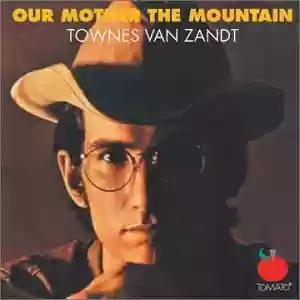
Deep and severe. His acoustic guitar and his voice; breaking syllables with luminous precision, dripping bitter honey in grave registers. The pure and crystalline country, marvelously merging with the blues of the fathers and the best folk tradition. Our Mother The Mountain is his most mature and powerful album, adorned with afflicted violins and sweet guitars; one of the highest and most noble manifestos of the true meaning contained within the most genuine country tradition. His is the best vision of this style, second only to that of the unparalleled master Hank Williams. But in this case, the pupil comes so close to the master that Our Mother The Mountain gives the impression of being an investiture directly from heaven: it truly seems that the spirit of Hank Williams is sitting next to him, just as he sings these beautiful pieces. Furthermore, throughout the album looms the ghost of another great master of the past: the great father of folk and Dylan, Woody Guthrie.
Kathleen, the second track of the album, lets us entirely savor what has been said so far. The track is severe and austere but at the same time of a harrowing melancholy. The other emotions that this piece manages to convey cannot really be explained in words. It is a sweet and at the same time chilling shiver. Along the same line, we find the soft and desolate Like a Summer Thursday, splendid in its melody that truly takes you far away. One thus encounters one of the most beautiful songs ever written: Our Mother The Mountain, magnified by that enchanted flute that elevates it to an otherworldly dimension. Second Lovers Song is instead a relentless manifesto of the depression that continuously afflicts him. But it is halfway through this already splendid album that Van Zandt gives us his two greatest jewels: first St.John The Gambler, a caressing and melancholic ballad that touches directly the listener's heart if they have a heart for music. And then, one of those songs that is worth an entire career or an entire life: Tacumseh Valley, sung with a voice drenched in tears, standing out on an absolute melody, elusive yet real, pierced by the entry of a harmonica that inevitably stays inside.
Tacumseh Valley knows no rivals, having the same weight and importance as Visions of Johanna by Dylan, Suzanne by Cohen, or Ambulance Blues by Neil Young.
This review is not flattering. It honors an unjustly unknown artist, forgotten even by critics. I hope it will be useful for you to discover and love a true genius, misunderstood and forgotten for too long.
Loading comments slowly
Summary by Bot
This review praises Townes Van Zandt as an underrated songwriting genius whose album Our Mother The Mountain stands as a profound and melancholic masterpiece. The reviewer highlights the emotional depth, poetic quality, and importance of Van Zandt's work within American folk and country music, comparing him to legends like Dylan, Cohen, and Hank Williams. The album is noted for its haunting and beautiful songs that convey pain and resignation. Ultimately, the review calls for greater recognition of Van Zandt’s legacy.Tracklist Lyrics Videos
Townes Van Zandt
American singer-songwriter born March 7, 1944 in Fort Worth, Texas; died January 1, 1997. A cornerstone of modern folk and country, known for stark, poetic songs and intimate performances.06 Reviews
