
 •
Rating:
•
Rating:
THE REVIEW
Laziness, my worst enemy. It's because of it that lately I've been revisiting the same old omelets; I'm on the road to decline, my liver aches from poor diet. Emotions lost forever and emotional regeneration that has yet to arrive. Fortunately, yesterday I managed to force myself and pop a vintage VHS of "Fuori orario" into the VCR, from the "Ghezzi-in-shirt" period (today it's instead desynchronized boiled egg).
I had started watching this "Bara no soretsu" a few years ago, the day after recording it, but I left it halfway through (thanks to the diabolical ennui that has been tormenting me for years). Yesterday I avoided rewatching Cuchillo for the third time and overcame my need for consolations, stumbling upon a wonderful work.
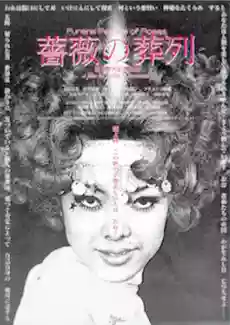
"Bara no soretsu" (which seems to mean "Funeral Procession of Roses") is one of the three films directed by Toshio Matsumoto (http://www.imdb.com/name/nm0559564/bio), now a professor at the Faculty of Art and Design in Kyoto. Films that never received the proper attention from the broader audience; and who cares? In fact, thank god, not everyone deserves and has the sensitivity to savor a film as splendid and unconventional as this. Astonishing even for Japanese cinematography.
With a deconstructed language, thanks to the influences of pop art, nouvelle vague, and camera stylo, Matsumoto tells the story of Eddie, a beautiful young crossdresser, prima donna of a gay bar run by a madame envious of Eddie's beauty and success with her man. The plot used by Matsumoto is the myth of Oedipus; the chronological progression of the story is completely altered, making Tarantino's temporal shifts look childish.
When we think we're witnessing a linear development, we're deep in the future or in a flashback. A recurring nightmare travels through Eddie's mind, a distant guilt, a premonition for the final tragedy. Interspersed throughout the film are vérité moments where the actors share their impressions of Matsumoto's work and their real-life experiences as crossdressers, with their dissatisfactions and joys; scenes of protest parades, the madame's death by suicide found dressed as a bride amidst fake roses, Japanese hippie filmmakers, drugs, subliminal one-two frame images, electric solarizations of faces and bodies, fights and love scenes at double speed, film within a film, psychedelia and pop art, cinema within cinema but joyfully (1969, remember), flowers and poetry.
Many moods populate this film kaleidoscope, bathed in a splendid black and white; there's room for happiness, laughter, despair. But above all, it's a powerful example of cinema play, as was done then when, as mentioned during the film, "the world was ending" and it seemed everything could be overturned before the entropy of souls. The opening images are gorgeous, where Eddie makes love with her protector; the bodies are bathed in an opalescent light that highlights the silhouettes, and Eddie's face expresses joy and carnal pleasure with ecstatic astonishment.
While watching, Kubrick's name sprang to mind, in a comparison that seemed impossible to me; "I exaggerate! It's just because of the scenes shot with a Chaplin effect" similar to those of Alex and the devotchkas in "A Clockwork Orange."
I've discovered that this film was one of Kubrick's favorites...
Loading comments slowly
Summary by Bot
Bara No Soretsu is a powerful and visually striking 1969 film by Toshio Matsumoto. It offers a deconstructed narrative blending pop art and psychedelia, exploring crossdressing and identity through a non-linear, emotionally complex story. The film stands out in Japanese cinema for its innovative style and remains a cult classic. The review applauds its unique storytelling, visual poetry, and emotional depth.
Toshio Matsumoto
Japanese film director and video artist best known for the 1969 experimental film Bara No Soretsu (Funeral Parade of Roses).01 Reviews
