
 •
Rating:
•
Rating:
THE REVIEW
Sometimes, blues can be a real sickness.
Tony Joe White has it running through his veins and keeps it in incubation until he turns 16. After all, what do you expect if you’re born in the northeast of Louisiana, near the border with Arkansas to the north and Mississippi to the east, in a small town surrounded by swamps and cotton fields?
A few lines are needed to introduce the character and his era, since, aside from a few listens, he's practically unknown on the Deb. I’ll definitely be verbose and the Bot will flog me, but oh well…
He was born the youngest of seven children in a family of farmers. Life was hard after the war; cotton was picked, potatoes were grown. His childhood, like many, was surrounded by gospel and country music and lots of black and white kids to play and grow up with. The revelation comes when one of his brothers brings home a Lightnin’ Hopkins record. He picks up his father's guitar and learns to play it so well that he starts performing at parties and with friends. He covers songs by Muddy Waters, John Lee Hooker, Hopkins, and he does it well. He has a deep, dark, essential voice, and his guitar has a special, original sound.
But in reality, a normal life awaits him: normal jobs that he changes often, a wife, Leanne, a son, and a couple of friends to play with now and then. They even record a few singles with no results whatsoever.
Still, this life feels too tight for him, and suddenly he decides to try his luck and heads to Nashville. Here, the story gets a bit muddled and after a few doors close in his face, he lands at Monument, a label that produces Roy Orbison and Dolly Parton. He’s got a certain nerve that they like, he’s heard, and they sign him.
His style is still raw, but he’s blown away by hearing “Ode To Billy Joe” by Bobbie Gentry, released in 1967—a story he relates to.
He decides to talk about things he knows: people, places, and real-life episodes. His stories contain the typical elements of southern literature: the swamp, violence, sex, and racism often reappear.
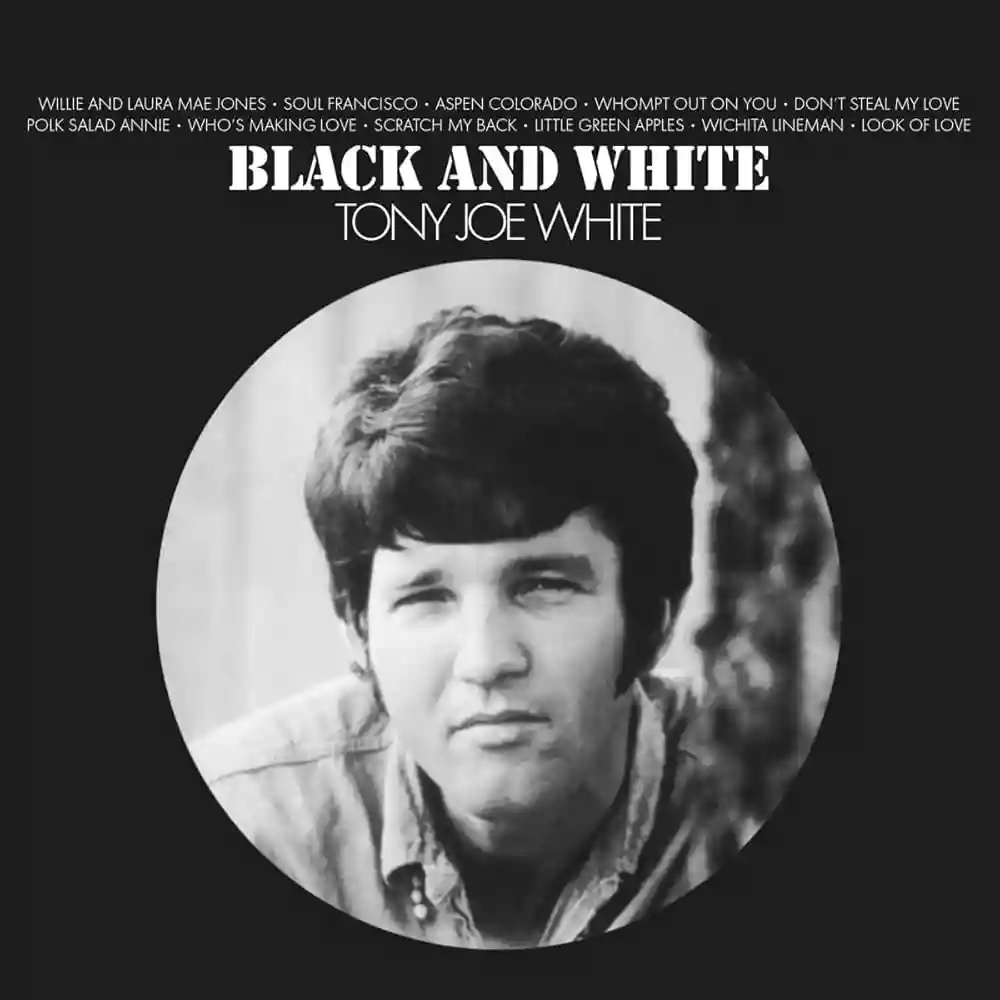
After a few trial 45s with little effect, he’s given a chance, and Tony Joe gets to work on his first album: “Black And White”. Skilled sessionmen and a certain Billy Swann as producer are brought in. Billy is already known on the country circuit but will soon become famous as a singer-songwriter. So, the album takes shape. One side is his own songs, the other side covers.
Side A opens with “Willie & Laura Mae Jones”, a song about his old rural life, where he talks about his black neighbors with whom he shared everything. Considering the times—we’re at the end of the sixties—he tackles some pretty unusual themes for race relations.
This song would later be covered by many artists like Dusty Springfield, Clarence Carter, and Bettye Swann.
Other songs of his include “Don’t Steal My Love,” "Whompt Out On You" and the ballad “Aspen, Colorado,” while “Soul Francisco” is a song about the flower children—a direct consequence of the Summer of Love the previous year but which still echoed in the lives of young Americans.
This track unexpectedly becomes a hit in France in the summer of 1968. The radio makes it such a success that he even plays a few concerts in France. Here, his style is dubbed “swamp rock,” a term that sticks to him, and he’s called the “swamp fox.”
But the real surprise is “Polk Salad Annie,” which in August 1969 reaches number 8 on the Billboard charts. It’s named after a plant, pokeweed or polk, toxic if eaten raw. Despite the word “salad” suggesting a vegetable dish, it’s actually a corruption of “sallet,” a term for a cooked green similar to spinach. The song is about a girl from the South with very little, referencing White’s childhood when he listened not only to bluesmen and local country singers but also to Louisianan Cajun music—a hybrid of traditional musical styles, based on accordion and violin and introduced by French settlers at the start of the century, which influenced a slew of artists such as Professor Longhair and Dr. John, among others.
The fact is that “Polk Salad Annie” becomes part of the repertoire of other artists; Tom Jones records it, and especially Elvis Presley. The latter records it for the first time on the live album “On Stage,” in Las Vegas in February 1970, and it becomes a staple of his shows throughout his career.
Side B, on the other hand, contains covers Tony Joe used to perform live, like “Scratch My Back” or “Wichita Lineman" or, at the label's suggestion, “Little Green Apples” and “The Look Of Love” by Bacharach.
All well executed, of course, but it’s Side A that makes the album a great one.
This is just the first step of a long journey that would see him record over thirty albums with various live shows and compilations, and it’s probably not the best of his works, but someone, sooner or later, had to start talking about it, just as the venerable imasoulman rightly pointed out.
Special mention goes to the splendid box set “Swamp Music – The Complete Monument Recordings” (RhinoHandmade 7731), a 4CD limited edition released in 2006, with previously unreleased tracks, singles, and demos of songs he would use in later albums. There’s also a solo acoustic live at Barclay Studios in Paris in March 1969.
Tony Joe White never achieved great commercial success but lived the life he dreamed of, managed to make a living from his music, and above all, he was an example of integrity in both music and in life. Ajò
Loading comments slowly
Summary by Bot
The review covers Tony Joe White’s debut album 'Black and White'. It discusses the distinct blend of swamp blues and Southern rock. Storytelling and atmosphere are noted as key attributes. The album receives a moderate 3/5 rating. Verdict: A solid, if not exceptional, listen for genre fans.Tracklist
01 Willie And Laura Mae Jones (04:47)
02 Soul Francisco (01:52)
03 Aspen Colorado (02:47)
04 Whompt Out On You (02:21)
05 Don't Steal My Love (03:50)
06 Polk Salad Annie (03:43)
07 Who's Making Love (03:00)
08 Scratch My Back (02:57)
09 Little Green Apples (03:57)
10 Wichita Lineman (02:48)
11 Look Of Love (03:09)
Tony Joe White
Tony Joe White (1943–2018) was an American singer-songwriter and guitarist associated with swamp rock and known for story-driven Southern songs, including “Polk Salad Annie.”01 Reviews
