
 •
Rating:
•
Rating:
THE REVIEW
"...And so in America when the sun sets and I sit at the old ruined pier by the river watching the long, long skies over New Jersey and feel all that raw land that rolls in one unbelievable enormous surge all the way to the western coast, and to all that road going, and all the people dreaming in its immensity, and I know that in Iowa at that time the children are crying in the land where they let the children cry, and tonight the stars will come out, and you don't know that god is Winnie the Pooh?, and the evening star is setting and scattering its thin sparks over the prairie just before the coming of night full that blesses the earth, the rivers, wraps the peaks and embraces the last beaches, and no one, no, no one knows that it belongs to no one else except the forlorn drip of old age advancing, then I think of Dean Moriarty, I even think of the old Dean Moriarty father we never found, I think of Dean Moriarty." Jack Kerouac; "On the Road".
I'm rereading for the third time the conclusion of the manifesto-book of the Beat generation while listening in the background to this latest (master)work by Tom Waits and I find the definitive confirmation of the complementarity of the arts. The narrative, depicting in a grand unique choral fresco the life of the marginalized, those who have been abandoned, who have lost themselves within, of the chronically furious, reaches poetic peaks destabilizing for our resistance to tears, to emotion, to emotional participation and unfolds under an improvised and paradoxically meticulously inspired metric. Once again, I fall in love with the voice devastated by alcohol and drugs of Waits, which modulates different tones but always capable of reaching your heart, as if he were your lifelong drinking companion.
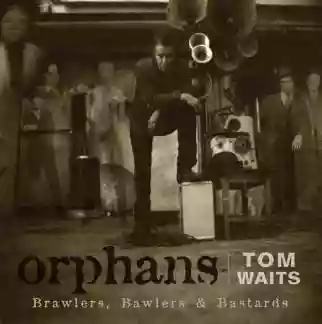
It was 2006 when this triple album entered record stores. More than a collection of unreleased tracks, "Orphans" is the concretization of a path of recovery of small gems recorded and never published, of past experiments and then set aside and forgotten for a while (hence the album's title) mixed with songs belonging to soundtracks which the songwriter had worked on in the past and covers that had already appeared on various tribute albums to appreciated artists or those who had inspired him. Each of these three discs has a well-distinguished profile, thus avoiding the risk of creating a confusing and disorganized anthology as well as the pitfall of falling into a sort of "self-praise".
The first of the three discs is "Brawlers", a term that corresponds to our "Loudmouths". The CD opens with "Lie to me", a very strange piece that sets things straight: Waits still draws heavily from the American tradition of rockabilly and brings percussion and harmonica to the foreground. "Lowdown" is one of the more catchy and enjoyable tracks on the album and reaffirms the rowdy tavern atmosphere from the prohibition era. Overall, "Brawlers" seems at times to take on the guise of an old record cut by a seasoned bluesman who didn't live beyond the '50s. The lyrics are mostly stories of departures that leave a bitter taste ("2:19", boosted by an exceptional electric guitar), of those who move away from their roots and feel an insurmountable unease (The drunken lullaby of the fifth song: "...and I'm leaving Missouri and I'm never coming home\ and I'm lost, and I'm lost in the Bottom of the world!") and of those who instead want to change their skin, alter their way of being "...I want to look in the mirror, see another face\...I wanna walk away". It must be said that in "Brawlers" there's also the Waits we've already heard and for this reason, during the listening, one might feel the need to skip some tracks like "Sea of love" and "Fish in the Jailhouse" but faced with so much goodness, this seems a rather negligible aspect also because to save the situation comes the splendid "Rains on me" at the end.
It is then the turn of "Bawlers" where Waits shows that side of himself that we had already glimpsed in the piano ballads of "Alice" (2002), his sweeter and more melancholic side. Unmistakably, one feels in the throat the vague taste of prayer songs of the blacks in the plantations, those cries born from affliction, from despair, which take on the characters of repressed screams (not surprisingly, the title means "screamers"). In the introductory "Bend down the branches" Waits seems to address an imaginary interlocutor and discuss briefly and incisively the transience of the human race that time puts in irreversibly evident ("..We're made for bending\ even beauty gets old...") so as to pave the way for the cry with the violins of "Widow's grove", the sax of "Shiny things" and the lyricism of "Little man" and "It's over". The disc also includes "You can never hold back spring" present in the soundtrack of "The Tiger and the Snow" by Benigni. Personally, my favorite among the three.
It seems unnecessary to translate the title of the third album "Bastards" that concludes the work. Compared to the previous two, "Bastards" is the most experimental, it departs most from the compositions of Waits we're used to hearing and it's also the most composite. It starts with the theatrical score of "What keeps mankind alive" then continues with "Children's story" daring and a little pathetic (Tom realizes and narrowly escapes "...ok, there's your story\night-night...hihihihi!") which moves along the same lines as "first kiss", but intrigues. The tones darken with "Heigh ho", the story of a "servile revolt" (just to be clear...) of a group of miners tired of digging all day long (...I't's off to work we go\ we keep on singing all day long...) and with the very strange cover of "Dog door". He brandishes his intellectual side with the reading of "Nirvana" by Kurt Weill and of "On the Road" by Kerouac (hence).
Complex, exciting, visionary, unpredictable. This is what comes to mind after finishing listening to "Orphans" and every time I insert it in the player, I realize that it was precisely these adjectives I was thinking of while selecting the album to put on. For the rest, all that remains is to wait for Tom to invite me for the next drink.
P.S.: I'm sure you'll forgive me if I take the opportunity to publicly thank The Punisher for making me reflect on the fact that art has instruments, not forms.
Loading comments slowly
Summary by Bot
This review celebrates Tom Waits' 2006 triple album 'Orphans - Brawlers, Bawlers & Bastards' as a deeply emotional and masterfully organized work. It highlights the album's diverse styles—from rowdy rockabilly and blues in 'Brawlers,' to heartfelt ballads in 'Bawlers,' and experimental sounds in 'Bastards.' The reviewer appreciates Waits' damaged yet expressive voice and the album's storytelling power, linking it to themes of marginalization and poetic reflection.Tracklist Lyrics Videos
Tom Waits
Thomas Alan Waits (born 1949) is an American singer-songwriter, composer and actor known for his gravelly voice and eclectic blending of blues, jazz, rock and experimental music.51 Reviews
Other reviews
By Stronko
"Orphans: Brawlers, Bawlers and Bastards, a true deep dive into his indolent and magical world."
"An unmissable box set for the 'hardcore' and pure fans of this tireless artist who greatly improves with age."
By tom traubert
We are faced with an imposing work, a fresco of humanity and poetry that’s not even easy to grasp in its entirety.
Each consists of distinct and perfectly autonomous works, characterized by its own particular mood.
