 •
Rating:
•
Rating:
THE REVIEW
A MASTERPIECE STAINED WITH BLOOD AND MUD (The frightful and terrifying music of the wrong side of America)
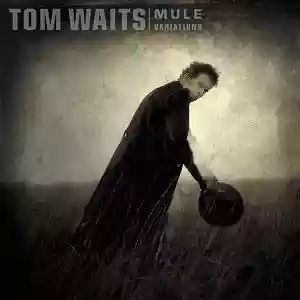
It was 1999 when this record came out. The last studio album by Tom Waits was "Bone Machine" in 1992 (excluding the theatrical soundtrack "The Black Rider"). "Mule Variations" is an absolute masterpiece, containing 16 tracks with a 'dirty and unsteady' sound but all driven by an irresistible musical force.
“Big In Japan” opens the album; it’s a highly rhythmic rock piece, marked by solid electric guitar riffs, powerful percussion, and accompanied by Waits’ rusty and almost demonic voice here. “Lowside Of The Road” the second track of the album fully represents the author's musical neo-realism: a depiction of an urban slice of life, in an unspecified time and place, all wrapped in a scary, absolutely unsettling atmosphere.
The rhythm is extremely slow and seems to advance with difficulty; Waits' voice drags along laboriously, scratching the bizarre and dirty sounds produced by instruments of an absolutely unconventional type.
“Hold On” is the magnificent single from the album, a ballad that seems to come from the rural landscapes of the American countryside: a 'black and white' melody that sounds romantic and ancient, gentle and yet stained with mud at the same time. “Get Behind The Mule” is a country-blues piece of overwhelming simplicity and strength, an old-style blues song that smells and 'stinks' of the wildest part of the American countryside. "House Where Nobody Lives" splits the heart in two, a beautiful tear-jerking ballad about a topic that might leave many indifferent, but not 'old Tom'. It speaks of a house abandoned by its resident family, left to be overtaken by weeds growing relentlessly there, and by the tales of people who see it at times as a cursed house haunted by something unnatural. An abandoned house is a house that has had its heart ripped away, as Tom tells it:
"...I've all of life's treasures and they're fine and they're good they remind me that houses are just made of wood what makes a house grand ain't the roof or the doors if there's love in a house it's a palace for sure without love. . . it ain't nothing but a house a house where nobody lives. . . "
“Cold Water” is a rough tavern blues, with simple yet effective strumming and a very energetic sound. This piece revisits a theme very dear to Waits for a long time, that of society's outcasts, the marginalized, the defeated, the homeless or, as the author aptly puts it, the 'Rain Dogs'. Those kicked to the curb and thrown to the outskirts by a society that cruelly and harshly advances, they remain overwhelmed and stranded on American soil. A song that can be considered as the continuation of his older pieces, reminding much of "Jin Soaked Boy" and "Murder In The Red Barn," to name two. “Pony” is the epilogue of the return home of a fantastic, slow and long journey on horseback riding a Pony. The eighth track “What's He Building?” is not a song, but a terrifying story about a mysterious neighbor. Thanks to the author's rough and 'underground' voice, this piece becomes particularly eerie. Few instruments and many sinister noises accompany Waits' voice. A horror track, undoubtedly stained with blood. The metropolitan and dark atmospheres of the second track are revisited in “Black Market Baby”: a spine-tingling slow-blues.
The autobiographical “Eyeball Kid” is also very successful, urgent, and highly rhythmic, enriched with beautiful percussions. In “Picture In A Frame” we find Waits sitting at the piano performing a beautiful and romantic song, with extremely simple and effective sounds here as well. "Chocolate Jesus" is a blues, with irresistible and blasphemous irony, a slow and very catchy rhythm.
The track that always leaves me speechless, my absolute favorite from this album and perhaps from Waits’ entire discography, is the thirteenth: “Georgia Lee”. Here we find Tom again at the piano narrating the terrifying story of the death of a girl in an unspecified American town, whose body was found among the frozen thorns of a bush not far from her house one winter. Faced with the brutality of such an event, Waits takes the opportunity to question the possible non-existence of any God. From this: "Why wasn't God watching? Why wasn't God listening? Why wasn't God there for Georgia Lee?" A colossal song, it always leaves me dumbfounded.
“Filipino Box Spring Hog” is a quirky, hard and energetic piece that immediately captivates. After the hardness of the previous track, the soul is warmed again by the magical piano notes of "Take It With Me", where Waits’ simple and direct romanticism is unleashed in its deepest essence:
"...In a land there's a town and in that town there's a house and in that house there's a woman and in that woman there's a heart I love I'm gonna take it with me when I go."
Epochal and not coincidentally concluding, “Come On Up To The House”. Transcendental piece, with winds and powerful percussion, on the passage from earthly life to the unknown, represented here by the author by a mysterious house... from here:
"...Come on up to the house Come on up to the house the world is not my home I'm just a passin thru Come on up to the house..."
Waits has hit the mark once again and produces at the brink of 50 years one of his most beautiful albums, a masterpiece that will forever remain in music history, which will never go out of style (because it never was) and will never cease to be talked about, to move those who listen to it and leave them with an indelible mark.
Loading comments slowly
Summary by Bot
Mule Variations is Tom Waits' 1999 album, praised as a masterpiece blending gritty blues, rock, and raw emotional storytelling. The album explores themes of American life, outcasts, and haunting narratives through uniquely arranged tracks and evocative voices. Standout songs like 'Georgia Lee' and 'Hold On' demonstrate his ability to mix dark atmospheres with deep romantic and social commentary. This album is regarded as a timeless work that deeply influences listeners.Tracklist Lyrics Videos
Tom Waits
Thomas Alan Waits (born 1949) is an American singer-songwriter, composer and actor known for his gravelly voice and eclectic blending of blues, jazz, rock and experimental music.51 Reviews
Other reviews
By AR (Anonima Recensori)
This work stands out for the rural atmosphere that accompanies every song, recorded in the Northern California countryside amidst the greenery and mules.
An excellent return after a long period of silence... where we find a calmer and more reflective Tom but with great impact from the first listen.
By Morgan
"Tom Waits, with his music that tastes of old, of ancient, yet eternal, outside of time."
"'Mule Variations' is a collection of violent and romantic tracks, his harsh and aggressive voice in 'Big in Japan' and calm and welcoming in 'Hold On'."
By blechtrommel
"I didn't marry a man, I married a mule"
His voice becomes the ultimate instrument, the thread of these thousand stories, the firecracker and the clarinet imbued in the verses.
