 •
Rating:
•
Rating:
THE REVIEW
THE LAST WAITS PRE-TROMBONES
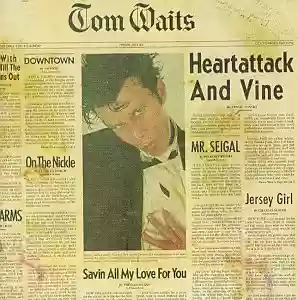
“Heartattack And Vine” was released in 1980, just two years after the splendid masterpiece “Blue Valentine” of 1978. The artist's music has changed quite a bit from the early albums of the early '70s, which were of a more composed and purely singer-songwriter style, compared to the wild and eccentric tracks we find on this album. However, this was not a sensational news because Waits' style had already changed for a few years and indeed does not differ much from the previous work (“Blue Valentine”).
There is indeed the same metropolitan, dirty, infamous but extremely lively and exciting atmosphere. A world that goes on ignored by the well-to-do society, from which 'old Tom' always manages to find his best compositional inspirations. Compared to the certainly more successful and richer “Blue Valentine”, here the memorable pieces are definitely fewer in number (and partly also in substance), but they are definitely there. (Only) nine tracks.
Some energetic and full of powerful and rudimentary percussions that mark the rhythm (mainly in the first part of the album), others slower and more reflective, masterfully guided by Tom Waits' piano (mainly in the last part of the album). Among those of the first group, the beautiful “'Til The Money Runs Out” and the engaging and hallucinatory journey into the underground bowels of the city in “Downtown”. Among the latter, I must absolutely mention the beautiful, melancholic and romantic closing track “Ruby's Arms” along with my favorite track of the album: “On The Nickel”, a sweet, gentle and soft orchestral music complete with accompanying strings, carrying Waits’ rugged, splendid and gritty voice, here more than ever particularly highlighted.
A few words are also deserved by “Mr. Siegal”, a neighborhood blues marked by guitar riffs and by Waits' piano. Songs of this type will also be composed in the future, with always excellent results, I am talking about “Jin Soaked Boy” from the legendary album “Swordfishtrombones” 1983 and the spectacular “Table Top Joe” from the album “Alice” 2002. The sticky and catchy chorus of “Jersey Girl” made it the most famous track on the album, perhaps not among the best songs on the album, but certainly the one that gets stuck in your head the fastest.
After this album (with the exception of the soundtrack “One From The Heart”), Waits will steer his compositions towards an increasingly distorted and unreal style, increasingly dark and cursed, which seemed to apparently distance him from reality, but which actually dug into it, up to touch its deepest viscera. This will give birth to masterpieces such as “Swordfishtrombones”, “Raindogs” and many more to follow.
Loading comments slowly
Summary by Bot
The review highlights Tom Waits' 1980 album Heartattack And Vine as a continuation of the gritty, lively metropolitan style from his previous work. While not as rich as Blue Valentine, it offers powerful percussion-driven tracks and reflective ballads led by Waits' piano and voice. Key songs like 'On The Nickel' and 'Jersey Girl' are praised. This album marks the last phase before Waits' musical style became more experimental and darker.
Tom Waits
Thomas Alan Waits (born 1949) is an American singer-songwriter, composer and actor known for his gravelly voice and eclectic blending of blues, jazz, rock and experimental music.51 Reviews
