 •
Rating:
•
Rating:
THE REVIEW
If the ultimate sense of the word 'creation' is to bring into being with absolute freedom—without any limits or censorship of any kind—it is also true that giving order, a form, to the fruit of inventiveness does not always harm the final product or impoverish it. In some cases, even in music, one can indeed affirm the opposite: how many artists owe the success of their work to the intervention of an external "agent" who—with professionalism and, when necessary, detachment—weaves the threads of a discourse that could risk foundering in solipsism? Often, it is the arduous task of the producer—a sometimes overlooked but fundamentally important figure for works of melodic ingenuity. Then, when this singular character—who is often, and mistakenly, relegated to the mere economic sphere of the music discourse—engages in sound experiments himself, so much the better for the cause of art and its outcomes.
"Genius and recklessness": the expression seems to fit well for types like Todd Rundgren. But only if you extend the semantic range of the first term, compelling it into an elementary bifurcation of meaning: as brilliant in giving a definitive shape to the works of others as he is unpredictable, crazy, experimental in beating his own singer-songwriter path. As obsessive in fulfilling his role as supervisor/producer (one for all: the masterpiece of XTC "Skylarking"—for which our man almost came to blows with the equally meticulous, as well as enlightened, Andy Partridge) as he is uncontrollable in the proposition of his untamed eclecticism. This latter disposition is a bit of a double-edged sword: whereas it sometimes—in its more 'glam' outcomes—leads Todd into the depths of a creative anarchy that is difficult to access and enjoy, elsewhere it flows into masterpieces of astounding innovative charge and consequent historical importance.
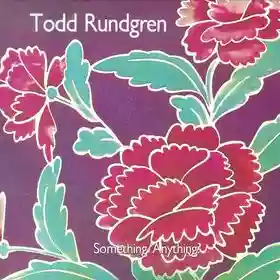
This is undoubtedly the case of "Something/Anything?" (1972)—a double and unparalleled output from a mind in continuous search of the sensational. A quest that employs all possible means to reach the goal, not least a superhuman attitude that manifests itself—in three of the four phases of the work—in Todd’s multi-instrumentalism. Listing the genres covered risks the "grocery list" effect: only a madman could manage to juxtapose with such ease Beatlesque pop psychedelia ("I Saw The Light", "It Takes Two To Tango") with electronic experiments with a 'black' scent ("Breathless"), powerful rock divagations in sixties style ("Couldn't I Just Tell You") and fiery R'n'B ("Wolfman Jack") with colorful Latin interludes ("One More Day"). The blues peeks through where the most restless (and lazy) soul of the composer is revealed ("I Went To The Mirror"), but there's also room for sublime cabaret digressions ("The Night The Carousel Burnt Down") and dizzying slow songs ("Torch Song", "Cold Morning Light"). The soul ballads are extraordinary: "It Wouldn't Have Made Any Difference", "Sweeter Memories", "Hello It's Me", the superb "Dust In The Wind" alone would make the journey in a compositional tour de force capable, at the height of 1972, of making three quarters of his fellow musicians pale. But so much can—in a state of grace—the clarity of a mad mind. From the name it proudly bears, "Something/Anything?" is a monument to the possibility of making music without limits, a work that exudes daring and inventiveness from every pore, an ideal destination for any spirit that seeks its path to freedom in melodic creation.
Loading comments slowly
Summary by Bot
This review praises Todd Rundgren's 1972 double album Something/Anything? as a brilliant showcase of creative freedom and musical mastery. Rundgren’s multi-instrumentalism and genre-bending approach produce an eclectic yet cohesive work. The album blends Beatlesque pop, rock, R&B, electronic experiments, and more, demonstrating artistic inventiveness and historic importance. The review highlights Rundgren’s balance between genius and recklessness, and the album’s enduring impact as a milestone in melodic creation.Tracklist Lyrics Videos
Todd Rundgren
Todd Rundgren is an American singer-songwriter, multi-instrumentalist, and record producer known for studio experimentation, eclectic songwriting across pop/rock/soul, and work both solo and with the band Utopia.25 Reviews
