
 •
Rating:
•
Rating:
THE REVIEW
The theme of the innocent man on the run after being unjustly accused of murder is almost as old as cinema itself, and when it works it’s a perfectly oiled machine: someone running for their life, chased with the truth always just one step ahead. Alfred Hitchcock built a filmography of excellence around it, to name just the most famous: "The 39 Steps", "Saboteur", and "North by Northwest" (in Italy "Complotto Internazionale"). Noir replied with gems like "The Big Clock" and its remake "No Way Out", while sci-fi took a shot with "Minority Report".
Then comes "Mercy", determined to join the genre… with the grace of a drunken elephant.
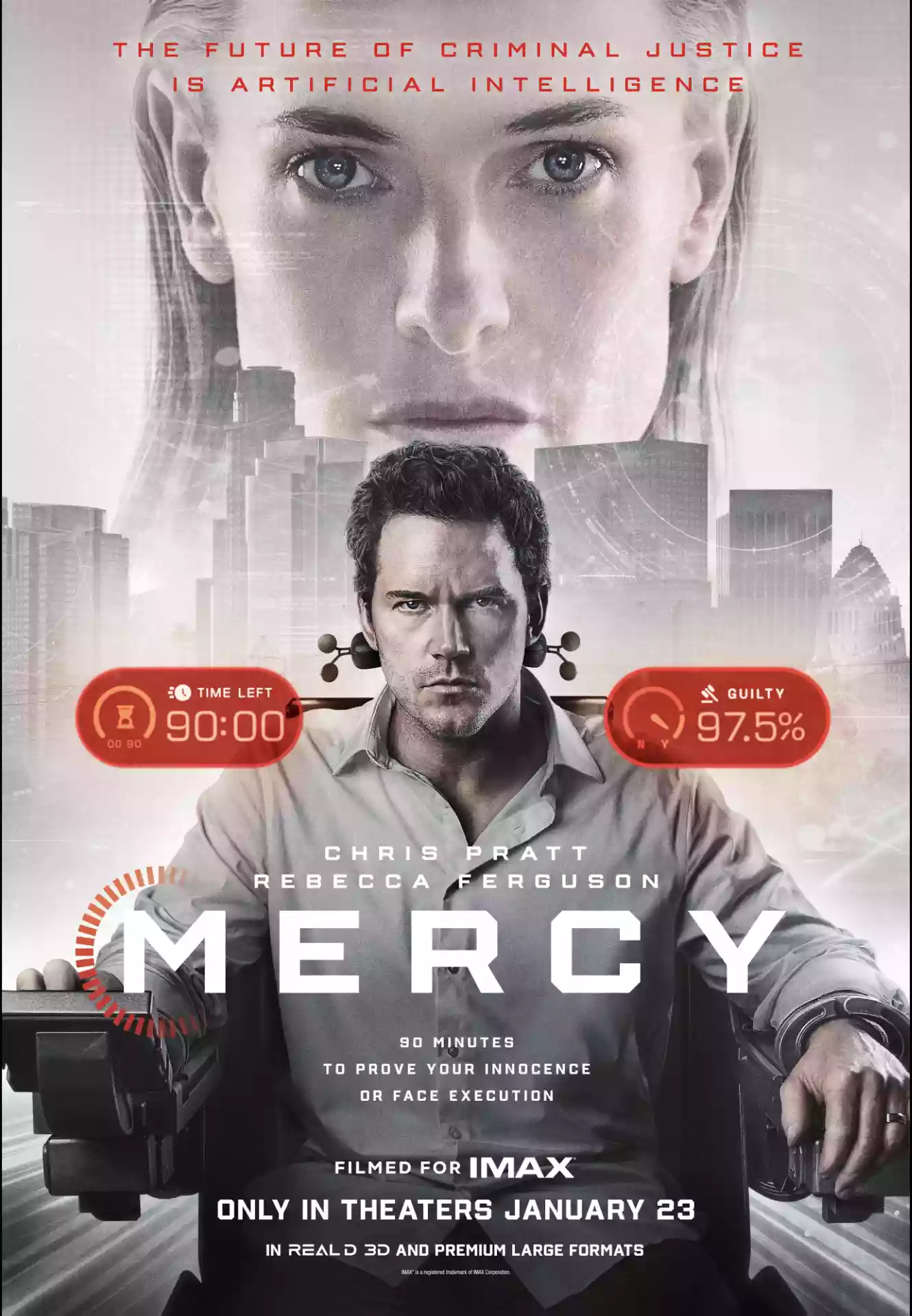
The idea, on paper, sounds irresistible: innocent man on the run + Artificial Intelligence paranoia. In practice, Chris Pratt is detective Raven, accused of killing his wife and shackled to a chair before a virtual judge, an AI with the likeness of Rebecca Ferguson. He’s got 90 minutes to prove his innocence, because the AI is nearly omniscient and finds him guilty with a probability of 97.5%. It’s an intriguing premise, no doubt. The execution, unfortunately, feels like it’s been entrusted to the AI itself after a failed update.
The first stumble is philosophical, but also very concrete: Raven has to prove his innocence within a system that’s already decided he’s guilty. And what is this system based on? The digitalization of our lives: cameras, emails, messages, social media, etc... Every crumb is blended together and served up as evidence of the classic “crime of passion”: he’s an alcoholic, in rehab but with various relapses; she’s fed up and cheating; the marriage is over. Nothing else to prove… but the film has to last at least those 90 minutes.
The tension deflates almost immediately. Raven remembers nothing, he was drunk (of course), but he’s sure he didn’t kill his wife (of course). Selective amnesia: the poor tired horse of mediocre screenwriting, put back on the track as a gallant colt. And we’re supposed to believe him because Chris Pratt has that “nice guy” look that cinema has been using for decades as a moral certificate.
Too bad everything around him is a visual bombardment worthy of compulsive scrolling: videos, posts, clips, snatches that go by at supersonic speed. Instead of building tension, they build a state of nausea. And above all, they offer no openings: there’s no mistake to discover, no clue to chase. There’s just an algorithm that needs to be convinced it’s read the data wrong. More than a thriller, it's an exasperating negotiation with digital customer service.
But the real crime is that the innocent man is not on the run. He’s sitting. No trains, no highways, no chases. Just a room, a chair, and a virtual judge. The genre is reduced to procedural claustrophobia disguised as futurism. And as if that weren’t enough, what little plot emerges from the blender is a catalog of absurdity: a suspect who hides out for two days in a basement without eating, drinking, or... taking care of the most basic needs of existence; private vendettas improvised seemingly during a coffee break; trucks speeding along that no one can stop (those spike strips truly are science fiction).
Labeled as a budget Minority Report, or alternatively for those with the attention span of a fruit fly, the film flaunts a surprising 82% on Rotten Tomatoes, while the usually more forgiving IMDb audience sits at 6.2/10.
If you love images shot at you like deranged confetti, if you settle for blurry action scenes filtered through handheld cameras, if you find it erotic when an algorithm with Rebecca Ferguson’s face spits out percentages like a doomsday accountant… then "Mercy" might just be the film for you.
The others may prefer an innocent man who at least tries to run away.
Loading comments slowly
Summary by Bot
This review delivers a critical perspective on Timur Bekmambetov's film 'Mercy.' The reviewer rates it poorly, highlighting significant shortcomings. The tone is serious and evaluates various cinematic elements. Readers are encouraged to consider this review before watching. It serves those seeking an honest critique.
Timur Bekmambetov
Timur Bekmambetov is a Kazakhstani-Russian film director, producer, and screenwriter known for high-energy, visually kinetic genre films. He broke out internationally with Night Watch (2004) and Day Watch (2006), then directed the Hollywood hit Wanted (2008). He later advanced the Screenlife format with Profile (2018).03 Reviews
