
 •
Rating:
•
Rating:
THE REVIEW
Going Out Of Business: Life is a Killer / Love is a Dog from Hell.
..............................................................................................................
1. Great moments that splash away next to a bus.
Outside it was dark. Gloomy. The kind of deeply sad, damp, and bleak atmosphere that you’d expect any English evening to provide. What that nation really had, in truth, were four kinds of winter, and this one was particularly cold. Eddie Coffin was a perpetual vortex of thoughts. He stepped out into the night’s darkness and spent his time thinking that tonight was peaceful all around and how many ugly and insignificant buildings there were out there. This was the era marking the end of his career as a timed thinker. The end of his career as an academic philosopher, the end of commerce through thought aka the end of his paid thinking. But the plane was late.
He had almost ended up in jail recently, couldn’t even recall the reason, had been taken to the police station from an apartment where he had been found in his birthday suit, and couldn’t remember a thing about it. But at the station they’d been forced to release him. They already had a couple of existentialists and a deconstructionist in the cell doing elautirips acitsannig. Sneaking out of town had always been an honored philosophical tradition, Eddie thought. Montaigne gave him rhythm. Every thinker had always paired themselves with some name from the past, every thinker chose a page-companion. The beauty of the system, Coffin reflected, was that dead philosophers couldn’t refuse to dance. Eddie had chosen for himself La Mettrie and the art of enjoyment. La Mettrie, a devilish eudemonist who’d eaten himself to death and died with his cutlery still in his hand. The only ones Coffin could tolerate were Diderot, not for his thinking but his writing, and La Mettrie yet again, because anyone who could eat himself to death deserved to be taken seriously. Hamann meanwhile reminded him that no amount of intelligence could save you from stupidity, and that however much you trusted in your own mind you never truly were safe from stupidity, yet Hamann had been a shiftless twenty-nine-year-old who’d just gotten back from London, where he’d squandered, among prostitutes and banquets, an enormous sum of money and was now ready to dedicate himself to religion. Gemeinsinn. John Locke, Thomas Reid, 1710-1796, inquiries concerning the human mind on the basis of common sense. Mendelssohn, Morgenstunden. Why bother your mind with facts? Since no brilliant idea was coming to him, Eddie settled for a dumb one and pondered the plain fact: no matter how smart you were, you could never escape your own stupidity. Hamann, perhaps, had been right. Ithypallic maniacs, Zalmoxis, reading Zegabenus on Z, Kineidologoi, specialists in the obscene, the Epicurean Metrodorus, Democritus, according to whom a wrong unrectified is a double wrong, Ludwig and the clarification that what you see is all there is, Kant: indescribable boredom, Dionysus the renegade whose famous line was that pleasure is the goal of action, a whole bunch of -ologies, theology, aletheiology, eschatology. The literary contest. Coffin thought, in the end, the philosopher is a human being, and whenever a backside is presented, must decide whether to lick it or kick it, and since he had no brilliant idea, he settled for a dumb one. After all, Emperor Justinian decided to close the Athenian Academy in 529, persuaded that philosophers brought more trouble than anything, together with assorted charlatans, conmen, geloscopes, fortune-tellers, capnomancers, ichthyomancers, oneiromancers, belomancers, and catoptromancers. And undoubtedly there were also necromancers, alphitomancers, axinomancers, tephromancers, ornithomancers, alectryomancers, chiromancers, dowsers, halomancers, cleromancers, and haruspices. Everything is more interesting abroad, even death. But the plane was late. Once in Taipei, watching a man at the bus stop, he thought: ours will be a brilliant friendship. A moment later, a bus took the man away.
2. There isn’t enough future.
Coffin, dipsomaniac of abstinence and nychthemeron, had had the suspicious privilege of a chair at Cambridge. His students were eager to be supervised by him, and when they missed appointments Eddie didn’t complain, since he didn’t show up either. His philosophy for philosophy exams was that it was enough to add some question marks and a bit of incomprehensibility to the questions, a dash of opacity to the answers, things quite chic. Being slightly vague, or, if you wanted to be brave, even deliberately obscure, would allow others to insert their own ideas and worries into his work on the contingent and the particular; if you were too clear, in Coffin’s philosophy, all propositions would be too definite, the intent was to encourage interpretation. One of his students, though, came to the conclusion she would no longer attend his individual lessons, and became convinced that for the tiniest intellectual satisfaction there was nothing left for her but suicide. To colleagues, Coffin was the one who ate staggering amounts of food in staggeringly expensive restaurants, drank staggering amounts of staggeringly priced wine, and copulated more than the average logical positivist or deipnosophist. Potentially, the world was his zenana. Colleagues often misunderstood him, like in the case of Tanizaki, who succumbed to the fairly common bias of thinking philosophy a kind of moral calisthenic exercise. Furthermore, Eddie was a lover of sleep and oneironautics; his thinking was: I am in bed with the hippo, therefore I am. Coffin found the horizontal position helped him think better, making people more aerodynamic against life’s blows; most of existence’s troubles, to him, stemmed from the upright position, so why put up with verticality when you could easily be horizontal? He never had any trouble staying in bed, the charm of remaining mattress-bound was unaltered for him, but he now found it harder and harder to seize those invigorating flashes of darkness and surrender to sleep. The undertakers were starting to take his measurements. It had been so long since doctors had told him he should already be dead that he no longer found it fun to consult them. The last doctor he’d seen feared he’d never see him again and bid him farewell. Eddie thought he was right—so much so, the same doctor was murdered by his wife a week later. At Cambridge he was commissioned to write a book, but Coffin didn’t budge, thinking it would be pointless, since as long as he was absorbed in not writing his book on Spinoza, it was pointless unless he came up with the right title. On the other hand, he toyed with the idea of doing a book on the millennium, but the trouble was he had no idea what to say, being much too busy (in his view) perfecting his uselessness. One last book in his career, he thought, and then it’s curtains; after all, plenty of people had managed to build a career writing a single book and just changing the title regularly. But Eddie would do all this only for the money, nothing else. Coffin had always had a certain contempt for those who played down the allure of money, thinking such people usually awaited an inheritance so they could land a castle. For Eddie, money was the indispensable aid in attaining the supreme good—a contemplative life. But the trouble with signing a contract, Coffin reflected, was it might give people the impression you actually agreed to do something, which obviously was not his intention. So Eddie kept thinking, imagining that sooner or later everyone ended up running a brothel with too little experience, in Amsterdam.
3. The pantry of depth is empty.
France already had at that time some of the best run-down hotels in the world. In Montpellier, Coffin found one perfect for him, with different colored wallpaper peeling off the walls and in-room amenities that weren't much amenity anymore. Hubert tried to mug him in that hotel, but Eddie had already lost everything in an accident just before, and in the end, he wandered around with Hubert, sharing a couple of baguettes and letting him sleep on an armchair in his room. Hubert had appeared in life from a dumpster and landed in an orphanage. Hubert, a bruiser with deadly headbutts and a very peculiar passion for cement. Hubert was, in the end, a romantic. He had only one eye, one arm, one leg, but was an artist of revenge and a connaisseur of all weapons. Hubert, henceforth just Hube, would have recognized an orphanage companion by the look on the cover of a porn magazine. At the time, Eddie loved all words starting with Z and conciseness, a quality he found lacking in modern philosophy. And Hube’s concise request had convinced him with a simple: your cash or else! Sooner or later in life you reach the point where you have to go out and rob banks, thought Eddie deeply, and from that instant onward, he and Hube would be the Thought Gang, a name coined by Hube himself and sent to reporters to avoid bad titles in the press. Eddie thought philosophical bank robberies didn’t hurt anyone, in fact they were exciting, entertaining, stimulated the economy, and invited reflections. Every robbery would be conducted with a different zetetic method, without ever losing sight of the Stoic method – that is, remain calm. Robbery had this beauty, you could work whenever you wanted, but robbing banks seemed addictive, but above all shielded you from the bibliopara class and insurance salesmen. When the Thought Gang entered a bank and announced themselves, if anyone replied at once with a quotation from a philosophy classic, they would leave that bank alone. Their slogan would be: only knowledge will save you from the Thought Gang; don’t call the police, study the classics, don’t buy an alarm, buy the works of Zeno. Once Hube declared this would be a Neoplatonic robbery, and everyone should concentrate hard to distinguish it from a Platonic job, and that in doubt, you could ask the prof right there. Hube was almost always disappointed; he would have loved, just once, to leave a bank empty-handed, blocked by a learned quotation, but this never happened—a fast food language, one minute and twenty-seven seconds for the job, twenty seconds to tell ten years of his life. All that crap unrelated to philosophy had to go—frankly, not a good way of running a business. And he thought if people didn’t pay for things, they would never truly appreciate them. Eddie was coming to the conclusion it wasn’t such a great idea to leave Hube alone to ambush a mouse with a loaded, silenced revolver. And he thought the Eliasts were right to worship the sun. He reflected on the greed for knowledge that had seized his partner. Wanted more books; said he didn’t feel cultured enough, felt his stupidity growing. Hube was a very slow but meticulous reader. You don’t know how tough a mug is until it’s thrown at a wall. It evokes an atmosphere of refined domestic violence, and violence always suffers from bad press. Hube had a very deadly and very fashionable disease, even brute force suffers a bad reputation in the news, and the people he beat up weren’t used, of course, to getting battered with dialectics too, and sometimes they made a thousand francs for bullets and for advice. As though he were a Serb set on shelling Sarajevo, and the Mujahidin, who usually laughed during firefights, now were running around screaming black is not what it seems, and you couldn’t be the Antichrist and expect universal appreciation. What people couldn’t understand was all that cement. The toilet bowl, washbasins, and sinks had all been filled with cement, several pieces of furniture glued to the ceiling. He wasn’t doing it out of malice, Hube was in quite a good mood as he trashed the apartment. Such were the Lives of Philosophers. Dishonesty too was hard work. Isratnemal elituni, eautomorphism. Disc Jockey of Thought: mindfuck, mindgames, gaslighting, Psi and Omega, the shrink confessed he had actually been born a woman, his wife had killed herself the week before, but what Hube had in mind was another no.
Hube was the Enlightenment. Cheiromania. He forced investigators to look up verbs in the dictionary, because there was nothing, absolutely nothing, he said, that would piss a cop off more than an ex-con with a better vocabulary than his own. Enough joking, he decided: they would buy a bigger dictionary, gangdelpensiereggiante, since getting robbed by the Thought Gang was a privilege. Followers of Wolff in Zeebrugge, if you’re not predator, you’re prey, Hube snorted.
A force of destiny, invincible, invisible, The Thought Gang. Open contempt for anyone who wanted to rob banks for the money alone. Hit hard, above all the rich. Those always preaching solidarity and charity, the ones obsessed with beneficence and sympathy, were the very ones who mistreated waiters, neglected children, and underpaid gardeners. The Thought Gang. The beauty of having a pistol was that it automatically put you on the right side in a Socratic dialogue.
Eudaimonia and Ars Rhetorica. Sensory data had encountered the Thought Gang.
4. Losing other people’s homes.
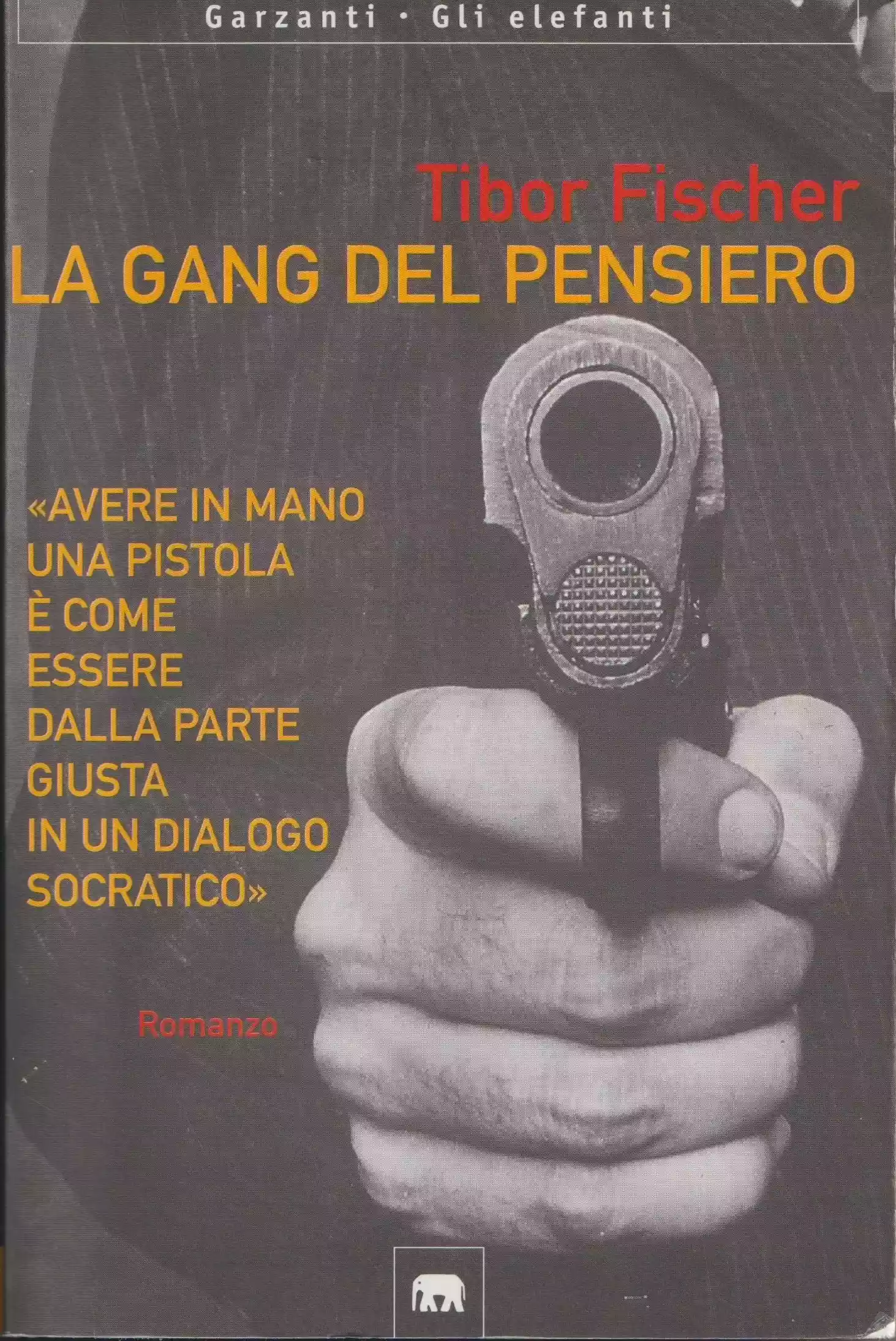
The Thought Gang [Polygon Books (UK) - The New Press (US)] was put out in 1994.
A novel with a cycloid development and highly irregular structure, it stands apart from that assembly-line narrative so dear to the industrial heart. An unceasing tour de force, sensitive and sensorial, digressions and pulp, transmigrations of the soul, urban stage sets. A book of English and deeply East European culture, where an ugly truth is always preferable to a beautiful lie. Sex shops and lifers in a survey of banality and unbeatable passing time, the great curtain, the West End. Scenes of living room pools built for revenge, of people forced to write chained to radiators, Nobel winners losing their trophies at cards, headbutts in bars, bookstores punished for too much ignorance, cement, Hube.
The Thought Gang. Eddie, the middle-aged philosopher; Hube, the crippled punk apprentice-philosopher full of prostheses, who’d lived thirty years with himself and didn’t even know who he was, certainly not the kind who would take two hours to make a woman come. Gang assisted, de facto, by Jocelyne the nullipara, already robbed at her workplace in her own bank, who despite her age lost not a moment of her beauty, and by Thales the mouse. Scenes of John Smith. But John Smith never actually existed. There were people who’d read and, apparently, appreciated his entire œuvre. They had seen his documents. People remembered him well. They discussed conferences he hadn’t attended and lunch invitations he’d mysteriously canceled at the last minute by bizarre forms of indirect communication.
But the Thought Gang is refined, polite, spectacular. After their robberies, they don’t go into hiding, they go to a restaurant. And in Turin there exists a bookstore that calls itself, in their honor, La Gang del Pensiero.
5. My friends lose their phone.
Hube had been off for a few days in Paris, searching for his orphanage companion. He’d bought several magazines with her face on them and now was sure, it was her. He tracked her down by hiring a few private investigators, and now wanted to spend some time with her. Using his lockpicking skills, he spent the night at her place, under her bed, without revealing himself, wanting just to be near her, just to hear her breathing. The next morning, he waited till she went to the bathroom, slipped out of the apartment, and rang the doorbell. Introduced himself, but she didn’t seem to remember him. They spent a morning at a café having breakfast; she was now a cop, and they took a photo at the table. When provided with film, his memory really was photographic. Then he went back to Toulon. That was where, for the moment, the Thought Gang was based.
Meanwhile Eddie vegetated, debauched, and rested wrapped in a thunderstorm, surprised to find himself remembering some of his family. His maternal grandfather, for example. Once, in the middle of a conversation, he interrupted someone claiming to have heard someone calling him. Told the person not to move while he went to see who it was. Eddie thought his grandfather must have had very sharp ears, since after a while they realized he’d ended up in Florence. His paternal grandfather, on the other hand, never hid his powerful signs of imbalance from anyone. The irascible type, instead of leaving for Italy, he’d grab a chair and retire to his room, warning everyone that his “five minutes” were about to come, and this happened about every eighteen months. He’d lock himself in and shred the chair to pieces, tidy up, then go buy a new chair to put in that death row, awaiting the next execution as soon as eighteen months were up. You could always trigger his destruction mechanism by leaving something on your plate: just a bread crust, a single Brussels sprout. Abandoned food made him twist in uncontrollable rage. He was a maniacal collector of editions of Schiller’s and Hölderlin’s works, both new and antique, which he would burn to ash in the fireplace in winter. Schiller and Hölderlin were the sole authors in the Stalag library where he’d been interned. Always imagining a world reduced to ashes, he’d bury the works of Shakespeare in lead-lined crates in the oddest places. He showed uncontainable cruelty to all waiters: he’d order steak, then claim he’d asked for fish. The wartime forgery trade he practiced in prison was used to register at countless libraries, where he’d wipe out the stocks of Schiller and Hölderlin. He exchanged contacts at traffic lights. He ordered cement mixers for people who had no use for them, with the current driver waving an order written and signed by a professor.
He absolutely ordered all his relatives that his tombstone should read: Schiller? Hölderlin? Who were they?
Hube, meanwhile, had returned from Paris. His emaciated face was, for once, relaxed.
It had been a long time since anyone had finally seen him asleep.
6. It’s never too late to be late.
Bars of the world. What happens in hell. The bar was swathed in dimness, maybe to encourage relaxation. On many of the walls were postcards from countries of incomparable political instability. Eddie had been introduced there by Hube, who told him a number of coups had been organized at the tables. Once, in that bar, Hube had gotten into a fight. Eddie was alone now, there, sitting in that bar full of unhappy people acting as if they were happy. Sleepy, aged, round, filthy. Priapic lads, the product of a dying civilization, teenagers tired of life already—noetically speaking. He had landed in hell. He mused about the magnetic pull train stations have on misfits panting and madmen howling. He’d never had trouble making friends among the outcasts. One guy told him his wife had committed suicide the week before. 1987 always left him puzzled, as did people who didn’t understand what they were saying. Eddie, surrounded by the sadness all around him. He stared at his Babylonian hourglass. He thought: one of the few advantages of advanced middle-age was knowing there was little that could be done to improve your packaging in a short time. More and more, as you grew less young, after forty, your social engagements changed, and you ended up carrying your conscience to funerals, and as you grew older it got harder to make friends. Another of the few true benefits of losing your youth was that you expected so little from life you could more easily appreciate things when they happened. He replayed in his head the robberies, all that money from the tricks, but it was just money, nothing more, and the money went away as high-proof piss. Eddie had returned to Toulon with the whole gang; he’d lived there once as a young man, on a street nobody cared about. Neither the street nor the building had anything special, except one thing: he had lived there. His disintegration had started right there. And nothing tells your age on your back like seeing cities changed in certain ways. A clue, a memo of your own youth. And Toulon represented his youth, the truth of the youthful age. It seemed impossible that that young man could have anything to do with him now. Young Eddie at twenty had health, a future, and moral dignity. That’s why Toulon seemed so different now. It bore witness to a brand-new memory, and youth in general creates regrets. No more phoning up a foundation for a scam, and recently he’d discovered his intellectual and adrenal resources refused to get excited by such things anymore; Eddie felt he no longer had any room for time, and reflected that the harm you did, you always did to yourself. Opportunities he’d had, including hefty advances for books never even started and written by a copy editor. It was hard to miss certain targets, but he managed to miss the toilet bowl from less than a meter away. For him, simply being a living being was tiring enough; for him, having once been Eddy was more than enough. His soul took the express elevator to the fortieth basement floor. Once, in one of those bars, he’d met Gérard. Eddie had always arrived late to meetings, that time he was very late too, but even if twenty years late was a phenomenal record, Gérard was happy, he knew that if he waited, Eddie would show up and settle the score.
In the end you always have to pay the bill, for knowledge as for pleasure, and Eddie didn’t believe he could afford the one headed his way. Night on Earth. In bars, late at night, but also in Jesuit dormitories, fear passes and leaves its mark. Nothing rational can shield you from the volleys fired by death. He thought toward the end, before leaving: life or death, one of the two will screw you for sure.
7. Reflection on Great moments that splash away next to a bus.
You have to know when to start, but you also have to know when to stop. Thought Gang, a single, last, unique book, and then exit the stage. A Hapax. Jocelyne had spent the whole night driving around trying to track them down, but since even they didn’t know where they were, it was no surprise she didn’t find them. They’d driven around in circles without finding the bank, either they got lost or the bank did. Hube was at the wheel and had insisted on stopping to ask for directions at a police station. Their philosophy of escapism and escapology was simple: never confess in an emergency, never get yourself in trouble, after all, cops get paid to do what they do, never do the job for them. Their boiled-down version consisted of firm “no”s, complete with “no” and a bonus “no.” The method devised by Robert Oskar Kruger. But the way Hube carelessly changed gear had driven Eddie nuts. To make matters worse, Hube seemed undisturbed and that increased Eddie’s irritation. But Eddie knew well that the trouble with losing your temper was that it usually only served to make you look ridiculous. Hube, however, knew what he was doing: just drove, much more aware than Eddie that when you're going nowhere, there’s nowhere else to go. Hube’s theory was there was nothing more suspicious than driving fully by the law. His own version of the liar paradox. Even the most beautiful things come to an end.
A bank, a date, a gang. They had pre-announced themselves, lightening the police workload.
The Thought Gang would commit one last robbery, there would be no more after that. The important thing was being there in spirit, not in body. They would distribute autographs. The robbery really did happen, the cash sent through cables right under the noses of the authorities and law enforcement. Now the Thought Gang could retire to private life, because you have to know when to begin, but also when to stop, and at the terminus, you certainly don’t want to look like an idiot. Reaching the peak on the top of the pyramid taught them existence is full of darkness and awful cold. But after a while even the perfect bastards get boring, and like most truths, that one bored him too. That was the last robbery. All that remained now was not to ruin their unblemished career by getting busted in a supermarket—or going for major crime and running a country, but to rule you had to get up early, unless you stayed up late and woke up early, and they never slept. But they were philosophers, not criminals. What was it like being the biggest dickhead in France? So, said Hube, what’s it like being the biggest dickhead in France? They organized a farewell dinner. They left the restaurant at night as easily the best-fed, most cultured, and niftiest robbers in that section of the Milky Way. Anyone could well imagine that now the Thought Gang was only looking for peace and a period of rest. All they wanted right then was a bed safe from raids and insurance salesmen. They circumnavigated the silence, then stopped and headed into the darkness, stopped with the bank and bookstore robberies, and stopped because their task was done, then towards the stars... then towards the stars. Beautiful Helen of Mathematics, so true: the scariest thing is the unknown. The disappearance of the Thought Gang. There has never been any doubt that truly capable people create turmoil. Over everyone with real talent hovers an air of struggle. Endings are by definition sad, but here there are no sad endings, no pointlessly glorious final scenes, essentially a disappearance. The disappearance of the Thought Gang. Rarely do exits immediately reveal their meaning. Usually, a minute later you feel little different than before. Even the weakest can endure a loss for a few hours, days, weeks; it’s the months that start to teach you what’s missing. And it can sometimes take ten or twenty years for things said to reveal their meaning, and sometimes years before bumping by chance into the secret semantic passage. The only solution to a very difficult problem, Eddie thought, is to let it go. Hube had tattooed a huge Z—chosen as the symbol for atomic number—on his good arm. Hubert left, and went out exactly as he’d come in, through nothingness. Eddie released Thales in Cannes, the greatest sewer he knew. A released mouse; they needed him to settle certain doctrinal issues. From now on: try to lead a virtuous life, drink in moderation, exercise, maybe convert to nephalisme, make sure you look after your health, move to some gloomy northern town that’s paradise for pluviometrists, maybe right in that metropolis full of repulsive bureaucrats, Brussels. But this sentence was false—a liar’s paradox. He remembered that time in Taipei, watching a man at the bus stop: ours will be a brilliant friendship. A moment later, a bus took the man away. Intraural banter, philosophical inquiries, deep friendship and real affection to fight off the nothingness looming ahead. Then disappearance. What mattered was remembering Zoe, who said philosophers made excellent lovers but terrible husbands; the essential thing was Patricia’s spark—that you could even invent your memories, and make your own existence enough, that the important thing was to restructure your memories, the important thing was to remember to call Jocelyne. Flood Strategies. The street loses the Thought Gang.
Loading comments slowly
Summary by Bot
This review praises Tibor Fischer's 'La Gang del Pensiero' for its clever writing and darkly humorous storytelling. The reviewer admires the book's sharp wit, engaging narrative, and thought-provoking themes. Fischer's unique voice and satirical style make this novel a standout in contemporary literature. The review highlights the book's originality and recommends it to readers seeking both humor and depth. Overall, it is depicted as a must-read for literary fiction fans.
Tibor Fischer
Tibor Fischer is a British novelist known for comic and satirical fiction. He is the author of The Thought Gang (1994) and Under the Frog.01 Reviews
