
 •
Rating:
•
Rating: THE REVIEW
Do not rest on your laurels, change, take risks, shed skin, try new solutions: all of this is Thrice.
A band that rose to prominence in the underground scene with the second album "The Illusion Of Safety", but especially with the beautiful third "The Artist In The Ambulance" a blend of hardcore, emo, and metal, which at the time of its release sounded original and far from banal.
From then on, there was the legitimization of a genre over time, which gradually became saturated and saw the emergence of a myriad of clone bands, often with improbable names, riding the wave.
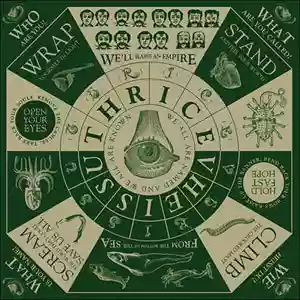
Thrice, who were among the first to propose certain sounds along with other bands, had two choices: continue down the same path or take risks by largely renouncing their origins. The answer is found in "Vheissu," a stylistically very distant album from their previous ones, which sees the Californian group, like other colleagues (see Finch), making a decisive 360° turn.
And so, "Vheissu" presents itself as something surprising and at the same time bewildering for those fans still attached to the previous album, which was more direct and immediate, characteristics that this new work does not possess, being more intense and deep, harder to understand, often with very slow tempos unlike the past, with considerable use of instruments never used before such as keyboards, synthesizers, music boxes, xylophones, and violins, creating a rich and multiform musical web.
More than a few have spoken of diverse and distant influences, including those of the Radiohead for the sweeter, subdued, and dreamy parts close to certain alternative rock and the Deftones for the few rougher and shouted parts, recalling only partly the recent past.
Well, often these two souls merge into a single organism, like in the case of the beautiful "For Miles" opened by a sublime piano arpeggio and surrounded by an astonishing instrumental progression, leading to an epic final outburst or "The Earth Will Shake" which starts like a folk sonnet and ends like a nu-metal piece.
Other times, however, it is the more melancholic and intimate side of the band, which had never been heard in these tones, coming forth bringing to light little gems like "Music box" surrounded by the sound of a melancholic music box, equipped with one of the best choruses of the work, the ballad "Atlantic" and the wonderful "Of Dusts And Nations" among the best pieces Thrice have ever written where Dustin Kensrue proves to be an added value. But there is also room for the electronics and epicness of the second single "Red Sky" and the magical and dreamy atmosphere of "Between The End And Where We Lie."
The only invisible thread that ties the previous "TAITA" to this Vheissu serving as an ideal connecting bridge is the opener "Image Of The Invisibile" a straightforward piece endowed with a certain energy, which could easily have come from the previous album.
The lyrics also deserve a read, as they touch on topics worth reflecting upon.
The band's choice not to propose a carbon copy of the previous album should be appreciated, even though perhaps for many, myself included, an evolution and intermediate step would have been more appreciated, as for many this work will be quite controversial.
The same writer, after listening to a few pieces, had discarded it quite some time ago and only recently reevaluated its complexity and entirety, and it is over time that one understands the great work of dedication, sound research, and attention to detail that the Californians have put into an ambitious project like "Vheissu" which gives ample emphasis to Thrice's creativity.
Loading comments slowly
Summary by Bot
Thrice's Vheissu marks a bold and experimental departure from their earlier hardcore and emo roots, embracing slower tempos and new instruments. The album mixes influences from Radiohead and Deftones, offering a rich, multilayered listening experience. Though initially divisive, its complexity and artistry have earned high praise over time. The band's creativity shines through in deep, introspective songs with a unique instrumental blend.Tracklist Lyrics Videos
Thrice
Thrice is an American rock band from Irvine, California, known for moving from early hardcore/punk and post-hardcore into broader alternative rock and experimental directions across their albums.16 Reviews
Other reviews
By seifer77
I never would have expected Thrice to pull out of the hat an album of such great intensity, beautifully sung and played, that emanates dreaminess from every note.
The scream is reduced to the bare minimum, so as to reveal the great melodic qualities of Dustin’s voice, here warmer and more alluring, rather than angry and gritty.
