
 •
Rating:
•
Rating:
THE REVIEW
We are in 1976 and our four Irish pioneers are at the peak of their songwriting vein that will lead them to international success.
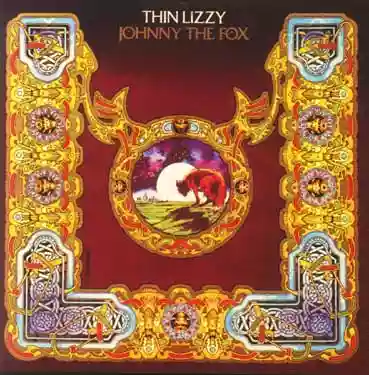
Johnny The Fox is released a few months after the more famous Jailbreak, and perhaps feels the popularity of its rather illustrious predecessor, but in my humble opinion, ours turns out to be overall more fresh and genuine even though it doesn't have a masterpiece like Emerald.
The two fiery guitars of Californian Scott Gorham and the barely older than teenager Brian "Robbo" Robertson (who was 19 at the time!) work in unison to perfection, grinding out never banal or clichéd riffs and collecting a series of very precise and clean solos that provide certain emotions.
What can be said about the always sublime performance of that genius Phil Lynott, a colored boy in the difficult ultra-Catholic reality of Seventies Ireland, a musician who explored a wide variety of musical genres, a songwriter attentive to political reality, a singer with a smooth and hypnotic voice.
Also noteworthy is the excellent work of the energetic Brian Downey behind the drums, as always punctual.
Pieces worth mentioning are undoubtedly Johnny, Rocky, the ballad Borderline, the cadenced Don’t Believe A Word, and that Fool’s Gold, memorable if only for the intro, which I would describe as almost legendary, where Lynott's warm spoken voice is accompanied by the dreamy notes of the two guitars.
But the most remarkable episode is represented by Massacre, where a hysterical riff and powerful drumming provide the backdrop to Lynott's touching lyrics.
The track, as Phil recounted, was conceived from a visit to the Manchester hospital (where he was admitted for viral hepatitis) by a Protestant priest.
Phil’s strict Catholic upbringing made him shy and distrustful. Only later did he realize how foolish he had been and condemned, with the lyrics of this piece, religious prejudices and holy wars.
The other tracks are not far behind even if they navigate a bit in anonymity.
Want a scoop? Well, it is said that before a performance on the American tour, preceding the release of the album in question, Lynott so glorified his band that he informed Mr. Blackmore (yes, that one) that his Lizzy would annihilate the performance of the former Purple guitarist's creation: the legendary Rainbow. The amusing quarrel between the two was also witnessed by the mighty drummer John "Bonzo" Bonham (Led Zeppelin), who was amused and charmed by Lynott's incredible swagger.
I don't know how that evening ended, but one thing is certain, the charisma and artistic abilities of Phil are beyond doubt.
After all, even the Purple guitarist Ritchie Blackmore, who didn’t hide his admiration for the band, revealed: “Phil is the only person who can fit five riffs into the space of four.”
And if he says so…
Loading comments slowly
Summary by Bot
Johnny The Fox, released in 1976 shortly after Jailbreak, showcases Thin Lizzy at their songwriting peak with fresh and genuine tracks. The album highlights the harmonious guitars of Scott Gorham and Brian Robertson, alongside Phil Lynott's hypnotic voice and deep lyricism. Standout tracks include 'Johnny,' 'Massacre,' and 'Fool's Gold,' blending powerful music with meaningful themes. Anecdotes about Lynott's charisma and live swagger further elevate the album's legacy. Though not as famous as Jailbreak, it remains a crucial and emotionally powerful record.
Thin Lizzy
Thin Lizzy were an Irish rock band formed in 1969, led by bassist and singer Phil Lynott. They became widely associated with a twin-lead-guitar sound and a blend of hard rock with melodic and Celtic-inflected elements, releasing a run of influential 1970s albums and later heavier early-1980s work before disbanding in 1983.13 Reviews
