
 •
Rating:
•
Rating:
THE REVIEW
Living and dying in Chinatown...
A jungle waiting to be explored. The first gay-friendly clubs, peep shows, and brothels its vegetation. Underworld, corruption, early gangs, alcohol, and drugs (of all kinds) lurking dangers.
In short, the made-in-China district of London stepping into the new decade.
The prelude to the gestation of this "Chinatown" ('80) for Lizzy was not the happiest. The departure of "Robbo" Robertson, owner of 50% of the magical sound of riffing and explosive solos that trademarked T. L., was definitive. Internal frictions, kept in check until then, overcame reason. Various abuses were the right accomplices, dismantling the last inhibitions.
Lending a hand to replace him was his close friend Gary Moore, an Irishman from Belfast, (guess what) with him came the excellent "Black Rose"('79), then the quarrels and the desire to break out on his own thanks to the natural talent in his wrists and his purebred voice. So, back to square one.
To this, add the vicious atmosphere described at the beginning in which the album recordings were made.
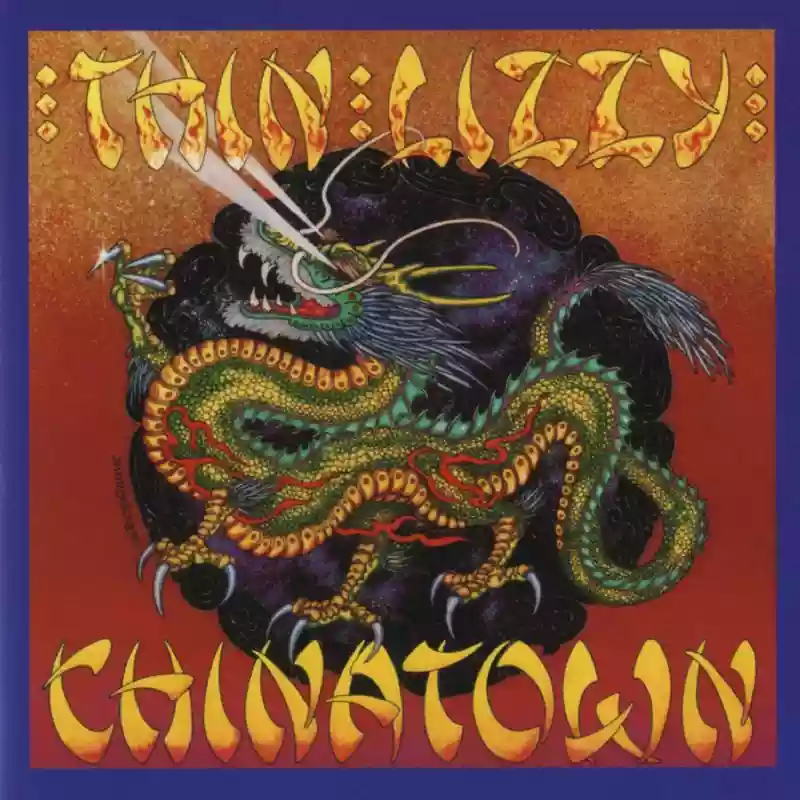
But like in the old stories still heard around here, not all evil comes to harm; so much so that the blond Snowy White (then a session musician with Roger Waters), a skilled guitarist with a blues soul, found himself dueling in typical Lizzy style with Scott Gorham, within the grooves of what Phil Lynott himself admitted to be the make-or-break record. The Chinese microcosm, made up of a thousand contradictions (the work culture symbol of the lowest popular substratum contrasted with the lavishness of powerful "families" opposed and pursued by any means, especially illicit ones), was a cue and inspiration for Lynott, starting with the cover depicting the dragon king, an imperial symbol of China. But beware, not the five-claw one you find in history books, but with three (an evident reference to the triad, the feared Chinese mafia). The claw of death (the EVIL) amidst the other two symbolizing POWER and MONEY. After all, it was also what he saw every day in the cobblestone alleys of Soho, that ghetto city. It was the era of Kung-Fu movies and the widespread exploitation of the eastern lord. The title track is this and more, it's a totem erected to the twin guitars, which for Lizzy were a bit like tights for Batman (the '70s TV version) or, to stay a bit higher, like the vertical rise of buildings in Gothic style.
No need to say how important and fundamental they were for the hard rock movement or the NWOBHM about to explode. Who hasn't heard at least once "Killer On The Loose".
Going deeper:
The hymn to never give up, the energetic "We Will Be Strong" goes hand in hand with the explosive blues-rock of "Sugar Blues" which not so subtly hints at the Texan trio Gibbons-Hill-Beard, great love of the newcomer Snowy White. To reinforce an already self-assured band, the presence of Midge Ure on backing vocals and the introduction of the fifth element, only present so far in live concerts but already mentioned in the credits. I'm referring to the then, still underage, Darren Wharton (keyboards and vocals) also a friend of Lynott. (later author with Dare of the romantic masterpiece "Out Of The Silence").
The true greatness of Thin Lizzy was not (only) here but was to be sought in the far-sighted compositional approach and the blending of styles. A fruit-and-music crossing born from the perfect balance between typically English and American sounds. Two ways of interpreting rock that, in the seventies, were often in opposition. The bastard fruit of the union of two lead guitars. The American touch of Gorham and the malt-scented Scottish of Robertson and now in this "Chinatown" the all-British one of Snowy White (keep an eye on him now with his Blues Agency). That uniqueness given by the union of two elements so different (even on stage), was their strength, like the bastard mixture that flowed in the Brazilian-Irish veins of Phil Lynott. A unique character with dazzling charisma, whose pen revealed his dual nature of strength and disarming fragility. Needless to say, which of the two will have the upper hand on him, the evenings spent in the company of Sid Vicious, Johnny Thunder, and Co. did the rest. But even alone, he knew how to hurt himself well.
A modern poet, Lynott, able to extol the Celtic traditions of his Ireland as well as the urban tales of the suburban outskirts where the true hero is the one who survives. In Chinatown, more than in previous albums, there was focus on substance, the right mix of guitar intertwining without losing the melodic path dictated by good Scott Gorham, Lynott's narrating voice, and the drumming of Brian Downey, one of the most underrated rock drummers ever. References to American Indians "Genocide" (the natural continuation of "Massacre" from "Johnny The Fox" 1977) a recurring theme in the bassist's songwriting. Imagining the war drums and the ghosts of the natives haunting the chaotic streets of miniature China is still a spectacle.
Always transversal, never too hard to fit into the heavy trend (although live they were truly heavy), nor too FM oriented throughout their career, and this Chinatown is no exception. Sometimes epic, other times romantic, without ever straying into the garish or parody, and if you'll allow me, without ever having to dress up or paint their face.....
To the new generations flaunting black t-shirts of an Egyptian version Eddie or the futuristic one from Somewhere... I advise you to "get your hands dirty" but not to start with this "Chinatown" but to trace its evolution album by album to understand what is the weight and what is the legacy of the canvases you have on your shoulders.
In good faith, I tell you that if you find yourself in central London along Gerrard Street, and after a rickshaw ride you're asked for more than due, don't argue and pay because, as old Phil said: << When you are in Chinatown you better look around >>, I always do it and I'm still here to tell you about it.
Only now do I realize I have unnecessarily prolonged, wasting words to honor someone who perhaps did not ask for it. The last two verses of the famous "Warriors" (from "Jailbreak" 1976) were enough to explain Phil Lynott, his life, and his band: << My heart is ruled by Venus and my head by Mars >>.
Welcome to the Chinese New Year.
The opinion of commendatore Bossolazzi:
Frontmen like Filippo are not born that often and bands like Lizzy are born no more.
4 medlars to the album, maximum scores to everything else..... If it wasn't clear.
Loading comments slowly
Summary by Bot
Thin Lizzy's Chinatown album marked a turbulent yet inspiring period for the band, blending blues rock with hard rock and heartfelt storytelling. Despite lineup changes and internal struggles, the album delivers iconic twin guitars, memorable tracks like 'Killer on the Loose,' and a strong lyrical focus on Chinatown's gritty underworld. The reviewer highlights Phil Lynott's unique charisma and the band's evolving but cohesive sound. Chinatown stands as a testament to Thin Lizzy's musical legacy and resilience.
Thin Lizzy
Thin Lizzy are an Irish hard rock band formed in Dublin in 1969 by Phil Lynott (bass, vocals), Brian Downey (drums) and Eric Bell (guitar). With the classic twin-guitar lineup of Scott Gorham and Brian Robertson, they scored hits like The Boys Are Back in Town and crafted acclaimed albums including Jailbreak and Black Rose. The group disbanded in 1983; Lynott died in 1986.14 Reviews
