
 •
Rating:
•
Rating:
THE REVIEW
It’s April 15th, my birthday, and I’m in New York. I’ve just arrived in front of 243 West 63rd Street. After a long wait, I’ve finally been summoned. The apartment is on the ground floor. I’m let in and find myself before a bizarre character with a long goatee, wearing a damask vest and tie under a light dressing gown and a coolie hat. Towering at 191 centimeters and 100 kilos, he’s waiting for me beside a Steinway baby grand piano that starts in the kitchen and ends in the living room. On the piano lid, I can make out a volume of Chopin’s compositions, a jumble of various sheet music, but most notably, a stack of plates and cutlery, along with a mountain of neatly folded laundry.
I feel a bit intimidated, not so much by the fame of the musician in front of me, but rather because he is observing me with a strange look, almost as if I’m not really standing there before him.
I’ve come all this way to interview Thelonious Sphere Monk.
To overcome my blatant embarrassment, I break the ice right away with my first question.
DottorJazz: Mr. Monk, tell me about your musical training.
Monk: Well, I started playing piano at age 6. I was born with perfect pitch, but I studied a lot, I received a formidable musical education. By 13, I was competing in the evening contests at the Apollo Theater, but I got so good that they banned me from participating after I’d already won too many. At 17, I started playing organ in church. That’s how I learned tons of gospel and African American folk songs, absorbing the techniques and styles of ragtime pianists like Scott Joplin, or swing players like Duke Ellington.
DottorJazz: Thelonious, could you describe your technique in more detail?
Monk: The style that influenced me the most was the Harlem Stride of James Price Johnson. The technique is based on the left hand not playing just the accompaniment chords, but alternating them with bass notes played in different octaves of the keyboard, giving the music a driving and rhythmic feel, but also a shift in time and direction.
DottorJazz: Tell me about when you started playing in NY clubs.
Monk: When I finally felt satisfied with my style, I began playing at Minton’s Playhouse in Manhattan alongside Bird, Dizzy Gillespie, and Miles Davis. Our aim was to create a new musical movement that could overturn jazz as it was known. On those nights of improvisation in Harlem’s clubs and on 52nd Street, a revolutionary movement was launched that swept away the big band swing, a genre too distant from the life experiences, culture, and artistic creativity of the African American communities in the big cities of the East Coast.
DottorJazz: You’ve piqued my curiosity; please explain to me how you play your piano keyboard.
Monk: I never wanted to play like a virtuoso, like Oscar Peterson. I’ve always preferred to subtract rather than add. My distinctive sound is based on playing chords with just two notes (editor’s note: the root and the seventh), seeking to obtain a sort of “primordial” sound. That’s why I use silences. I insert them where they normally shouldn’t be, making them integral and assertive parts of the improvisation. I love dissonances, and that’s why I use outstretched and flat fingers, not arched as good piano technique would require. This hand posture is crucial to getting my sound: the hard and heavy touch that comes out is intended to turn the piano into a rhythm section, all characteristics diametrically opposed to the stylistic elegance of Bill Evans, a musician I greatly admire.
DottorJazz: Well, can you tell me about your latest studio recording, just produced by Teo Macero and released by Columbia Records?
At this point, Thelonious starts slowly spinning on himself, almost as if in a dance to music only he can hear, then suddenly stops and begins to stare at an indeterminate spot above my head and towards a corner of the room. I turn to look, but see nothing. He bursts out laughing, and I realize he’s just teasing me. Ok, I don’t take it too personally; it’s one of Monk’s quirks and that’s fair enough.
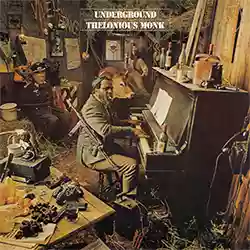
Monk: Since they put me on the cover of Time—one of the very few black jazz musicians to receive this tribute along with Louis Armstrong and Duke Ellington (editor’s note: the fourth was Wynton Marsalis)—my stock as a jazz musician is rising again after a long period of eclipse. Many claim I was chosen just because, unlike Miles Davis, I’m not a politicized musician. Precisely for this reason I decided to put out this record called “Underground” (editor’s note: CS 9632), and starting from the title, but especially from the cover designed by Horn Grinner Studios, I want to prove the exact opposite: that I’m someone who likes to make Revolution. That’s why I had myself portrayed as a French Resistance fighter during World War II, while keeping a Nazi officer prisoner in a hovel, among bunches of cherries and hand grenades, as well as various explosives, with a real cow and the cardboard cutout of my dear Nica who, dressed as a partisan, is holding her Sten gun.
DottorJazz: Speaking of your relationship with Baroness Pannonica de Koenigswarter, may I ask what you can tell me about her? I know you even dedicated a wonderful track to her in the album “Brilliant Corners” (editor’s note: Riverside Records).
Monk: Nica is a dear friend, my muse and also the protective wing stretched over me and all my family. I want to add that for me, my wife Nellie and my children Toot (editor’s note: Thelonious Jr.) and Boo Boo (editor’s note: Barbara) are the center of my world.
DottorJazz: Good, let’s go back to your “Underground.” What can you tell me about this most recent work?
Monk: Even though I wasn’t as explicit as Max Roach and Charles Mingus were in their respective works, I wanted to make my own contribution as testimony to how many African American artists—and not only them—see social injustice in the United States, linking it to a form of modern oppression and racial segregation. The title is meant to suggest that resistance continues, just in different forms.
DottorJazz: Would you like to describe the tracks from your album in more detail?
Monk: Well, with “Thelonious”, which opens the record, I intended right away to state my intentions. The jagged, almost caricatured theme, explored in earlier years, here becomes rarefied, with pronounced pauses and a sense of suspension that makes every note weighed, almost theatrical.
“Ugly Beauty” is my only waltz-time (3/4) composition. It’s stunningly beautiful thanks to the magnificent tenor sax playing by Charlie (editor’s note: Charlie Rouse). The melody is sweet only on the surface; underneath, a subtle rhythmic irregularity runs. It’s the most lyrical moment of the album, but unstable—as if this delicate balance could snap at any moment.
“Raise Four” I built on a simple harmonic idea but treated it freely. The theme is almost a pretext: the heart of the performance is in the improvisations, where my quartet now moves with elasticity, featuring sudden shifts and a tight yet perfect interplay. Ben (editor’s note: drummer Ben Riley) does an extraordinary job creating the magical atmosphere of this piece.
“Boo Boo’s Birthday” is one of the most playful tracks on the record, though no less complex in its musical architecture. The title immediately suggests it’s dedicated to my daughter; in fact, there’s an almost childish lightness in the theme, quickly, however, deformed by unpredictable accents and shifts in direction that characterize my music. Again in this piece, the interplay with good Charlie is nothing short of masterly.
With “Easy Street” I wanted to make my own reinterpretation of a jazz standard, composed by Alan Lerner and Frederick Loewe for the musical Paint Your Wagon. In my version, I deconstructed the original melody, rebuilding it in my style—made of surprising pauses, irregular accents, and percussive use of the piano. The feel is relaxed, but never really easy as the title suggests. The arrangement highlights the tight dialogue between piano and sax.
For “Green Chimneys” I conceived a theme built on unusual time intervals, creating a sense of harmonic instability. The performance alternates moments of cohesion with freer passages, maintaining a constant subtle tension. In this piece Larry shows off his art with a stunning solo (editor’s note: Larry Gales on double bass), in counterpoint to Riley’s drumming.
“In Walked Bud” is my personal tribute to my great friend Bud Powell. To try to protect him from the police, I sacrificed my Cabaret Card. Never mind—they didn’t let me play in clubs anymore but I’d do it again without a second thought. For this version I wanted to enrich it with the vocal part sung by Jon Hendricks. It’s one of the most “accessible” moments of the album, though always retaining my typical dissonances and strategic silences.
DottorJazz: Mr. Monk, for a final question, what can you tell me about your mental health issues?
Thelonious remains for a long time with his gaze lost toward an uncertain point, just like at the beginning of the interview, as if I weren’t really present, then, looking straight into my eyes and in a low but resolute voice, he answers: “The loudest noise in the world is silence.”
I hear the buzz as the arm of my record player returns to place.
The record is over.
I have returned home.
Loading comments slowly
Summary by Bot
This review explores 'Underground,' a celebrated album by Thelonious Monk. The reviewer praises its innovative jazz compositions and Monk’s artistry. The album is regarded as an essential listen for jazz fans. The review highlights both the music’s quality and historical significance. Overall, it highly recommends the album.
Thelonious Monk
Thelonious Monk (1917–1982) was an American jazz pianist and composer, a central figure in the rise of bebop and one of the music’s most distinctive voices. Raised in New York, he forged a percussive, space‑aware piano style and wrote standards such as 'Round Midnight, Blue Monk and Well, You Needn’t. He recorded seminal sessions for Blue Note and Riverside, later for Columbia, and appeared on Time’s cover in 1964.11 Reviews
