
 •
Rating:
•
Rating:
THE REVIEW
I confess I felt a certain emotion when I saw on the shelves the new deluxe edition, double with remixed versions and some unreleased tracks, of "Our Favourite Shop" by The Style Council.
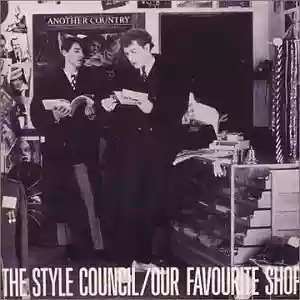
In that crucial year, it was 1985, I was just over twenty and that was (and in some ways still is) one of my favorite stores. Some of the reasons for this can be inferred by taking a close look at the cover, perhaps of the LP for those with eyesight problems, where the dandy Paul Weller and his more reserved partner, Mick Talbot, are depicted in a sort of small bazaar probably located on Carnaby Street. In the emporium, there are very Old England patent leather shoes, button-down shirts along with improbable ties, which served to give that eccentric touch, dark suits with cigarette trousers and coats of sober elegance; all elements reminiscent of the Jam, the first highly successful band of the young Weller, by then disbanded, true standard bearers of the late '70s mod-revival culture, encapsulated in the motto "clean living in difficult circumstances." But in the store, besides these externally significant elements of continuity, there are other images and objects that catch the eye: a colorful tailcoat, a recognizable relic of the passengers of the yellow submarine, photos of Frank Sinatra, Alain Delon, Al Green, and the poster of "Another Country," a film set in the '30s, with the unfulfilled promise Rupert Everett, which became a manifesto against the respectability of the Thatcher era, against an increasingly sclerotic and motherland-like Great Britain, especially for the young generations of the working class.
They had already appeared before the year this album saw the light, not only its illustrious predecessor "Café Bleu," but also "Eden" by Everything But The Girl, "Diamond Life" by Sade; and still in eighty-five the awaited "Working Nights" by Working Week would come out. Undoubtedly, all these works had many points in common: reference to the best black-music and cool jazz in particular, return to traditional instruments after the synthesizer binge and also, for most of them, an explicit political commitment and an open aversion to the then Tory government. Some spoke, perhaps inappropriately, of a movement; but without a doubt there was a common feeling, shared aesthetic and social ideals: "Our Favourite Shop" is perhaps what best represents that cultural-musical mood.
It manages to hold together something that may escape those who do not know English or do not have the lyrics at hand: catchy melodies, never taken for granted, sophisticated in some cases, which, however, have come to terms with the punk tabula rasa, and committed lyrics, explicit, strongly political, in the best sense of the word. Exemplary in this respect are tracks like "Homebreakers," an elegant R&B and realistic picture of the catastrophic consequences caused by the Thatcher government's restructuring policies in the industrial areas of the country; or "Internationalist," a nervous song, almost funky, with horns and Mick's acidic Hammond in the foreground, which urges class solidarity that transcends borders and the firm assertion of one's rights. The description of a depressing historical-social picture that the younger ones were able to know thanks to films like "Full Monty."
Among the fifteen tracks, which in this rich double version become many more, with the addition of some pearls never released on CD being B-sides of vinyl singles, I remember only one for all, the intense and moving "Ghosts Of Dachau," there are also some of the best singles of the era like "Boy Who Cried Wolf," "The Lodgers," "Shout To The Top" and the proto-acid jazz of the rhythmic "With Everything To Lose." Not only that: references to French chanson are not lacking either, the despair that fades into slight melancholy, of "Down In The Sein," to the bossa nova of "All Gone Way," another short circuit between sunny music and problematic lyrics. Furthermore, another merit should be recognized of the Weller group: that of being prescient, intuitively sensing the end of the Iron Lady's experience in "Walls Come Tumbling Down." However, I don't know if Blair has lived up to the great expectations Paul had at that time; I don't think so.
Anyway, "Our Favourite Shop," besides having now become a classic, and the present deluxe edition definitively confirms this, is another essential piece to know and understand the richness and quality of '80s pop music, an era in which, much to the chagrin of detractors, songs of such strong political and social commitment managed to also climb the charts: from the "top" it was still possible to send a "shout."
Loading comments slowly
Summary by Bot
Our Favourite Shop by The Style Council is praised for its sophisticated melodies and politically charged lyrics reflecting 1980s Britain under Thatcher. This deluxe edition enriches the experience with remixes and unreleased tracks. The album blends mod revival fashion, varied musical influences, and sharp social critique, making it a key work of its era. The reviewer highlights tracks like 'Homebreakers' and 'Ghosts Of Dachau' as especially powerful. Overall, it is considered a classic essential for understanding 80s pop's depth and commitment.Tracklist Lyrics Videos
The Style Council
The Style Council were a British group formed in 1983 by Paul Weller and Mick Talbot. Active through 1989, they blended soul, jazz, pop and political commentary, scoring major UK hits and notable international success.04 Reviews
Other reviews
By lovetojour
This seems like a more cohesive album in its stylistic intentions with 'heavy' lyrics that make me think of this work as the Style Council’s Sandinista!
‘Walls Come Tumbling Down’—Masterpiece of Post-Work for the working masses—that would make even Fassino tap his feet.
