
 •
Rating:
•
Rating:
THE REVIEW
The first time I heard about these The Roots was when their single "the seed 2.0" was in heavy rotation on the FM stations of the Western world and perhaps elsewhere. I later read Zion's excellent review on what I believe was their debut album, and I promised myself to give it a listen as soon as possible.
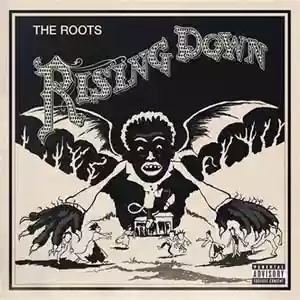
Recently, drifting in inconclusive thoughts that were gladly accompanied by the very cheesy jingles of a shopping mall, I spotted the "rounded" case (those new ones with rounded corners, and with a booklet that doesn't get destroyed when pulling it out) and the beautiful cover you see at the top right.
That I am completely alien to hip hop as a social and musical culture seems to be a necessary premise as a key to reading my writing; I detest its image but particularly appreciate its influences and contaminations. In the case of these The Roots, who as the name suggests are a virtual bridge between past black music, the roots, and current hip hop from a fundamentally intellectual perspective. To the MC is added a complete ensemble including the inevitable DJ, but also guitar, bass, and drums.
"Never Do What They Do" was (and is) their categorical imperative, a manifest detachment from the contemporary hip hop scene, completely philosophically alien from what this ensemble aims (to propose).
Syncopated beats "from the basement", sound blended made of polyrhythms as well as rhythmic obsessions, (strictly played by the drummer/producer) funk guitar riffs, synths, and occasional contribution of jazz/soul-flavored horns. The focus of the sound canvas of the album is therefore equally found in the flow and rhymes as in the music; a base, but not necessarily a simple background.
In an America internationally increasingly in the background politically, discovering it has lived beyond its means at the sight of the hefty bill every crisis as such demands, and moreover on the razor's edge of tradition opposed to probably necessary change, the The Roots (and numerous featuring artists) respond by accelerating the bpm and focusing on the frustrated invective of those tired spectators of their own impotence.
The coordinates are all in a modern and crepuscular hip-hop pierced by coldly existential electronics. The title track relies on beats dear to the old school and a resigned minor arpeggio, the rhymes flow, taking stock of the situation with passionate intensity, then giving way to the frantic scratches and tracked drums of "Get Busy".
The lyrics avoid genre stereotypes, limiting the f-bombs to the exacerbation of the negative mood that can be felt from the first to the last track of an album that makes its homogeneity a very positive compactness of intentions.
Therefore, I find it difficult to underline the highlights, as the tracks are very successful and reveal their peculiarities through repeated listening. Honorable mention to the tracks placed at the end, "The Show" and its instrumental closing which finds its effectiveness in synthesis, and the only episode that breaks away from the shadows of the album, the single "Rising Up" placed at the end: the cure after the poisoning.
In this essentially lean 2008, I believe that an excellent production, (sweat and refinement) and a lot of genuine inspiration can dissipate the curtain of mistrust towards musical shores generally rarely frequented on these pages. Hip-hop enthusiasts, I believe, can finally pop the bottle they were saving for great occasions, it's time at least for a toast.
Loading comments slowly
Summary by Bot
The Roots' album 'Rising Down' presents a sophisticated blend of hip hop, funk, jazz, and electronic elements with thoughtful social commentary. The reviewer, while not a hip hop aficionado, appreciates the album's intellectual depth and musical richness. The production is praised for its polish and cohesion, with highlights especially in the closing tracks. 'Rising Down' is seen as an important and accessible entry for hip hop fans and beyond.Tracklist Lyrics
01 The Pow Wow (01:15)
02 Rising Down (feat. Mos Def & Styles P) (03:40)
03 Get Busy (feat. Dice Raw & Peedi Peedi) (03:29)
04 @ 15 (00:51)
06 Becoming Unwritten (00:36)
07 Criminal (feat. Truck North & Saigon) (04:08)
08 I Will Not Apologize (feat. Porn & Dice Raw) (04:34)
09 I Can't Help It (feat. Malik B., Porn, Mercedes Martinez & Dice Raw) (04:39)
10 Singing Man (feat. Porn, Truck North & Dice Raw) (04:07)
11 Unwritten (feat. Mercedes Martinez) (01:22)
12 Lost Desire (feat. Malik B. & Talib Kweli) (03:58)
13 The Show (feat. Common & Dice Raw) (03:44)
14 Rising Up (feat. Wale & Chrisette Michele) (04:19)
15 The Pow Wow 2 (03:18)
The Roots
The Roots are an American hip hop band from Philadelphia, formed in 1987 by Ahmir “Questlove” Thompson and Tariq “Black Thought” Trotter. Renowned for live instrumentation and adventurous fusions of jazz, soul, and funk, they became the house band for Late Night with Jimmy Fallon (2009–2014) and The Tonight Show Starring Jimmy Fallon (2014–present).07 Reviews
